 Add to Chrome
 Add to Firefox
 Add to Edge
Dissipative Latent Residual Physics-Informed Neural Networks for Modeling and Identification of Electromechanical Systems
Apr 20, 2026
Accurate dynamical modeling is essential for simulation and control of embodied systems, yet first-principles models of electromechanical systems often fail to capture complex dissipative effects such as joint friction, stray losses, and structural damping. While residual-learning physics-informed neural networks (PINNs) can effectively augment imperfect first-principles models with data-driven components, the residual terms are typically implemented as unconstrained multilayer perceptrons (MLPs), which may inadvertently inject artificial energy into the system. To more faithfully model the dissipative dynamics, we propose DiLaR-PINN, a dissipative latent residual PINN designed to learn unmodeled dissipative effects in a physically consistent manner. Structurally, the residual network operates only on unmeasurable (latent) state components and is parameterized in a skew-dissipative form that guarantees non-increasing energy for any choice of network parameters. To enable stable and data-efficient training under partial measurability of the state, we further develop a recurrent rollout scheme with a curriculum-based sequence length extension strategy. We validate DiLaR-PINN on a real-world helicopter system and compare it against four baselines: a pure physical model (without a residual network), an unstructured residual MLP, a DiLaR variant with a soft dissipativity constraint, and a black-box LSTM. The results demonstrate that DiLaR-PINN more accurately captures dissipative effects and achieves superior long-horizon extrapolation performance.

Self-supervised Physics-Informed Manipulation of Deformable Linear Objects with Non-negligible Dynamics
Feb 03, 2026We address dynamic manipulation of deformable linear objects by presenting SPiD, a physics-informed self-supervised learning framework that couples an accurate deformable object model with an augmented self-supervised training strategy. On the modeling side, we extend a mass-spring model to more accurately capture object dynamics while remaining lightweight enough for high-throughput rollouts during self-supervised learning. On the learning side, we train a neural controller using a task-oriented cost, enabling end-to-end optimization through interaction with the differentiable object model. In addition, we propose a self-supervised DAgger variant that detects distribution shift during deployment and performs offline self-correction to further enhance robustness without expert supervision. We evaluate our method primarily on the rope stabilization task, where a robot must bring a swinging rope to rest as quickly and smoothly as possible. Extensive experiments in both simulation and the real world demonstrate that the proposed controller achieves fast and smooth rope stabilization, generalizing across unseen initial states, rope lengths, masses, non-uniform mass distributions, and external disturbances. Additionally, we develop an affordable markerless rope perception method and demonstrate that our controller maintains performance with noisy and low-frequency state updates. Furthermore, we demonstrate the generality of the framework by extending it to the rope trajectory tracking task. Overall, SPiD offers a data-efficient, robust, and physically grounded framework for dynamic manipulation of deformable linear objects, featuring strong sim-to-real generalization.
Scalable Kernel Inverse Optimization
Oct 31, 2024
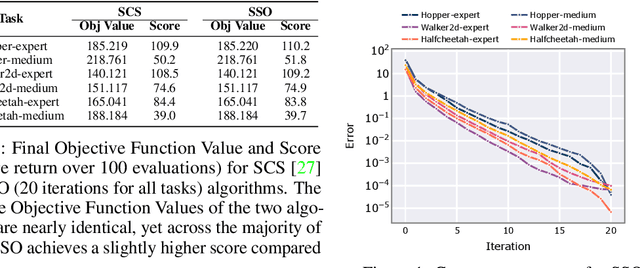
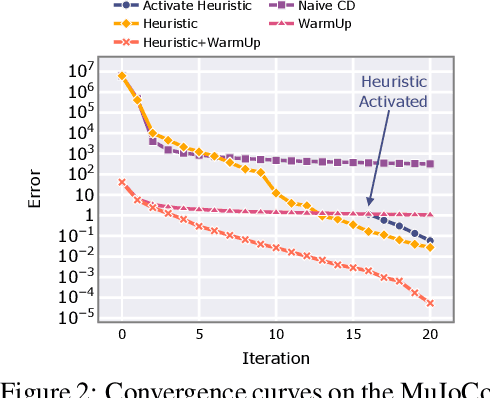

Inverse Optimization (IO) is a framework for learning the unknown objective function of an expert decision-maker from a past dataset. In this paper, we extend the hypothesis class of IO objective functions to a reproducing kernel Hilbert space (RKHS), thereby enhancing feature representation to an infinite-dimensional space. We demonstrate that a variant of the representer theorem holds for a specific training loss, allowing the reformulation of the problem as a finite-dimensional convex optimization program. To address scalability issues commonly associated with kernel methods, we propose the Sequential Selection Optimization (SSO) algorithm to efficiently train the proposed Kernel Inverse Optimization (KIO) model. Finally, we validate the generalization capabilities of the proposed KIO model and the effectiveness of the SSO algorithm through learning-from-demonstration tasks on the MuJoCo benchmark.