 Add to Chrome
 Add to Firefox
 Add to Edge
Scaling Adversarial Training via Data Selection
Dec 26, 2025
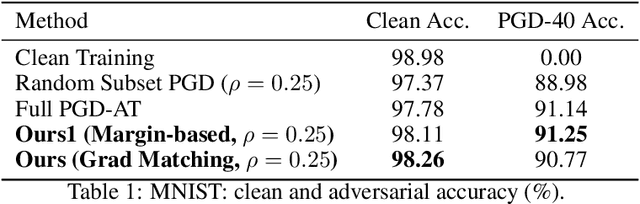
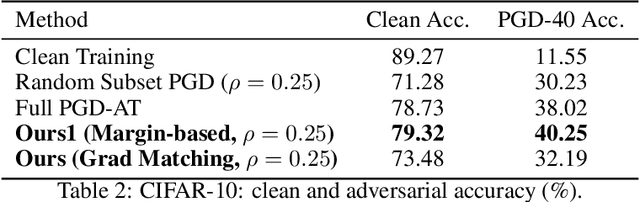
Projected Gradient Descent (PGD) is a strong and widely used first-order adversarial attack, yet its computational cost scales poorly, as all training samples undergo identical iterative inner-loop optimization despite contributing unequally to robustness. Motivated by this inefficiency, we propose \emph{Selective Adversarial Training}, which perturbs only a subset of critical samples in each minibatch. Specifically, we introduce two principled selection criteria: (1) margin-based sampling, which prioritizes samples near the decision boundary, and (2) gradient-matching sampling, which selects samples whose gradients align with the dominant batch optimization direction. Adversarial examples are generated only for the selected subset, while the remaining samples are trained cleanly using a mixed objective. Experiments on MNIST and CIFAR-10 show that the proposed methods achieve robustness comparable to, or even exceeding, full PGD adversarial training, while reducing adversarial computation by up to $50\%$, demonstrating that informed sample selection is sufficient for scalable adversarial robustness.

Scalable Multi-Objective and Meta Reinforcement Learning via Gradient Estimation
Nov 16, 2025We study the problem of efficiently estimating policies that simultaneously optimize multiple objectives in reinforcement learning (RL). Given $n$ objectives (or tasks), we seek the optimal partition of these objectives into $k \ll n$ groups, where each group comprises related objectives that can be trained together. This problem arises in applications such as robotics, control, and preference optimization in language models, where learning a single policy for all $n$ objectives is suboptimal as $n$ grows. We introduce a two-stage procedure -- meta-training followed by fine-tuning -- to address this problem. We first learn a meta-policy for all objectives using multitask learning. Then, we adapt the meta-policy to multiple randomly sampled subsets of objectives. The adaptation step leverages a first-order approximation property of well-trained policy networks, which is empirically verified to be accurate within a $2\%$ error margin across various RL environments. The resulting algorithm, PolicyGradEx, efficiently estimates an aggregate task-affinity score matrix given a policy evaluation algorithm. Based on the estimated affinity score matrix, we cluster the $n$ objectives into $k$ groups by maximizing the intra-cluster affinity scores. Experiments on three robotic control and the Meta-World benchmarks demonstrate that our approach outperforms state-of-the-art baselines by $16\%$ on average, while delivering up to $26\times$ faster speedup relative to performing full training to obtain the clusters. Ablation studies validate each component of our approach. For instance, compared with random grouping and gradient-similarity-based grouping, our loss-based clustering yields an improvement of $19\%$. Finally, we analyze the generalization error of policy networks by measuring the Hessian trace of the loss surface, which gives non-vacuous measures relative to the observed generalization errors.