 Add to Chrome
 Add to Firefox
 Add to Edge
S$^3$LDBO: A Snapshot Single-Loop Algorithm for Decentralized Bilevel Optimization
May 29, 2026
Networked AI systems increasingly rely on multiple agents that collaboratively learn and adapt models over communication networks. In such systems, bilevel formulations naturally arise in hyperparameter optimization, data cleaning, and meta-learning, but the repeated evaluation of gradients, Jacobians, and Hessians can impose a substantial computational burden on individual agents. To address this challenge, we propose Snapshot-SLDBO (S$^3$LDBO), an efficient single-loop decentralized bilevel optimization algorithm that enables agents to intermittently skip expensive derivative evaluations through a snapshot mechanism. This mechanism can be interpreted as an autonomous computation-adaptation strategy for networked AI, where agents selectively perform costly local updates while maintaining global collaborative learning. We establish the ergodic iteration complexity and the high probability nonergodic iteration complexity of the proposed algorithm within a deterministic setting. Experimental results on hyperparameter optimization with synthetic and MNIST datasets, data hyper-cleaning on Fashion-MNIST, and decentralized meta-learning on miniImageNet demonstrate that the proposed algorithm improves computational efficiency while maintaining competitive learning performance.

Efficient Curvature-Aware Hypergradient Approximation for Bilevel Optimization
May 04, 2025
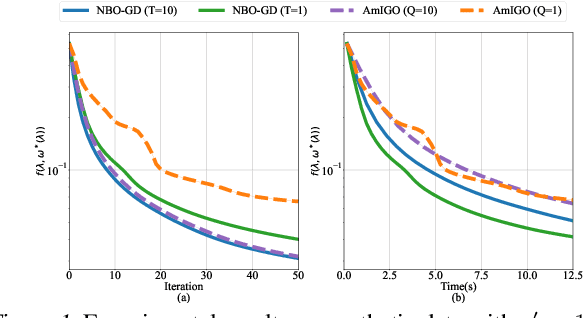
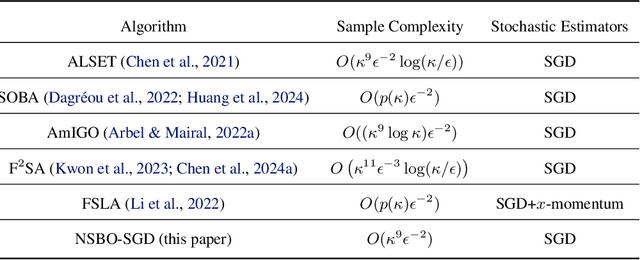
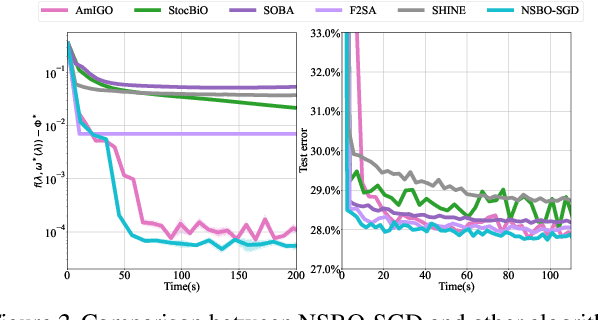
Bilevel optimization is a powerful tool for many machine learning problems, such as hyperparameter optimization and meta-learning. Estimating hypergradients (also known as implicit gradients) is crucial for developing gradient-based methods for bilevel optimization. In this work, we propose a computationally efficient technique for incorporating curvature information into the approximation of hypergradients and present a novel algorithmic framework based on the resulting enhanced hypergradient computation. We provide convergence rate guarantees for the proposed framework in both deterministic and stochastic scenarios, particularly showing improved computational complexity over popular gradient-based methods in the deterministic setting. This improvement in complexity arises from a careful exploitation of the hypergradient structure and the inexact Newton method. In addition to the theoretical speedup, numerical experiments demonstrate the significant practical performance benefits of incorporating curvature information.
A Single-Loop Algorithm for Decentralized Bilevel Optimization
Nov 15, 2023


Bilevel optimization has received more and more attention recently due to its wide applications in machine learning. In this paper, we consider bilevel optimization in decentralized networks. In particular, we propose a novel single-loop algorithm for solving decentralized bilevel optimization with strongly convex lower level problem. Our algorithm is fully single-loop and does not require heavy matrix-vector multiplications when approximating the hypergradient. Moreover, unlike existing methods for decentralized bilevel optimization and federated bilevel optimization, our algorithm does not require any gradient heterogeneity assumption. Our analysis shows that the proposed algorithm achieves the best known convergence rate for bilevel optimization algorithms.