 Add to Chrome
 Add to Firefox
 Add to Edge
SeaCache: Spectral-Evolution-Aware Cache for Accelerating Diffusion Models
Feb 22, 2026
Diffusion models are a strong backbone for visual generation, but their inherently sequential denoising process leads to slow inference. Previous methods accelerate sampling by caching and reusing intermediate outputs based on feature distances between adjacent timesteps. However, existing caching strategies typically rely on raw feature differences that entangle content and noise. This design overlooks spectral evolution, where low-frequency structure appears early and high-frequency detail is refined later. We introduce Spectral-Evolution-Aware Cache (SeaCache), a training-free cache schedule that bases reuse decisions on a spectrally aligned representation. Through theoretical and empirical analysis, we derive a Spectral-Evolution-Aware (SEA) filter that preserves content-relevant components while suppressing noise. Employing SEA-filtered input features to estimate redundancy leads to dynamic schedules that adapt to content while respecting the spectral priors underlying the diffusion model. Extensive experiments on diverse visual generative models and the baselines show that SeaCache achieves state-of-the-art latency-quality trade-offs.

ControlFace: Harnessing Facial Parametric Control for Face Rigging
Dec 02, 2024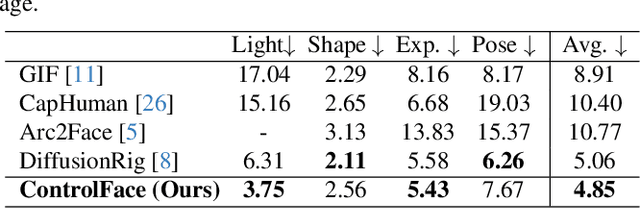
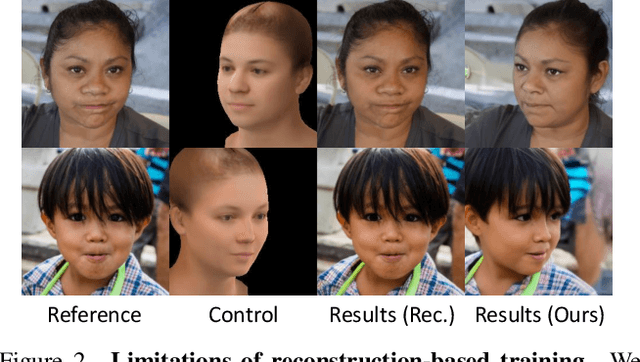
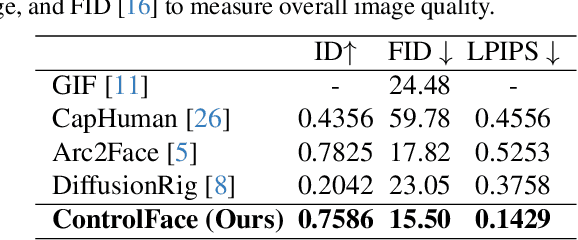
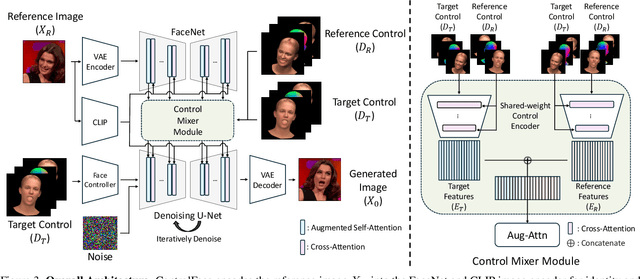
Manipulation of facial images to meet specific controls such as pose, expression, and lighting, also known as face rigging, is a complex task in computer vision. Existing methods are limited by their reliance on image datasets, which necessitates individual-specific fine-tuning and limits their ability to retain fine-grained identity and semantic details, reducing practical usability. To overcome these limitations, we introduce ControlFace, a novel face rigging method conditioned on 3DMM renderings that enables flexible, high-fidelity control. We employ a dual-branch U-Nets: one, referred to as FaceNet, captures identity and fine details, while the other focuses on generation. To enhance control precision, the control mixer module encodes the correlated features between the target-aligned control and reference-aligned control, and a novel guidance method, reference control guidance, steers the generation process for better control adherence. By training on a facial video dataset, we fully utilize FaceNet's rich representations while ensuring control adherence. Extensive experiments demonstrate ControlFace's superior performance in identity preservation and control precision, highlighting its practicality. Please see the project website: https://cvlab-kaist.github.io/ControlFace/.