 Add to Chrome
 Add to Firefox
 Add to Edge
Will Accurate Fields Mislead Photonic Design? FromGlobal Accuracy to Port Readout
Jun 02, 2026
Neural field surrogates can accelerate photonic design loops, but a surrogate that looks accurate in global field error can still mis-rank candidate devices when the final decision depends on localized output-port readouts. This risk is acute in propagation-dominated MMI splitters and couplers, where port power, splitting, phase, and coupling are determined by accumulated modal interference and output-window aggregation rather than by average field similarity alone. We study this field-to-design mismatch through a Field/Mediator/Readout view that separates dense complex-field error from propagation-profile and output-window errors before port aggregation. To align the surrogate with this chain, we propose PaNO, a propagation-aligned neural operator that keeps the full-field prediction interface while organizing latent states around local boundary structure, transverse modal content, axial propagation, and cross-mode interaction. We also evaluate PaNO-R2, an output-aware feedback variant for residual field components near the port region. On a 15-wavelength tunable $3{\times}3$ MMI benchmark with 4608 held-out fields, PaNO lowers NeurOLight's port-power error from 0.2018 to 0.0739 despite slightly higher cMAE, showing that global field accuracy alone is not sufficient for design-relevant readout fidelity. PaNO-R2 attains the best cMAE, propagation-profile error, output-profile error, and port-power error, reducing NeurOLight's port-power and output-profile errors by 72.7\% and 72.5\%.

Diffusion Model Based Signal Recovery Under 1-Bit Quantization
Nov 16, 2025Diffusion models (DMs) have demonstrated to be powerful priors for signal recovery, but their application to 1-bit quantization tasks, such as 1-bit compressed sensing and logistic regression, remains a challenge. This difficulty stems from the inherent non-linear link function in these tasks, which is either non-differentiable or lacks an explicit characterization. To tackle this issue, we introduce Diff-OneBit, which is a fast and effective DM-based approach for signal recovery under 1-bit quantization. Diff-OneBit addresses the challenge posed by non-differentiable or implicit links functions via leveraging a differentiable surrogate likelihood function to model 1-bit quantization, thereby enabling gradient based iterations. This function is integrated into a flexible plug-and-play framework that decouples the data-fidelity term from the diffusion prior, allowing any pretrained DM to act as a denoiser within the iterative reconstruction process. Extensive experiments on the FFHQ, CelebA and ImageNet datasets demonstrate that Diff-OneBit gives high-fidelity reconstructed images, outperforming state-of-the-art methods in both reconstruction quality and computational efficiency across 1-bit compressed sensing and logistic regression tasks.
Learning Single Index Models with Diffusion Priors
May 27, 2025
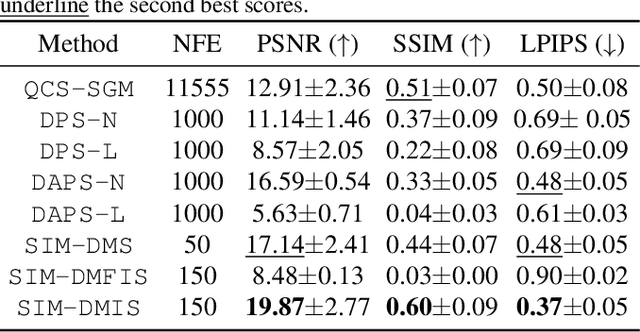
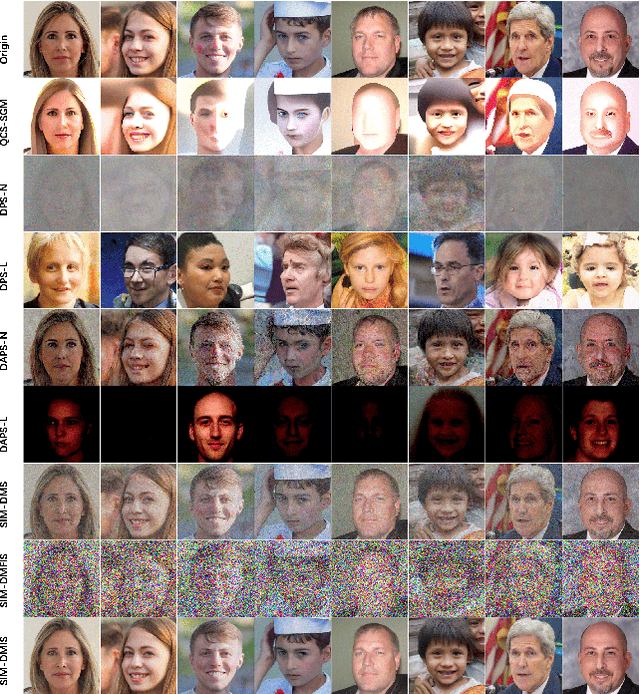
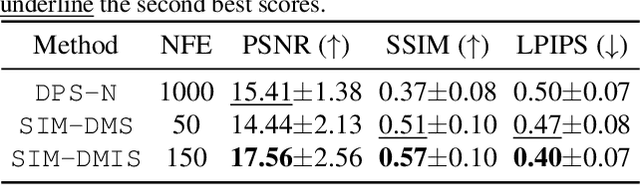
Diffusion models (DMs) have demonstrated remarkable ability to generate diverse and high-quality images by efficiently modeling complex data distributions. They have also been explored as powerful generative priors for signal recovery, resulting in a substantial improvement in the quality of reconstructed signals. However, existing research on signal recovery with diffusion models either focuses on specific reconstruction problems or is unable to handle nonlinear measurement models with discontinuous or unknown link functions. In this work, we focus on using DMs to achieve accurate recovery from semi-parametric single index models, which encompass a variety of popular nonlinear models that may have {\em discontinuous} and {\em unknown} link functions. We propose an efficient reconstruction method that only requires one round of unconditional sampling and (partial) inversion of DMs. Theoretical analysis on the effectiveness of the proposed methods has been established under appropriate conditions. We perform numerical experiments on image datasets for different nonlinear measurement models. We observe that compared to competing methods, our approach can yield more accurate reconstructions while utilizing significantly fewer neural function evaluations.