 Add to Chrome
 Add to Firefox
 Add to Edge
Hierarchical Graph Learning for Calendar Spread Strategies in Commodity Futures Markets
Jun 24, 2026
Commodity futures can be represented hierarchically, with underlying assets at the upper level and individual futures contracts at the lower level. Entities at each level can be connected by edges reflecting inherent correlations, with cross-level edges capturing contract-to-underlying asset connections. Building on our observations of these structures, we propose a hierarchical graph learning approach for calendar spread (CS) strategies in commodity futures markets, addressing two significant gaps in the machine-learning literature: (i) the absence of learning-based methods for CS strategies in futures markets, and (ii) the lack of consideration of maturity-dependent interrelationships across commodity futures. We first establish the efficacy of CS strategies by analytically showing that CS strategies can possess higher risk-adjusted returns, measured by the information ratio, and lower risk, measured by variance and delta, than long-only strategies. We then introduce a method to convert learning-based predictions into CS positions. Next, we develop a hierarchical graph learning method that predicts futures price movements by utilizing the maturity-dependent interrelationships, thereby yielding a CS trading algorithm. Empirical results on commodity futures markets traded on the Chicago Mercantile Exchange Group demonstrate that our method outperforms benchmark models in both prediction and trading performance. We find that maturity-dependent interrelationships across commodity futures are instrumental in prediction and that CS trading based on hierarchical graph learning is effective for statistical arbitrage.

Index Tracking via Learning to Predict Market Sensitivities
Sep 02, 2022
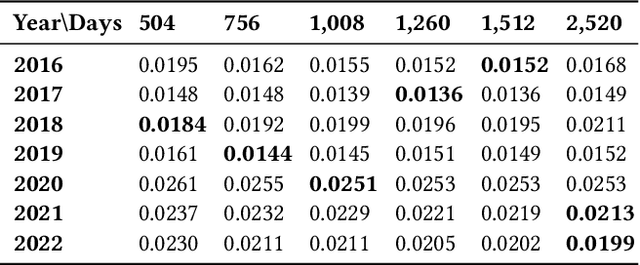
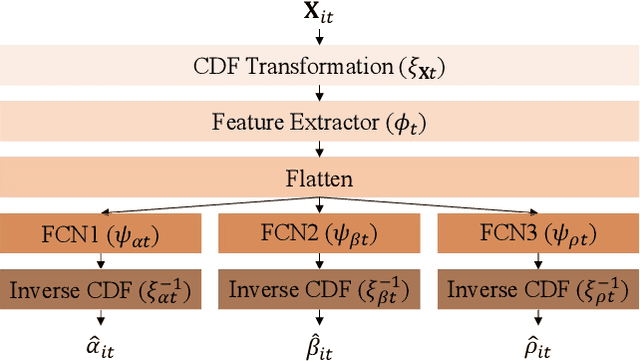
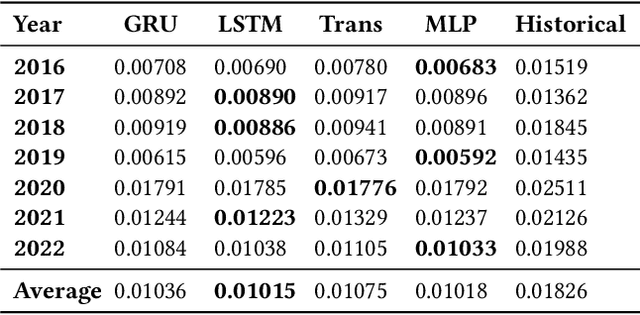
A significant number of equity funds are preferred by index funds nowadays, and market sensitivities are instrumental in managing them. Index funds might replicate the index identically, which is, however, cost-ineffective and impractical. Moreover, to utilize market sensitivities to replicate the index partially, they must be predicted or estimated accurately. Accordingly, first, we examine deep learning models to predict market sensitivities. Also, we present pragmatic applications of data processing methods to aid training and generate target data for the prediction. Then, we propose a partial-index-tracking optimization model controlling the net predicted market sensitivities of the portfolios and index to be the same. These processes' efficacy is corroborated by the Korea Stock Price Index 200. Our experiments show a significant reduction of the prediction errors compared with historical estimations, and competitive tracking errors of replicating the index using fewer than half of the entire constituents. Therefore, we show that applying deep learning to predict market sensitivities is promising and that our portfolio construction methods are practically effective. Additionally, to our knowledge, this is the first study that addresses market sensitivities focused on deep learning.