 Add to Chrome
 Add to Firefox
 Add to Edge
Mi:dm 2.0 Korea-centric Bilingual Language Models
Jan 14, 2026
We introduce Mi:dm 2.0, a bilingual large language model (LLM) specifically engineered to advance Korea-centric AI. This model goes beyond Korean text processing by integrating the values, reasoning patterns, and commonsense knowledge inherent to Korean society, enabling nuanced understanding of cultural contexts, emotional subtleties, and real-world scenarios to generate reliable and culturally appropriate responses. To address limitations of existing LLMs, often caused by insufficient or low-quality Korean data and lack of cultural alignment, Mi:dm 2.0 emphasizes robust data quality through a comprehensive pipeline that includes proprietary data cleansing, high-quality synthetic data generation, strategic data mixing with curriculum learning, and a custom Korean-optimized tokenizer to improve efficiency and coverage. To realize this vision, we offer two complementary configurations: Mi:dm 2.0 Base (11.5B parameters), built with a depth-up scaling strategy for general-purpose use, and Mi:dm 2.0 Mini (2.3B parameters), optimized for resource-constrained environments and specialized tasks. Mi:dm 2.0 achieves state-of-the-art performance on Korean-specific benchmarks, with top-tier zero-shot results on KMMLU and strong internal evaluation results across language, humanities, and social science tasks. The Mi:dm 2.0 lineup is released under the MIT license to support extensive research and commercial use. By offering accessible and high-performance Korea-centric LLMs, KT aims to accelerate AI adoption across Korean industries, public services, and education, strengthen the Korean AI developer community, and lay the groundwork for the broader vision of K-intelligence. Our models are available at https://huggingface.co/K-intelligence. For technical inquiries, please contact midm-llm@kt.com.

Not All Personas Are Worth It: Culture-Reflective Persona Data Augmentation
Mar 17, 2025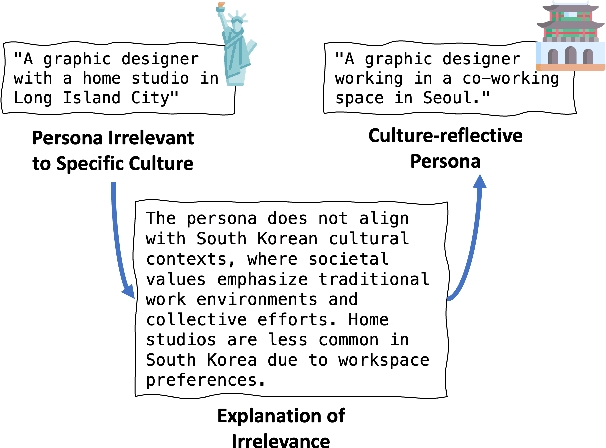
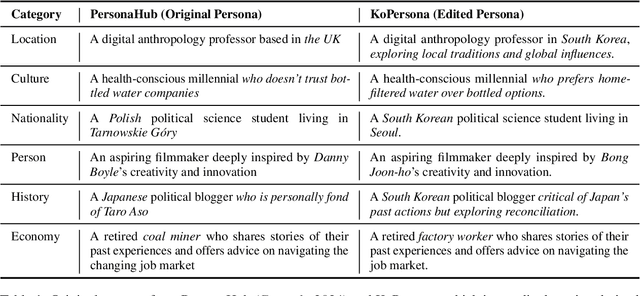

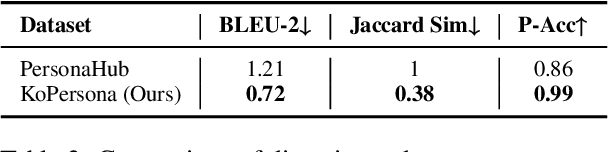
Incorporating personas into conversational AI models is crucial for achieving authentic and engaging interactions. However, the cultural diversity and adaptability of existing persona datasets is often overlooked, reducing their efficacy in building culturally aware AI systems. To address this issue, we propose a two-step pipeline for generating culture-specific personas and introduce KoPersona, a dataset comprising 200,000 personas designed to capture Korean cultural values, behaviors, and social nuances. A comprehensive evaluation through various metrics validates the quality of KoPersona and its relevance to Korean culture. This work not only contributes to persona-based research, but also establishes a scalable approach for creating culturally relevant personas adaptable to various languages and cultural contexts.
Efficient and Accurate Memorable Conversation Model using DPO based on sLLM
Jul 09, 2024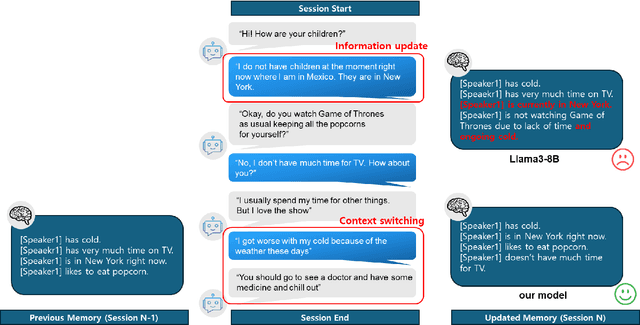
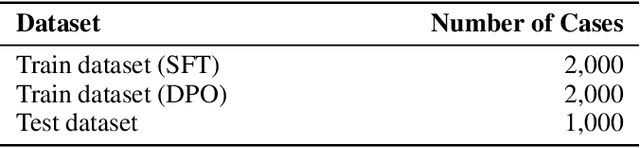
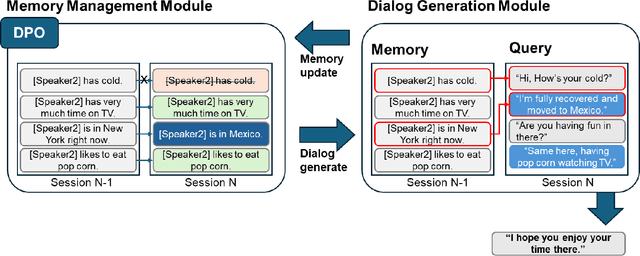
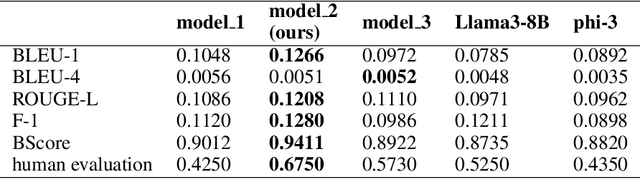
In multi-session dialog system, it is essential to continuously update the memory as the session progresses. Simply accumulating memory can make it difficult to focus on the content of the conversation for inference due to the limited input sentence size. Therefore, efficient and accurate conversation model that is capable of managing memory to reflect the conversation history continuously is necessary. This paper presents a conversation model that efficiently manages memory as sessions progress and incorporates this into the model to reflect the conversation history accurately with 3 methodologies: SFT, DPO and DPO with SFT model. Our model using DPO algorithm shows an improvement about 0.0591 of BERTScore in memory accuracy, and the rate of responses reflecting the memory increased as well. Also, response generation performance enhanced about 4.292 in fluency, 3.935 in coherence, and 2.896 in consistency. This paper describes a training method that yields better performance than models with more than twice the parameter size, even when the model size is smaller. Thus, our model demonstrates efficiency not only in terms of accuracy but also in resource utilization.