 Add to Chrome
 Add to Firefox
 Add to Edge
A Framework for Personalized Persuasiveness Prediction via Context-Aware User Profiling
Jan 09, 2026
Estimating the persuasiveness of messages is critical in various applications, from recommender systems to safety assessment of LLMs. While it is imperative to consider the target persuadee's characteristics, such as their values, experiences, and reasoning styles, there is currently no established systematic framework to optimize leveraging a persuadee's past activities (e.g., conversations) to the benefit of a persuasiveness prediction model. To address this problem, we propose a context-aware user profiling framework with two trainable components: a query generator that generates optimal queries to retrieve persuasion-relevant records from a user's history, and a profiler that summarizes these records into a profile to effectively inform the persuasiveness prediction model. Our evaluation on the ChangeMyView Reddit dataset shows consistent improvements over existing methods across multiple predictor models, with gains of up to +13.77%p in F1 score. Further analysis shows that effective user profiles are context-dependent and predictor-specific, rather than relying on static attributes or surface-level similarity. Together, these results highlight the importance of task-oriented, context-dependent user profiling for personalized persuasiveness prediction.

Expanding Search Space with Diverse Prompting Agents: An Efficient Sampling Approach for LLM Mathematical Reasoning
Oct 13, 2024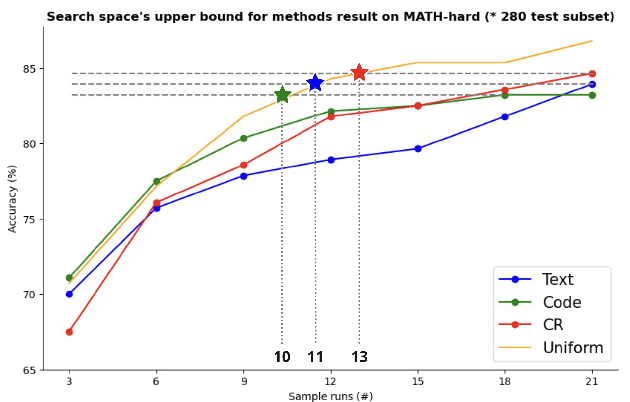
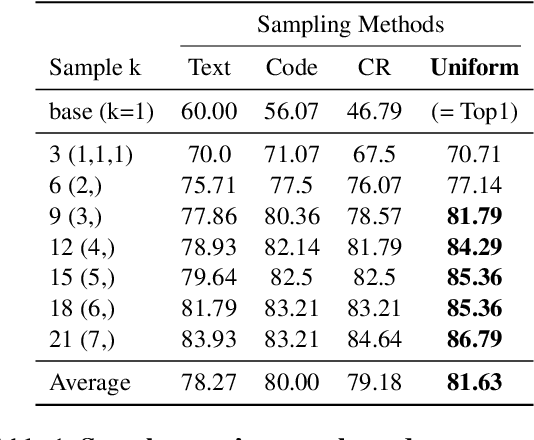
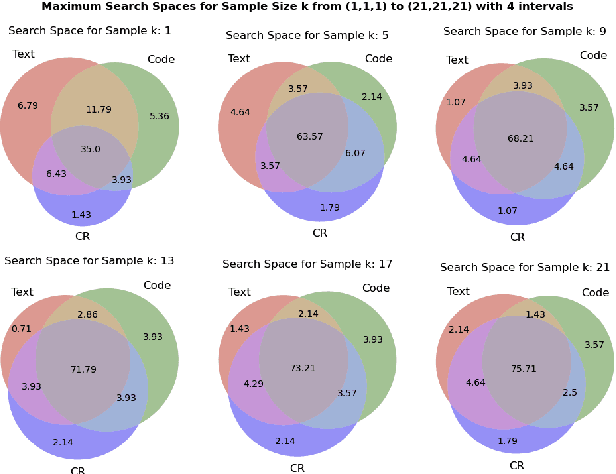
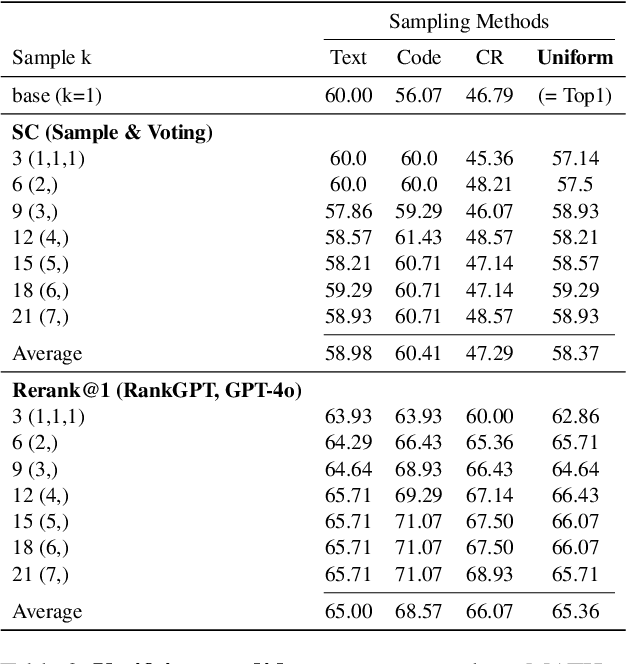
Large Language Models (LLMs) have exhibited remarkable capabilities in many complex tasks including mathematical reasoning. However, traditional approaches heavily rely on ensuring self-consistency within single prompting method, which limits the exploration of diverse problem-solving strategies. This study addresses these limitations by performing an experimental analysis of distinct prompting methods within the domain of mathematical reasoning. Our findings demonstrate that each method explores a distinct search space, and this differentiation becomes more evident with increasing problem complexity. To leverage this phenomenon, we applied efficient sampling process that uniformly combines samples from these diverse methods, which not only expands the maximum search space but achieves higher performance with fewer runs compared to single methods. Especially, within the subset of difficult questions of MATH dataset named MATH-hard, The maximum search space was achieved while utilizing approximately 43% fewer runs than single methods on average. These findings highlight the importance of integrating diverse problem-solving strategies to enhance the reasoning abilities of LLMs.