 Add to Chrome
 Add to Firefox
 Add to Edge
Breaking and Defending LLM-Powered Social Media Bot Detection Systems
Aug 16, 2026
The rise of social media bots poses a persistent threat, enabling misinformation, opinion manipulation, and the erosion of trust in online platforms. To combat this, machine learning systems have been developed to detect and limit bot activity, but attackers continuously adapt through techniques such as adversarial learning and behavior imitation, fueling an ongoing arms race between bots and detection tools. Recent advances in large language models (LLMs) have significantly improved bot detection by enabling deeper semantic and contextual analysis of accounts and their content. However, this shift also introduces new attack surfaces, allowing adversaries to craft exploits that directly target the reasoning and generation mechanisms of LLM-based classifiers. Industry tools such as Anthropic's Claude Code Security similarly leverage LLMs for security-critical decisions, further motivating a careful study of their attack surfaces. In this work, we investigate both the offensive and defensive aspects of LLM-powered, threat-specific cybersecurity applications. While centered on the challenge of social media bot detection, our methodology and insights generalize to a broad class of LLM-powered cybersecurity systems, including phishing detection, email classification, and fraud analysis. We introduce two novel adversarial attack strategies that systematically exploit the semantic and contextual weaknesses of LLM-based classifiers, degrading their detection accuracy by up to 48%. To counter these threats, we propose a robust multi-LLM defense architecture designed to preserve detection reliability under adaptive adversarial conditions. Our solution, LSABRE (LLM-powered Social Adversarial Bot Recognition Ensemble), is a multi-LLM framework that substantially improves robustness across a range of attacks, maintaining 86% detection accuracy even under strong, adaptive adversarial pressure.

Hierarchical Deep Reinforcement Learning Approach for Multi-Objective Scheduling With Varying Queue Sizes
Jul 17, 2020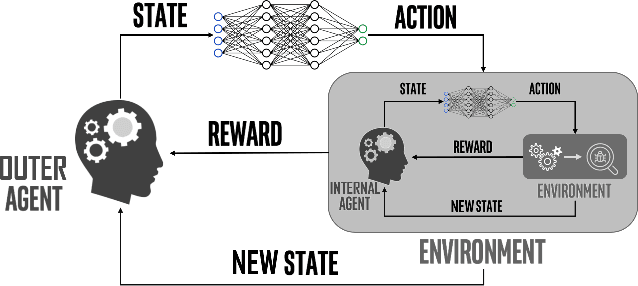
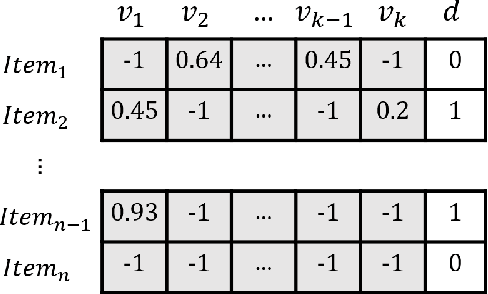
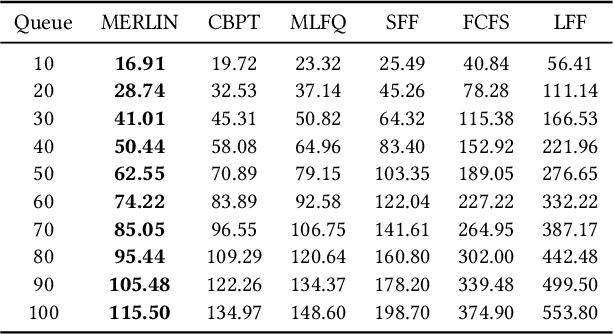
Multi-objective task scheduling (MOTS) is the task scheduling while optimizing multiple and possibly contradicting constraints. A challenging extension of this problem occurs when every individual task is a multi-objective optimization problem by itself. While deep reinforcement learning (DRL) has been successfully applied to complex sequential problems, its application to the MOTS domain has been stymied by two challenges. The first challenge is the inability of the DRL algorithm to ensure that every item is processed identically regardless of its position in the queue. The second challenge is the need to manage large queues, which results in large neural architectures and long training times. In this study we present MERLIN, a robust, modular and near-optimal DRL-based approach for multi-objective task scheduling. MERLIN applies a hierarchical approach to the MOTS problem by creating one neural network for the processing of individual tasks and another for the scheduling of the overall queue. In addition to being smaller and with shorted training times, the resulting architecture ensures that an item is processed in the same manner regardless of its position in the queue. Additionally, we present a novel approach for efficiently applying DRL-based solutions on very large queues, and demonstrate how we effectively scale MERLIN to process queue sizes that are larger by orders of magnitude than those on which it was trained. Extensive evaluation on multiple queue sizes show that MERLIN outperforms multiple well-known baselines by a large margin (>22%).
ASPIRE: Automated Security Policy Implementation Using Reinforcement Learning
May 25, 2019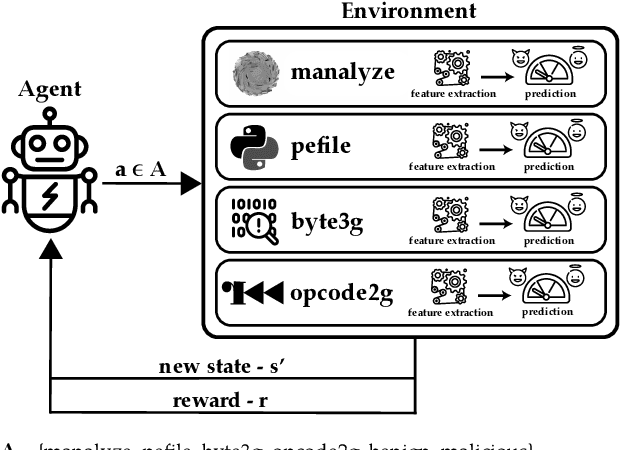
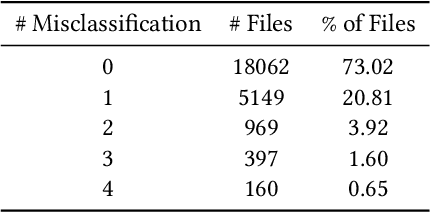
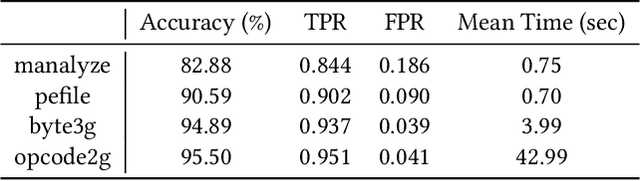
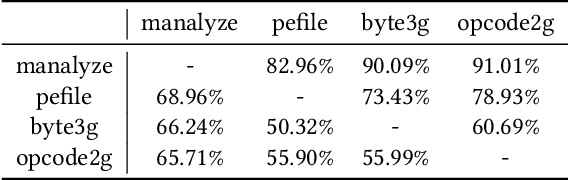
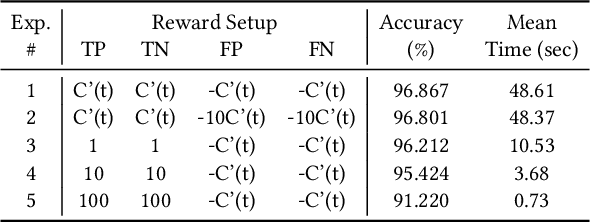
Malware detection is an ever-present challenge for all organizational gatekeepers. Organizations often deploy numerous different malware detection tools, and then combine their output to produce a final classification for an inspected file. This approach has two significant drawbacks. First, it requires large amounts of computing resources and time since every incoming file needs to be analyzed by all detectors. Secondly, it is difficult to accurately and dynamically enforce a predefined security policy that comports with the needs of each organization (e.g., how tolerant is the organization to false negatives and false positives). In this study we propose ASPIRE, a reinforcement learning (RL)-based method for malware detection. Our approach receives the organizational policy -- defined solely by the perceived costs of correct/incorrect classifications and of computing resources -- and then dynamically assigns detection tools and sets the detection threshold for each inspected file. We demonstrate the effectiveness and robustness of our approach by conducting an extensive evaluation on multiple organizational policies. ASPIRE performed well in all scenarios, even achieving near-optimal accuracy of 96.21% (compared to an optimum of 96.86%) at approximately 20% of the running time of this baseline.