 Add to Chrome
 Add to Firefox
 Add to Edge
RORA: Realistic Object Reconstruction with Articulation
Aug 05, 2026
Replicating real-world environments into simulation by realistic visual representation like NeRF and 3D Gaussian Splatting (3DGS) has emerged as an effective strategy to reduce the sim-to-real gap in robot learning. However, implementing object articulation during the real-to-sim process is still a challenging task. Existing motion tracking or learning based articulation methods shows low success rates on complex kinematic structures having multiple joints. Furthermore, those methods require scan of dynamic motion of objects, which makes reconstruction process much complicated. In this work, we propose the first end-to-end pipeline that reconstructs simulation-ready assets with accurate articulation from a single static object video input through suggestion based human-in-the-loop process. Our approach exports a hybrid representation combining 3DGS for photorealistic rendering and mesh-based geometry for physical interaction. In the reconstruction process, our pipeline performs convex decomposition followed by user grouping for intuitive part segmentation, subsequently binding 3D Gaussians to the corresponding mesh parts. An Automatic Joint Suggestion Algorithm then calculates candidate joint axes from local boundary geometries and presents them to users for efficient articulated asset reconstruction. We have shown that our method achieves precise articulation results on partnet-mobility-v0 dataset and real objects. Additionally we presented a potential usage of our framework on robot learning, deploying the reconstructed assets in Unreal Engine and NVIDIA Isaac Sim, demonstrating real-time dexterous hand manipulation tasks.

LensNet: Enhancing Real-time Microlensing Event Discovery with Recurrent Neural Networks in the Korea Microlensing Telescope Network
Jan 10, 2025Traditional microlensing event vetting methods require highly trained human experts, and the process is both complex and time-consuming. This reliance on manual inspection often leads to inefficiencies and constrains the ability to scale for widespread exoplanet detection, ultimately hindering discovery rates. To address the limits of traditional microlensing event vetting, we have developed LensNet, a machine learning pipeline specifically designed to distinguish legitimate microlensing events from false positives caused by instrumental artifacts, such as pixel bleed trails and diffraction spikes. Our system operates in conjunction with a preliminary algorithm that detects increasing trends in flux. These flagged instances are then passed to LensNet for further classification, allowing for timely alerts and follow-up observations. Tailored for the multi-observatory setup of the Korea Microlensing Telescope Network (KMTNet) and trained on a rich dataset of manually classified events, LensNet is optimized for early detection and warning of microlensing occurrences, enabling astronomers to organize follow-up observations promptly. The internal model of the pipeline employs a multi-branch Recurrent Neural Network (RNN) architecture that evaluates time-series flux data with contextual information, including sky background, the full width at half maximum of the target star, flux errors, PSF quality flags, and air mass for each observation. We demonstrate a classification accuracy above 87.5%, and anticipate further improvements as we expand our training set and continue to refine the algorithm.
Minimally Invasive Live Tissue High-fidelity Thermophysical Modeling using Real-time Thermography
Jan 23, 2023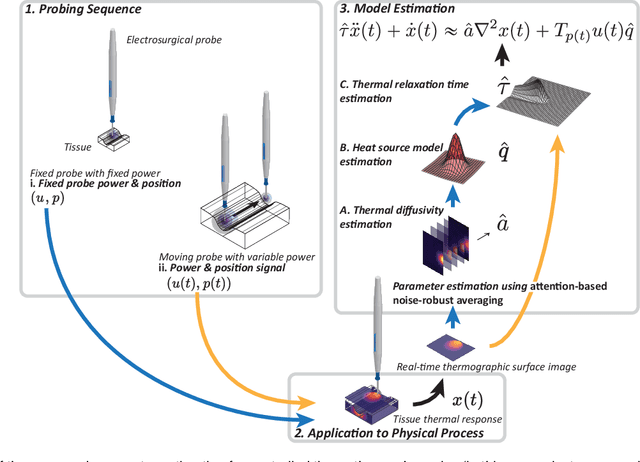
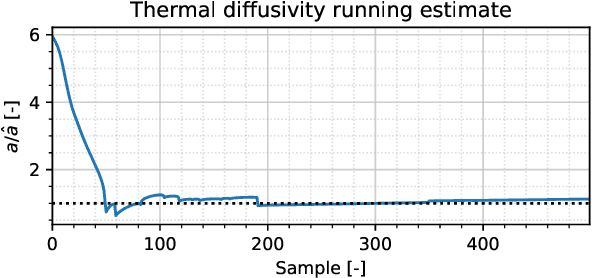

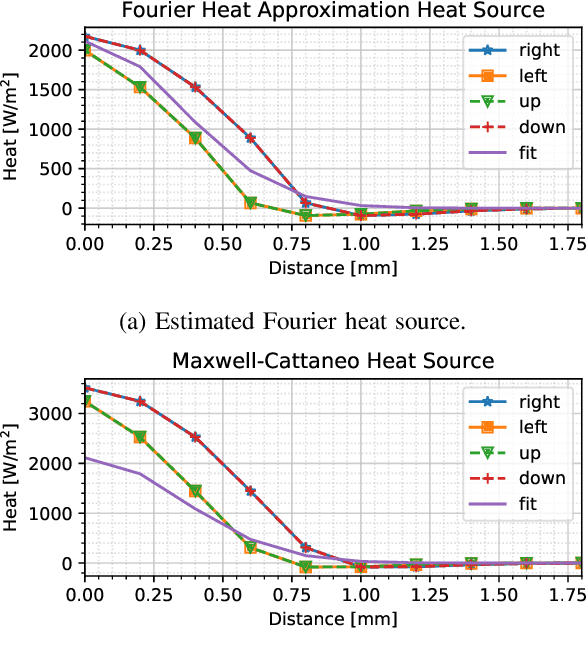
We present a novel thermodynamic parameter estimation framework for energy-based surgery on live tissue, with direct applications to tissue characterization during electrosurgery. This framework addresses the problem of estimating tissue-specific thermodynamics in real-time, which would enable accurate prediction of thermal damage impact to the tissue and damage-conscious planning of electrosurgical procedures. Our approach provides basic thermodynamic information such as thermal diffusivity, and also allows for obtaining the thermal relaxation time and a model of the heat source, yielding in real-time a controlled hyperbolic thermodynamics model. The latter accounts for the finite thermal propagation time necessary for modeling of the electrosurgical action, in which the probe motion speed often surpasses the speed of thermal propagation in the tissue operated on. Our approach relies solely on thermographer feedback and a knowledge of the power level and position of the electrosurgical pencil, imposing only very minor adjustments to normal electrosurgery to obtain a high-fidelity model of the tissue-probe interaction. Our method is minimally invasive and can be performed in situ. We apply our method first to simulated data based on porcine muscle tissue to verify its accuracy and then to in vivo liver tissue, and compare the results with those from the literature. This comparison shows that parameterizing the Maxwell--Cattaneo model through the framework proposed yields a noticeably higher fidelity real-time adaptable representation of the thermodynamic tissue response to the electrosurgical impact than currently available. A discussion on the differences between the live and the dead tissue thermodynamics is also provided.