 Add to Chrome
 Add to Firefox
 Add to Edge
CausShield: Sample Reconstruction-Resilient Vertical FL via Causal Representation Learning
Jun 06, 2026
Vertical federated learning (VFL) is a distributed learning paradigm that leverages vertically partitioned features across isolated parties without sharing raw samples; however, it remains vulnerable to active sample reconstruction attacks. Existing defenses fail to achieve a satisfactory trade-off between model utility and privacy protection, due to either suppressing task-relevant information alongside privacy-sensitive features or relying on end-to-end supervised training to converge the defense module, which exposes the model to early-epoch vulnerability. To address this challenge, we adopt a structural causal model (SCM) insight and construct CausShield. From a task-learning standpoint, causal features within a raw sample are those that are directly relevant and contributory to the learning objective, whereas non-causal features are task-irrelevant but often encode sample-specific private information, thereby facilitating reconstruction. Importantly, we lay a theoretical foundation to prove this insight. CausShield thus decomposes the shared representations between the client and the coordinating server in VFL into task-relevant and task-irrelevant components to ensure full-cycle privacy protection. Nonetheless, the decomposition is inherently challenging due to the dual objectives of preserving model utility while mitigating privacy leakage. We address this via a carefully formulated optimization problem, which is solved through unsupervised representation learning. We further theoretically prove that CausShield preserves the convergence behavior of standard VFL. Extensive experiments compare CausShield against seven SOTAs, including InvL (USENIX Security'25), and evaluate robustness against advanced reconstruction attacks such as URVFL (NDSS'25). Results demonstrate that CausShield consistently outperforms in privacy protection, model utility, and computational efficiency.

ArmSSL: Adversarial Robust Black-Box Watermarking for Self-Supervised Learning Pre-trained Encoders
Apr 24, 2026Self-supervised learning (SSL) encoders are invaluable intellectual property (IP). However, no existing SSL watermarking for IP protection can concurrently satisfy the following two practical requirements: (1) provide ownership verification capability under black-box suspect model access once the stolen encoders are used in downstream tasks; (2) be robust under adversarial watermark detection or removal, because the watermark samples form a distinguishable out-of-distribution (OOD) cluster. We propose ArmSSL, an SSL watermarking framework that assures black-box verifiability and adversarial robustness while preserving utility. For verification, we introduce paired discrepancy enlargement, enforcing feature-space orthogonality between the clean and its watermark counterpart to produce a reliable verification signal in black-box against the suspect model. For adversarial robustness, ArmSSL integrates latent representation entanglement and distribution alignment to suppress the OOD clustering. The former entangles watermark representations with clean representations (i.e., from non-source-class) to avoid forming a dense cluster of watermark samples, while the latter minimizes the distributional discrepancy between watermark and clean representations, thereby disguising watermark samples as natural in-distribution data. For utility, a reference-guided watermark tuning strategy is designed to allow the watermark to be learned as a small side task without affecting the main task by aligning the watermarked encoder's outputs with those of the original clean encoder on normal data. Extensive experiments across five mainstream SSL frameworks and nine benchmark datasets, along with end-to-end comparisons with SOTAs, demonstrate that ArmSSL achieves superior ownership verification, negligible utility degradation, and strong robustness against various adversarial detection and removal.
Intellectual Property Protection for Deep Learning Model and Dataset Intelligence
Nov 07, 2024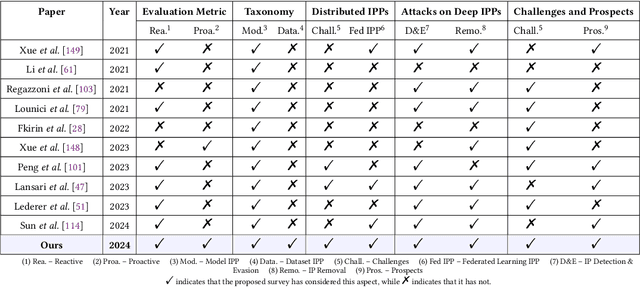
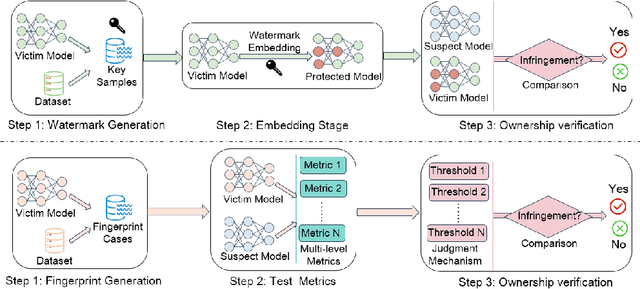
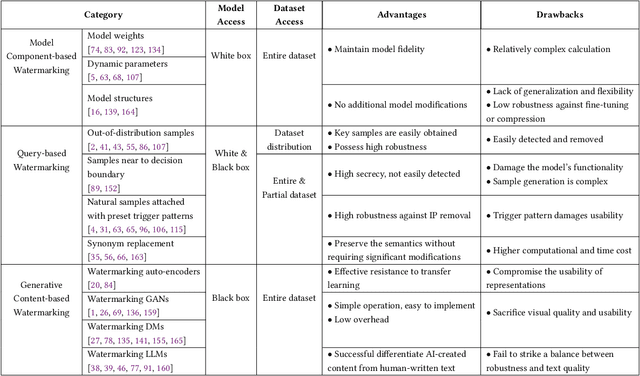
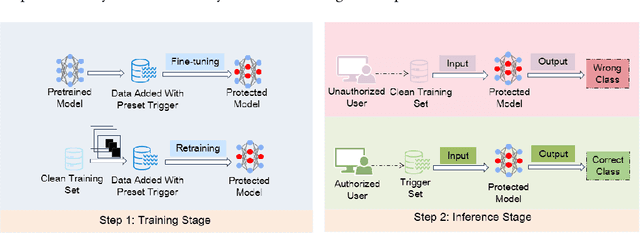
With the growing applications of Deep Learning (DL), especially recent spectacular achievements of Large Language Models (LLMs) such as ChatGPT and LLaMA, the commercial significance of these remarkable models has soared. However, acquiring well-trained models is costly and resource-intensive. It requires a considerable high-quality dataset, substantial investment in dedicated architecture design, expensive computational resources, and efforts to develop technical expertise. Consequently, safeguarding the Intellectual Property (IP) of well-trained models is attracting increasing attention. In contrast to existing surveys overwhelmingly focusing on model IPP mainly, this survey not only encompasses the protection on model level intelligence but also valuable dataset intelligence. Firstly, according to the requirements for effective IPP design, this work systematically summarizes the general and scheme-specific performance evaluation metrics. Secondly, from proactive IP infringement prevention and reactive IP ownership verification perspectives, it comprehensively investigates and analyzes the existing IPP methods for both dataset and model intelligence. Additionally, from the standpoint of training settings, it delves into the unique challenges that distributed settings pose to IPP compared to centralized settings. Furthermore, this work examines various attacks faced by deep IPP techniques. Finally, we outline prospects for promising future directions that may act as a guide for innovative research.