 Add to Chrome
 Add to Firefox
 Add to Edge
SEMamba++: A General Speech Restoration Framework Leveraging Global, Local, and Periodic Spectral Patterns
Mar 12, 2026
General speech restoration demands techniques that can interpret complex speech structures under various distortions. While State-Space Models like SEMamba have advanced the state-of-the-art in speech denoising, they are not inherently optimized for critical speech characteristics, such as spectral periodicity or multi-resolution frequency analysis. In this work, we introduce an architecture tailored to incorporate speech-specific features as inductive biases. In particular, we propose Frequency GLP, a frequency feature extraction block that effectively and efficiently leverages the properties of frequency bins. Then, we design a multi-resolution parallel time-frequency dual-processing block to capture diverse spectral patterns, and a learnable mapping to further enhance model performance. With all our ideas combined, the proposed SEMamba++ achieves the best performance among multiple baseline models while remaining computationally efficient.

RAF: Relativistic Adversarial Feedback For Universal Speech Synthesis
Mar 12, 2026We propose Relativistic Adversarial Feedback (RAF), a novel training objective for GAN vocoders that improves in-domain fidelity and generalization to unseen scenarios. Although modern GAN vocoders employ advanced architectures, their training objectives often fail to promote generalizable representations. RAF addresses this problem by leveraging speech self-supervised learning models to assist discriminators in evaluating sample quality, encouraging the generator to learn richer representations. Furthermore, we utilize relativistic pairing for real and fake waveforms to improve the modeling of the training data distribution. Experiments across multiple datasets show consistent gains in both objective and subjective metrics on GAN-based vocoders. Importantly, the RAF-trained BigVGAN-base outperforms the LSGAN-trained BigVGAN in perceptual quality using only 12\% of the parameters. Comparative studies further confirm the effectiveness of RAF as a training framework for GAN vocoders.
Wave-U-Mamba: An End-To-End Framework For High-Quality And Efficient Speech Super Resolution
Sep 17, 2024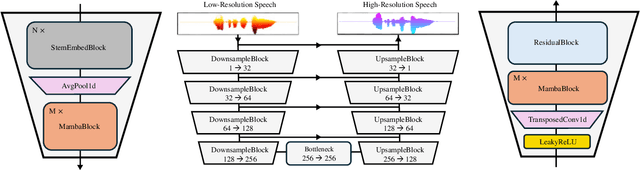
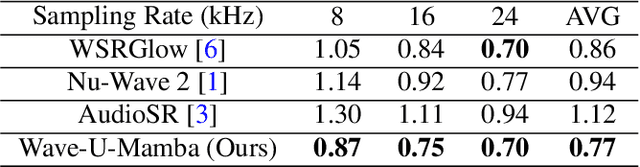
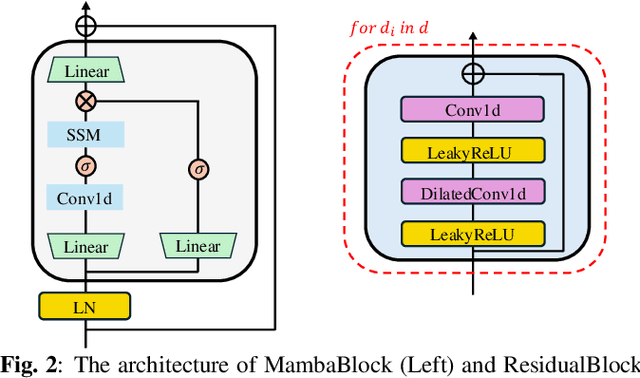
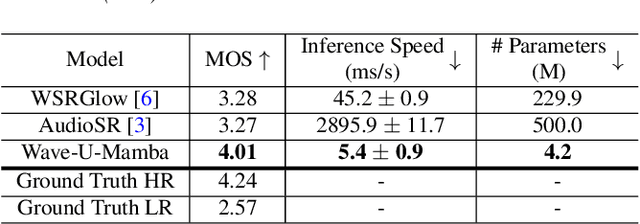
Speech Super-Resolution (SSR) is a task of enhancing low-resolution speech signals by restoring missing high-frequency components. Conventional approaches typically reconstruct log-mel features, followed by a vocoder that generates high-resolution speech in the waveform domain. However, as log-mel features lack phase information, this can result in performance degradation during the reconstruction phase. Motivated by recent advances with Selective State Spaces Models (SSMs), we propose a method, referred to as Wave-U-Mamba that directly performs SSR in time domain. In our comparative study, including models such as WSRGlow, NU-Wave 2, and AudioSR, Wave-U-Mamba demonstrates superior performance, achieving the lowest Log-Spectral Distance (LSD) across various low-resolution sampling rates, ranging from 8 kHz to 24 kHz. Additionally, subjective human evaluations, scored using Mean Opinion Score (MOS) reveal that our method produces SSR with natural and human-like quality. Furthermore, Wave-U-Mamba achieves these results while generating high-resolution speech over nine times faster than baseline models on a single A100 GPU, with parameter sizes less than 2% of those in the baseline models.