 Add to Chrome
 Add to Firefox
 Add to Edge
ospEDA: Orthogonal Subspace Projection for Electrodermal Activity Decomposition
Apr 08, 2026
Electrodermal activity (EDA) is a widely used physiological signal for assessing sympathetic nervous activity, such as arousal, stress, and pain. However, reliable decomposition into tonic and phasic components remains challenging, particularly in noisy environments and across individuals with varying signal morphologies and stimulus responses. We propose ospEDA, a novel Orthogonal Subspace Projection (OSP) based method for EDA decomposition. The method integrates (1) tonic estimation via physiologically motivated valley detection for noise robustness; (2) phasic extraction using OSP to accommodate inter subject variability; and (3) phasic driver estimation through non-negative least squares (NNLS) deconvolution with ridge regularization. We evaluated ospEDA on five real-world datasets and one simulated EDA dataset with ground-truth components, comparing its performance against six existing methods. In simulations with a 20 dB signal to noise ratio (SNR), ospEDA achieved the lowest root mean square error (RMSE) for estimated tonic (0.131) and phasic (0.132) components. Under noisier conditions (10 dB SNR), it maintained superior phasic RMSE (0.293), Pearson correlation (0.782), and R^2 (0.979) values. Furthermore, ospEDA consistently provided the highest F1 scores (0.573, 0.617, 0.638) for sympathetic nerve activity detection across 10, 20, and 30 dB SNR levels, respectively, compared to existing methods. On the real world datasets, ospEDA achieved a stimulus classification AUROC of 0.766 and consistently maintained strong effect sizes (ω^2>0.14) across all five datasets. Overall, ospEDA represents a promising framework for EDA decomposition, showing generally consistent performance and reliable phasic driver estimation under the varying noise conditions, with potential utility for real world physiological monitoring applications.

Atrial Fibrillation Prediction Using a Lightweight Temporal Convolutional and Selective State Space Architecture
Aug 26, 2025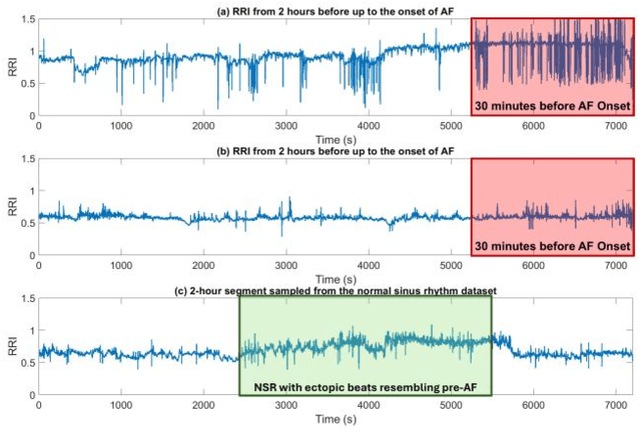
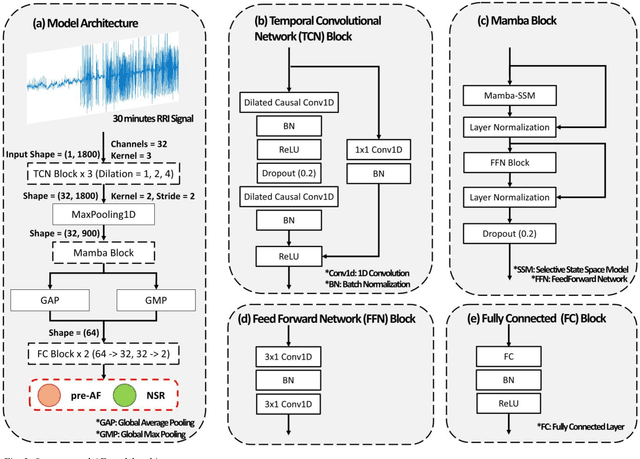
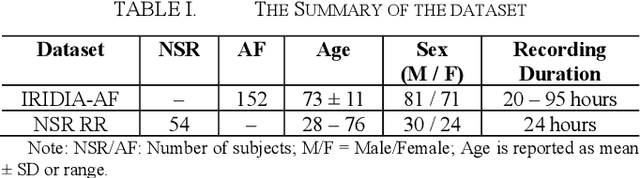
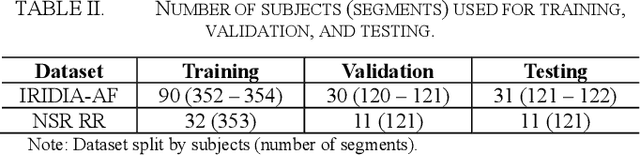
Atrial fibrillation (AF) is the most common arrhythmia, increasing the risk of stroke, heart failure, and other cardiovascular complications. While AF detection algorithms perform well in identifying persistent AF, early-stage progression, such as paroxysmal AF (PAF), often goes undetected due to its sudden onset and short duration. However, undetected PAF can progress into sustained AF, increasing the risk of mortality and severe complications. Early prediction of AF offers an opportunity to reduce disease progression through preventive therapies, such as catecholamine-sparing agents or beta-blockers. In this study, we propose a lightweight deep learning model using only RR Intervals (RRIs), combining a Temporal Convolutional Network (TCN) for positional encoding with Mamba, a selective state space model, to enable early prediction of AF through efficient parallel sequence modeling. In subject-wise testing results, our model achieved a sensitivity of 0.908, specificity of 0.933, F1-score of 0.930, AUROC of 0.972, and AUPRC of 0.932. Additionally, our method demonstrates high computational efficiency, with only 73.5 thousand parameters and 38.3 MFLOPs, outperforming traditional Convolutional Neural Network-Recurrent Neural Network (CNN-RNN) approaches in both accuracy and model compactness. Notably, the model can predict AF up to two hours in advance using just 30 minutes of input data, providing enough lead time for preventive interventions.