 Add to Chrome
 Add to Firefox
 Add to Edge
Graph-based Nearest Neighbors with Dynamic Updates via Random Walks
Dec 19, 2025
Approximate nearest neighbor search (ANN) is a common way to retrieve relevant search results, especially now in the context of large language models and retrieval augmented generation. One of the most widely used algorithms for ANN is based on constructing a multi-layer graph over the dataset, called the Hierarchical Navigable Small World (HNSW). While this algorithm supports insertion of new data, it does not support deletion of existing data. Moreover, deletion algorithms described by prior work come at the cost of increased query latency, decreased recall, or prolonged deletion time. In this paper, we propose a new theoretical framework for graph-based ANN based on random walks. We then utilize this framework to analyze a randomized deletion approach that preserves hitting time statistics compared to the graph before deleting the point. We then turn this theoretical framework into a deterministic deletion algorithm, and show that it provides better tradeoff between query latency, recall, deletion time, and memory usage through an extensive collection of experiments.

Fast Private Kernel Density Estimation via Locality Sensitive Quantization
Jul 04, 2023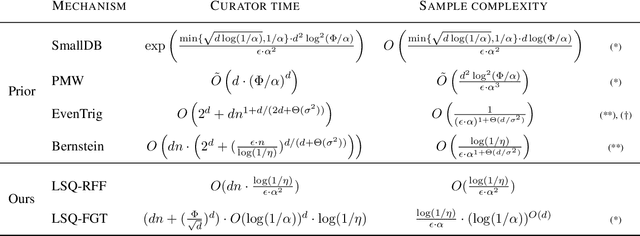
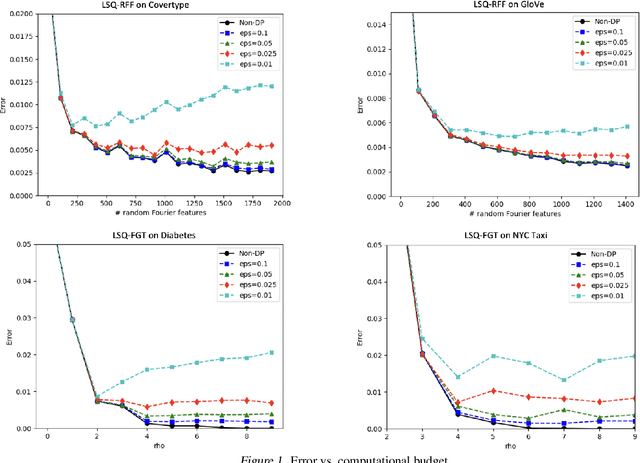
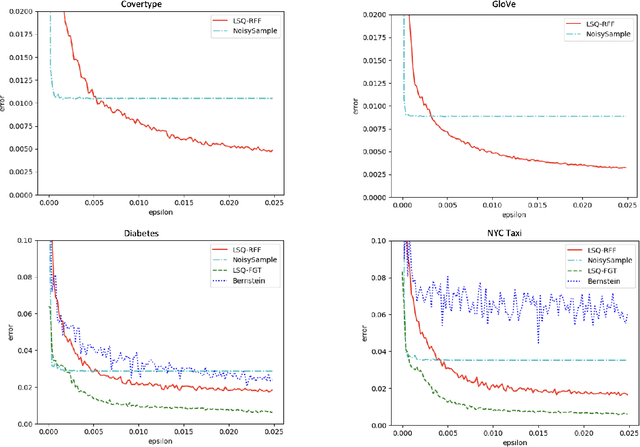
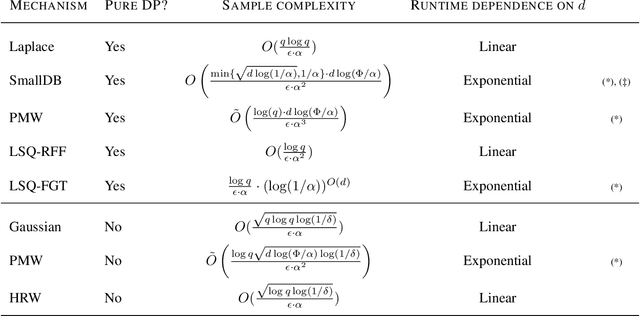
We study efficient mechanisms for differentially private kernel density estimation (DP-KDE). Prior work for the Gaussian kernel described algorithms that run in time exponential in the number of dimensions $d$. This paper breaks the exponential barrier, and shows how the KDE can privately be approximated in time linear in $d$, making it feasible for high-dimensional data. We also present improved bounds for low-dimensional data. Our results are obtained through a general framework, which we term Locality Sensitive Quantization (LSQ), for constructing private KDE mechanisms where existing KDE approximation techniques can be applied. It lets us leverage several efficient non-private KDE methods -- like Random Fourier Features, the Fast Gauss Transform, and Locality Sensitive Hashing -- and ``privatize'' them in a black-box manner. Our experiments demonstrate that our resulting DP-KDE mechanisms are fast and accurate on large datasets in both high and low dimensions.
Explaining a machine learning decision to physicians via counterfactuals
Jun 10, 2023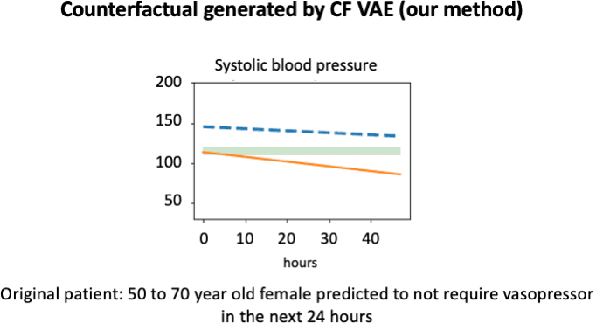
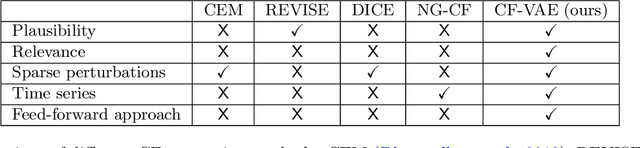
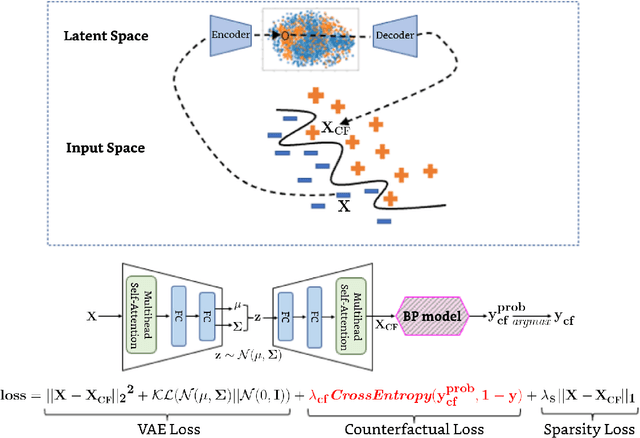

Machine learning models perform well on several healthcare tasks and can help reduce the burden on the healthcare system. However, the lack of explainability is a major roadblock to their adoption in hospitals. \textit{How can the decision of an ML model be explained to a physician?} The explanations considered in this paper are counterfactuals (CFs), hypothetical scenarios that would have resulted in the opposite outcome. Specifically, time-series CFs are investigated, inspired by the way physicians converse and reason out decisions `I would have given the patient a vasopressor if their blood pressure was lower and falling'. Key properties of CFs that are particularly meaningful in clinical settings are outlined: physiological plausibility, relevance to the task and sparse perturbations. Past work on CF generation does not satisfy these properties, specifically plausibility in that realistic time-series CFs are not generated. A variational autoencoder (VAE)-based approach is proposed that captures these desired properties. The method produces CFs that improve on prior approaches quantitatively (more plausible CFs as evaluated by their likelihood w.r.t original data distribution, and 100$\times$ faster at generating CFs) and qualitatively (2$\times$ more plausible and relevant) as evaluated by three physicians.