 Add to Chrome
 Add to Firefox
 Add to Edge
Detection and Ranging of Transient Extrinsic Contacts Based on 6D Dynamic Tactile Sensing
Aug 07, 2026
Delicate manipulation often involves transient and subtle collisions between a grasped object and the environment. While the human hand localizes these contacts effortlessly thanks to superior tactile sensitivity, robotic systems often lack the requisite resolution to acquire the information necessary for motion planning, resulting in clumsy manipulation or even task failure. Here, we propose transient extrinsic contact detection and ranging (TECDAR), a simple yet fast and efficient method for detecting and ranging extrinsic contact of grasped objects. Our design of gripper tips employs dynamic tactile sensing leveraging a single 2.5$\times$3 mm 6D inertial measurement unit. The sensor captures sub-millisecond tip deformations at a 7 kHz sampling rate, but operating on a data stream of only 84 KB/s. High bandwidth and compact data size enable the system to rapidly detect and localize contact between grasped objects and their surroundings. Specifically, fusing tactile data with robot pose via an extended Kalman filter enables fast and precise localization of extrinsic contact, reaching millimeter-level accuracy within 180 ms. Experimental results demonstrate that the system achieves an average localization accuracy of approximately 7\,mm in both line-contact and point-contact localization tasks. Furthermore, this near-instantaneous localization enables the robot to rectify its trajectory on a millisecond scale, facilitating precise tool manipulation and enhanced perception of complex environments purely through tactile exploration and mapping. We envision such techniques advancing the future of robotics across domains requiring delicate manipulation, including precision assembly, surgical assistance, and autonomous exploration in touch-dominant environments. Project page: humitlab.github.io/TECDAR/

A Wearable Tactile Sensor Array for Large Area Remote Vibration Sensing in the Hand
Aug 22, 2019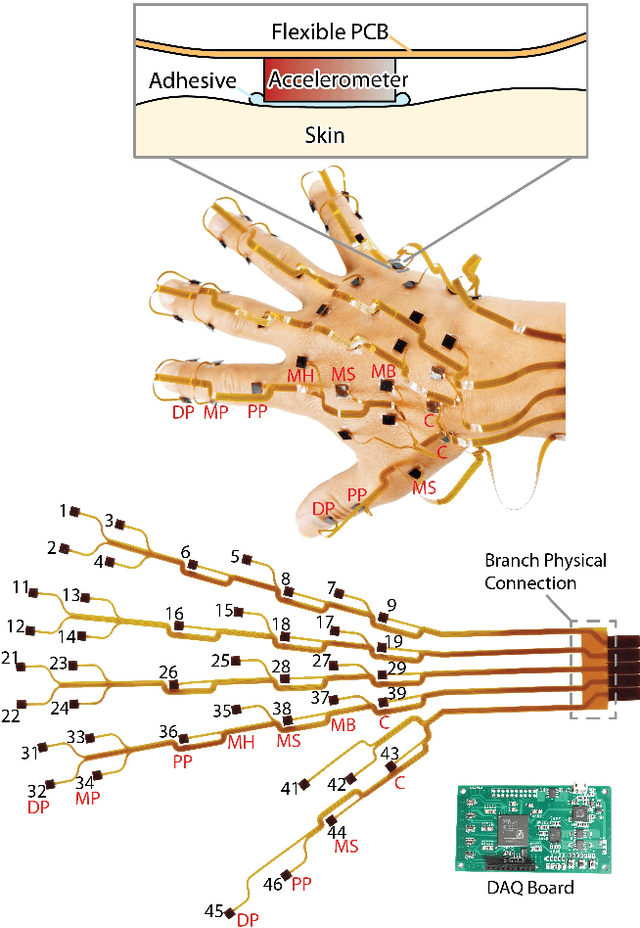
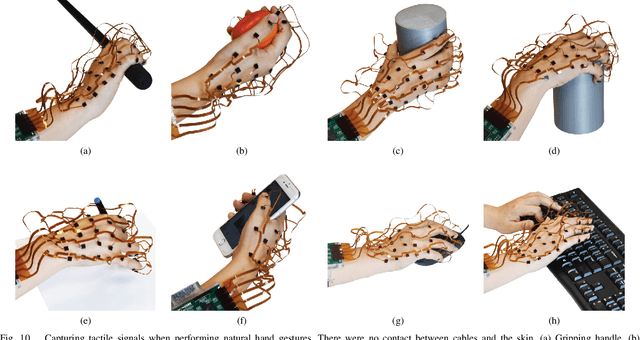
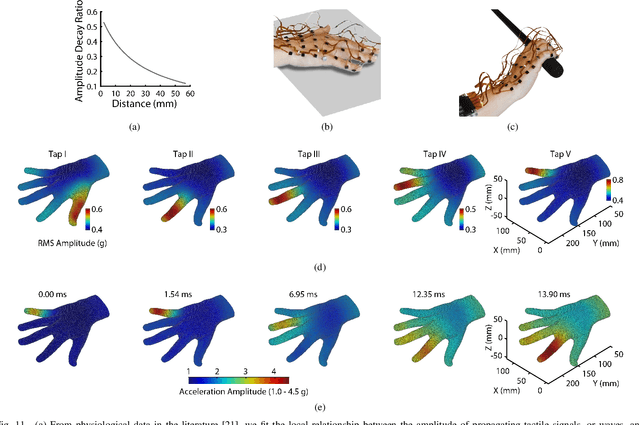
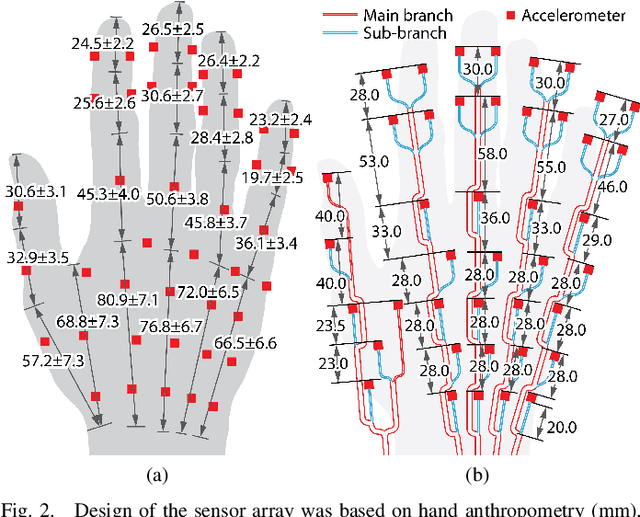
Tactile sensing is a essential for skilled manipulation and object perception, but existing devices are unable to capture mechanical signals in the full gamut of regimes that are important for human touch sensing, and are unable to emulate the sensing abilities of the human hand. Recent research reveals that human touch sensing relies on the transmission of mechanical waves throughout tissues of the hand. This provides the hand with remarkable abilities to remotely capture distributed vibration signatures of touch contact. Little engineering attention has been given to important sensory system. Here, we present a wearable device inspired by the anatomy and function of the hand and by human sensory abilities. The device is based on a 126 channel sensor array capable of capturing high resolution tactile signals during natural manual activities. It employs a network of miniature three-axis sensors mounted on a flexible circuit whose geometry and topology were designed match the anatomy of the hand, permitting data capture during natural interactions, while minimizing artifacts. Each sensor possesses a frequency bandwidth matching the human tactile frequency range. Data is acquired in real time via a custom FPGA and an I$^2$C network. We also present physiologically informed signal processing methods for reconstructing whole hand tactile signals using data from this system. We report experiments that demonstrate the ability of this system to accurately capture remotely produced whole hand tactile signals during manual interactions.