 Add to Chrome
 Add to Firefox
 Add to Edge
Verify, Repair, Repeat, or Stop? Robust Stopping for Noisy Verify-Repair Loops in LLM Agents
Jul 20, 2026
Verify-repair loops are a standard means for large language model (LLM) agents to correct faulty plans in code generation, mathematical reasoning, and tool use. When both the verifier and the repairer are noisy, repair can damage already-correct plans, and reported acceptance keeps rising while true validity falls, so existing methods lack a principled basis for deciding when repair should stop. We propose VRR-Stop, a robust stopping framework for noisy verify-repair-repeat (VRR) loops. A four-parameter noise model separates verifier false acceptance and false rejection from the repair and damage behavior of the repairer. Belief filtering turns repeated verification votes into an estimate of committed validity, and the loop commits or repairs according to the sign of the true marginal gain, which requires only sign identifiability rather than accurate recovery of all parameters. When verifier discrimination approaches zero, calibration itself fails and estimation error can flip the stopping sign, so we pair VRR-Stop with VRR-Guard, an estimation-free fallback that replaces the incumbent candidate only under a sufficient verification margin. On a GSM8K stress setting, VRR-Stop improves final true validity by 60.6 percentage points over fixed five-round repair at an average cost of 0.72 repair rounds. Across settings, stopping reliability is governed jointly by verifier discrimination and the decision margin rather than by the absolute size of estimation error.

Fusion-Poly: A Polyhedral Framework Based on Spatial-Temporal Fusion for 3D Multi-Object Tracking
Mar 09, 2026LiDAR-camera 3D multi-object tracking (MOT) combines rich visual semantics with accurate depth cues to improve trajectory consistency and tracking reliability. In practice, however, LiDAR and cameras operate at different sampling rates. To maintain temporal alignment, existing data pipelines usually synchronize heterogeneous sensor streams and annotate them at a reduced shared frequency, forcing most prior methods to perform spatial fusion only at synchronized timestamps through projection-based or learnable cross-sensor association. As a result, abundant asynchronous observations remain underexploited, despite their potential to support more frequent association and more robust trajectory estimation over short temporal intervals. To address this limitation, we propose Fusion-Poly, a spatial-temporal fusion framework for 3D MOT that integrates asynchronous LiDAR and camera data. Fusion-Poly associates trajectories with multi-modal observations at synchronized timestamps and with single-modal observations at asynchronous timestamps, enabling higher-frequency updates of motion and existence states. The framework contains three key components: a frequency-aware cascade matching module that adapts to synchronized and asynchronous frames according to available detection modalities; a frequency-aware trajectory estimation module that maintains trajectories through high-frequency motion prediction, differential updates, and confidence-calibrated lifecycle management; and a full-state observation alignment module that improves cross-modal consistency at synchronized timestamps by optimizing image-projection errors. On the nuScenes test set, Fusion-Poly achieves 76.5% AMOTA, establishing a new state of the art among tracking-by-detection 3D MOT methods. Extensive ablation studies further validate the effectiveness of each component. Code will be released.
Offline-Poly: A Polyhedral Framework For Offline 3D Multi-Object Tracking
Feb 14, 2026Offline 3D multi-object tracking (MOT) is a critical component of the 4D auto-labeling (4DAL) process. It enhances pseudo-labels generated by high-performance detectors through the incorporation of temporal context. However, existing offline 3D MOT approaches are direct extensions of online frameworks and fail to fully exploit the advantages of offline setting. Moreover, these methods often depend on fixed upstream and customized architectures, limiting their adaptability. To address these limitations, we propose Offline-Poly, a general offline 3D MOT method based on a tracking-centric design. We introduce a standardized paradigm termed Tracking-by-Tracking (TBT), which operates exclusively on arbitrary off-the-shelf tracking outputs and produces offline-refined tracklets. This formulation decouples offline tracker from specific upstream detectors or trackers. Under the TBT paradigm, Offline-Poly accepts one or multiple coarse tracking results and processes them through a structured pipeline comprising pre-processing, hierarchical matching and fusion, and tracklet refinement. Each module is designed to capitalize on the two fundamental properties of offline tracking: resource unconstrainedness, which permits global optimization beyond real-time limits, and future observability, which enables tracklet reasoning over the full temporal horizon. Offline-Poly first eliminates short-term ghost tracklets and re-identifies fragmented segments using global scene context. It then constructs scene-level similarity to associate tracklets across multiple input sources. Finally, Offline-Poly refines tracklets by jointly leveraging local and global motion patterns. On nuScenes, we achieve SOTA performance with 77.6% AMOTA. On KITTI, it achieves leading results with 83.00% HOTA. Comprehensive experiments further validate the flexibility, generalizability, and modular effectiveness of Offline-Poly.
Rethinking the Spatio-Temporal Alignment of End-to-End 3D Perception
Dec 29, 2025Spatio-temporal alignment is crucial for temporal modeling of end-to-end (E2E) perception in autonomous driving (AD), providing valuable structural and textural prior information. Existing methods typically rely on the attention mechanism to align objects across frames, simplifying the motion model with a unified explicit physical model (constant velocity, etc.). These approaches prefer semantic features for implicit alignment, challenging the importance of explicit motion modeling in the traditional perception paradigm. However, variations in motion states and object features across categories and frames render this alignment suboptimal. To address this, we propose HAT, a spatio-temporal alignment module that allows each object to adaptively decode the optimal alignment proposal from multiple hypotheses without direct supervision. Specifically, HAT first utilizes multiple explicit motion models to generate spatial anchors and motion-aware feature proposals for historical instances. It then performs multi-hypothesis decoding by incorporating semantic and motion cues embedded in cached object queries, ultimately providing the optimal alignment proposal for the target frame. On nuScenes, HAT consistently improves 3D temporal detectors and trackers across diverse baselines. It achieves state-of-the-art tracking results with 46.0% AMOTA on the test set when paired with the DETR3D detector. In an object-centric E2E AD method, HAT enhances perception accuracy (+1.3% mAP, +3.1% AMOTA) and reduces the collision rate by 32%. When semantics are corrupted (nuScenes-C), the enhancement of motion modeling by HAT enables more robust perception and planning in the E2E AD.
RockTrack: A 3D Robust Multi-Camera-Ken Multi-Object Tracking Framework
Sep 18, 2024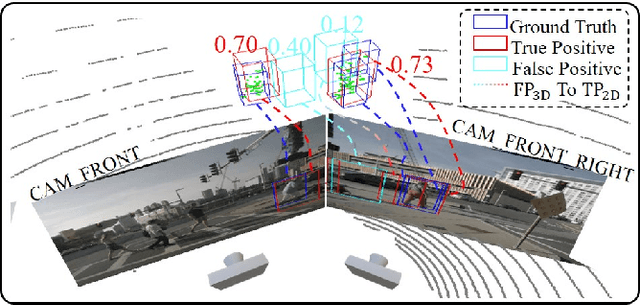
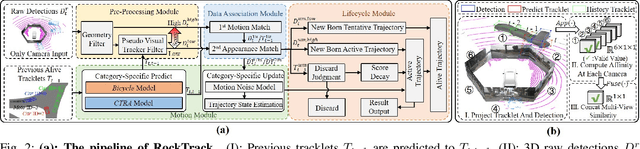

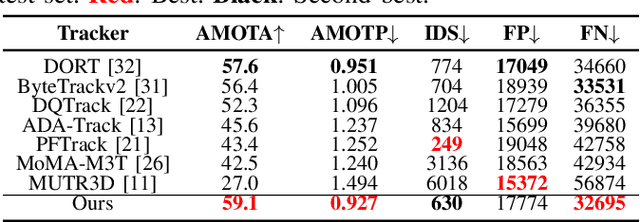
3D Multi-Object Tracking (MOT) obtains significant performance improvements with the rapid advancements in 3D object detection, particularly in cost-effective multi-camera setups. However, the prevalent end-to-end training approach for multi-camera trackers results in detector-specific models, limiting their versatility. Moreover, current generic trackers overlook the unique features of multi-camera detectors, i.e., the unreliability of motion observations and the feasibility of visual information. To address these challenges, we propose RockTrack, a 3D MOT method for multi-camera detectors. Following the Tracking-By-Detection framework, RockTrack is compatible with various off-the-shelf detectors. RockTrack incorporates a confidence-guided preprocessing module to extract reliable motion and image observations from distinct representation spaces from a single detector. These observations are then fused in an association module that leverages geometric and appearance cues to minimize mismatches. The resulting matches are propagated through a staged estimation process, forming the basis for heuristic noise modeling. Additionally, we introduce a novel appearance similarity metric for explicitly characterizing object affinities in multi-camera settings. RockTrack achieves state-of-the-art performance on the nuScenes vision-only tracking leaderboard with 59.1% AMOTA while demonstrating impressive computational efficiency.
Fast-Poly: A Fast Polyhedral Framework For 3D Multi-Object Tracking
Mar 20, 2024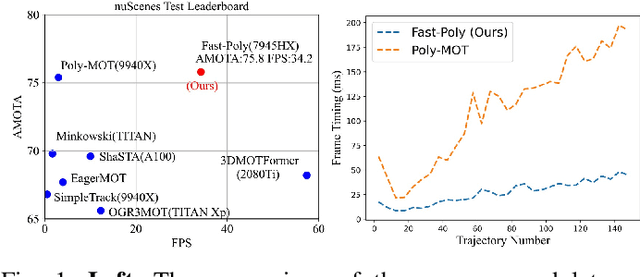
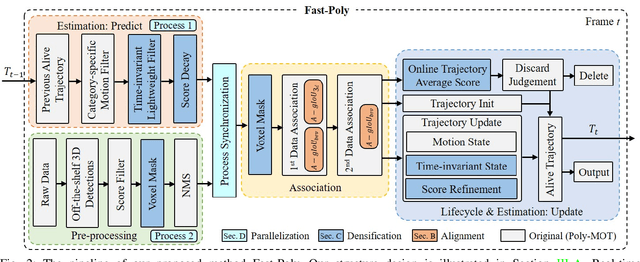
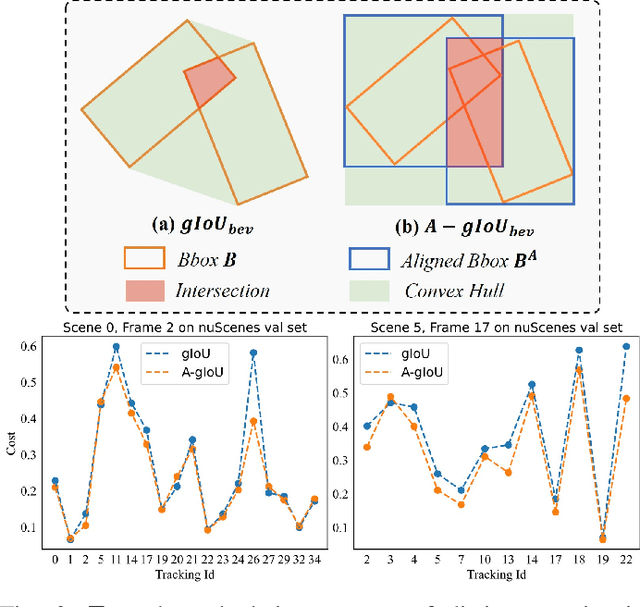
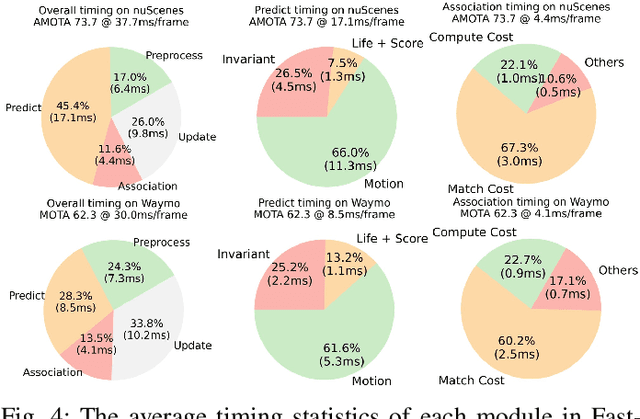
3D Multi-Object Tracking (MOT) captures stable and comprehensive motion states of surrounding obstacles, essential for robotic perception. However, current 3D trackers face issues with accuracy and latency consistency. In this paper, we propose Fast-Poly, a fast and effective filter-based method for 3D MOT. Building upon our previous work Poly-MOT, Fast-Poly addresses object rotational anisotropy in 3D space, enhances local computation densification, and leverages parallelization technique, improving inference speed and precision. Fast-Poly is extensively tested on two large-scale tracking benchmarks with Python implementation. On the nuScenes dataset, Fast-Poly achieves new state-of-the-art performance with 75.8% AMOTA among all methods and can run at 34.2 FPS on a personal CPU. On the Waymo dataset, Fast-Poly exhibits competitive accuracy with 63.6% MOTA and impressive inference speed (35.5 FPS). The source code is publicly available at https://github.com/lixiaoyu2000/FastPoly.