 Add to Chrome
 Add to Firefox
 Add to Edge
RISE: Roadside Infrastructure Sequence Understanding across 3D Tracking and Structured Vision-Language Reasoning
Aug 17, 2026
We present RISE (Roadside Infrastructure Sequence Understanding and Evaluation), a framework spanning metric 3D tracking and structured vision-language reasoning in roadside sequences. For metric tracking, our image-only method combines SAM3 video identities with calibration-guided mask agreement for multi-view identity association, recovering persistent 3D tracks without LiDAR or task-specific 3D training. Its calibration-conditioned geometry allows the procedure to be instantiated at different calibrated multi-camera intersections without layout-specific retraining. On 20 human-reviewed clips from six intersections, the generated tracks achieve 66.9 MOTA within the defined multi-view evaluation scope. For structured vision-language reasoning, a human-reviewed MLLM pipeline mines high-value clips and uses a constrained full-context Oracle to construct bbox-grounded predictive QA without exposing future evidence to evaluated models. The resulting RISE-VQA dataset contains 33,910 QA pairs from 557 clips across 16 intersections and 61 roadside views. Its intersection-held-out RISE-Bench evaluates semantic choices, coordinates, future boxes, and interaction sets with deterministic task-specific metrics. Experiments show consistent benefits from domain adaptation and generally from temporal context, while revealing persistent challenges in spatial grounding, future localization, and interaction reasoning.

DRIFT: Drift and Aggregation for Motion Planning
Jul 16, 2026End-to-end trajectory planners need to represent multiple plausible driving behaviors while producing a single executable trajectory under real-time constraints. Proposal-based approaches address this ambiguity by generating multiple candidates, but converting the proposal set into a final plan remains a key design problem. We present DRIFT, a fixed-depth planner that combines one-step drifting in a compact trajectory latent space with scene-aware proposal aggregation. Conditioned on features from a pretrained visual encoder, the DRIFT Decoder generates 48 proposal features in a single batched pass, with 32 samples at alpha=0.5 and 16 samples at alpha=0.9. A lightweight Aggregation Head integrates these features with scene, navigation, and ego-state information and directly predicts the final trajectory without requiring trajectory-level quality labels for aggregation. Its output is trained with expert-trajectory imitation and a map-derived boundary regularizer that penalizes waypoints outside the drivable polygon and inside waypoints near its boundary. On NAVSIM navtest, DRIFT achieves 89.6 PDMS and 90.4 EPDMS, with strong drivable-area compliance and ego progress among the methods compared. The proposal-generation and aggregation module runs in 10.82 ms on an NVIDIA RTX 4090, while full-model inference including the visual backbone takes 66.43 ms. These results show that one-step latent proposal generation and direct aggregation provide an efficient design for multi-hypothesis motion planning.
CLEAR: Cognition and Latent Evaluation for Adaptive Routing in End-to-End Autonomous Driving
Jun 04, 2026End-to-end autonomous driving models often struggle to balance multi-modal maneuver generation with real-time inference constraints. While diffusion models successfully capture diverse driving behaviors, their iterative denoising process incurs unacceptable latency for safety-critical deployment. To address this, we propose CLEAR (Cognition and Latent Evaluation for Adaptive Routing), a framework that combines ultra-fast generative planning with deep semantic reasoning. CLEAR employs Drive-JEPA as the visual encoder and replaces the multi-step denoising chain with a single-step conditional drift in a VAE latent space, introducing a conditioning coefficient to balance diversity and expert precision. Meanwhile, we fully fine-tune Qwen~3.5~0.8B on driving QA pairs to extract scene-aware hidden states. These states guide both an Adaptive Scheduler, which selects the conditioning coefficient $α$ and sample count $N$ from a discrete set of predefined schemes, and a cross-attention scorer that selects the optimal trajectory from candidates. On the NAVSIM v1 benchmark, CLEAR achieves a state-of-the-art PDMS of 93.7. Our results demonstrate that high-fidelity, multi-modal planning can be executed efficiently without dense geometric annotations or iterative sampling.
MISTY: High-Throughput Motion Planning via Mixer-based Single-step Drifting
Apr 23, 2026Multi-modal trajectory generation is essential for safe autonomous driving, yet existing diffusion-based planners suffer from high inference latency due to iterative neural function evaluations. This paper presents MISTY (Mixer-based Inference for Single-step Trajectory-drifting Yield), a high-throughput generative motion planner that achieves state-of-the-art closed-loop performance with pure single-step inference. MISTY integrates a vectorized Sub-Graph encoder to capture environment context, a Variational Autoencoder to structure expert trajectories into a compact 32-dimensional latent manifold, and an ultra-lightweight MLP-Mixer decoder to eliminate quadratic attention complexity. Importantly, we introduce a latent-space drifting loss that shifts the complex distribution evolution entirely to the training phase. By formulating explicit attractive and repulsive forces, this mechanism empowers the model to synthesize novel, proactive maneuvers, such as active overtaking, that are virtually absent from the raw expert demonstrations. Extensive evaluations on the nuPlan benchmark demonstrate that MISTY achieves state-of-the-art results on the challenging Test14-hard split, with comprehensive scores of 80.32 and 82.21 in non-reactive and reactive settings, respectively. Operating at over 99 FPS with an end-to-end latency of 10.1 ms, MISTY offers an order-of-magnitude speedup over iterative diffusion planners while while achieving significantly robust generation.
A Survey on Datasets for Decision-making of Autonomous Vehicle
Jun 29, 2023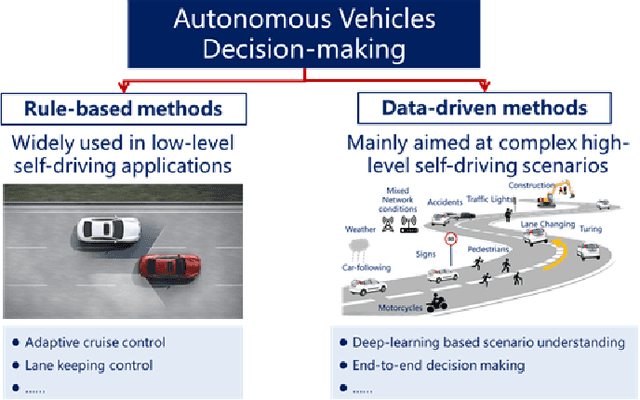
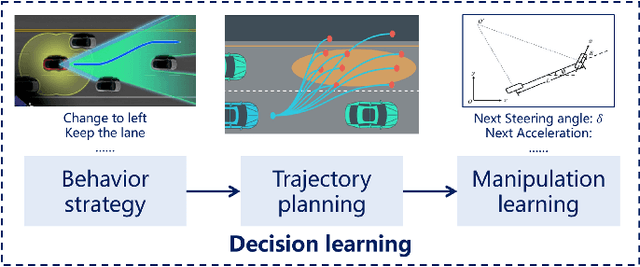
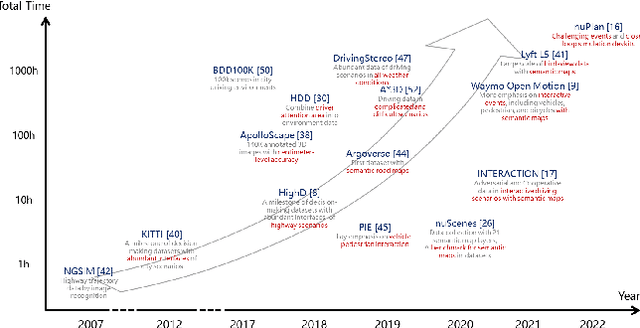
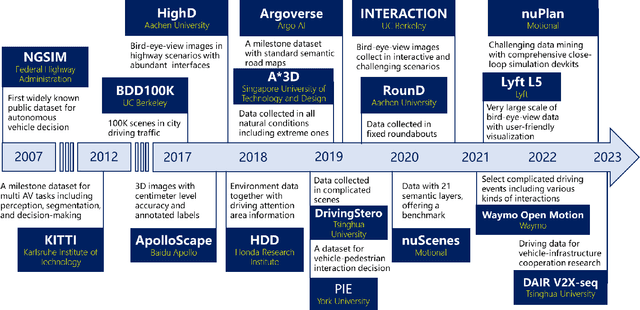
Autonomous vehicles (AV) are expected to reshape future transportation systems, and decision-making is one of the critical modules toward high-level automated driving. To overcome those complicated scenarios that rule-based methods could not cope with well, data-driven decision-making approaches have aroused more and more focus. The datasets to be used in developing data-driven methods dramatically influences the performance of decision-making, hence it is necessary to have a comprehensive insight into the existing datasets. From the aspects of collection sources, driving data can be divided into vehicle, environment, and driver related data. This study compares the state-of-the-art datasets of these three categories and summarizes their features including sensors used, annotation, and driving scenarios. Based on the characteristics of the datasets, this survey also concludes the potential applications of datasets on various aspects of AV decision-making, assisting researchers to find appropriate ones to support their own research. The future trends of AV dataset development are summarized.