 Add to Chrome
 Add to Firefox
 Add to Edge
A Convolutional Neural Deferred Shader for Physics Based Rendering
Dec 22, 2025
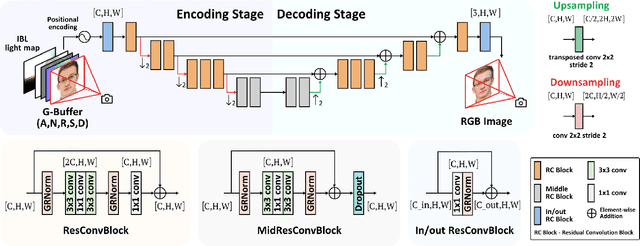
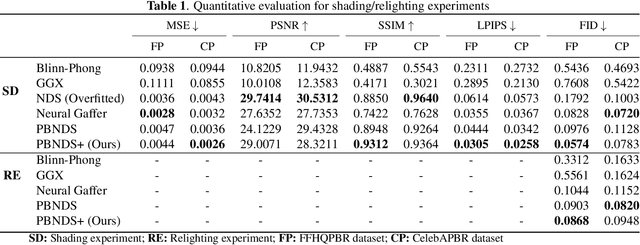

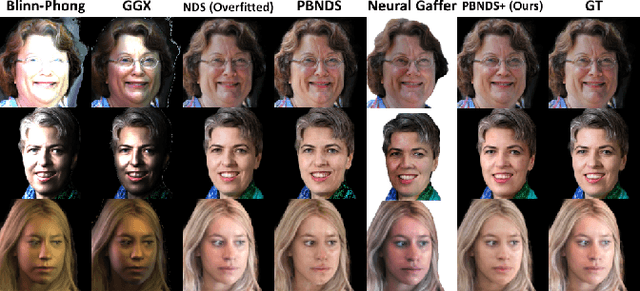
Recent advances in neural rendering have achieved impressive results on photorealistic shading and relighting, by using a multilayer perceptron (MLP) as a regression model to learn the rendering equation from a real-world dataset. Such methods show promise for photorealistically relighting real-world objects, which is difficult to classical rendering, as there is no easy-obtained material ground truth. However, significant challenges still remain the dense connections in MLPs result in a large number of parameters, which requires high computation resources, complicating the training, and reducing performance during rendering. Data driven approaches require large amounts of training data for generalization; unbalanced data might bias the model to ignore the unusual illumination conditions, e.g. dark scenes. This paper introduces pbnds+: a novel physics-based neural deferred shading pipeline utilizing convolution neural networks to decrease the parameters and improve the performance in shading and relighting tasks; Energy regularization is also proposed to restrict the model reflection during dark illumination. Extensive experiments demonstrate that our approach outperforms classical baselines, a state-of-the-art neural shading model, and a diffusion-based method.

Masked Generative Policy for Robotic Control
Dec 09, 2025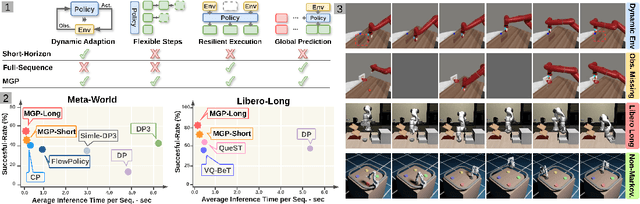
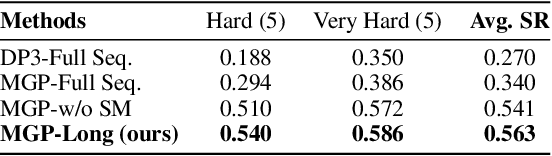
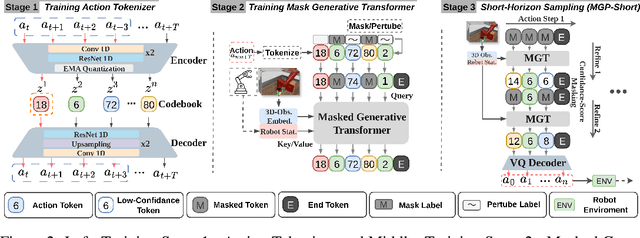

We present Masked Generative Policy (MGP), a novel framework for visuomotor imitation learning. We represent actions as discrete tokens, and train a conditional masked transformer that generates tokens in parallel and then rapidly refines only low-confidence tokens. We further propose two new sampling paradigms: MGP-Short, which performs parallel masked generation with score-based refinement for Markovian tasks, and MGP-Long, which predicts full trajectories in a single pass and dynamically refines low-confidence action tokens based on new observations. With globally coherent prediction and robust adaptive execution capabilities, MGP-Long enables reliable control on complex and non-Markovian tasks that prior methods struggle with. Extensive evaluations on 150 robotic manipulation tasks spanning the Meta-World and LIBERO benchmarks show that MGP achieves both rapid inference and superior success rates compared to state-of-the-art diffusion and autoregressive policies. Specifically, MGP increases the average success rate by 9% across 150 tasks while cutting per-sequence inference time by up to 35x. It further improves the average success rate by 60% in dynamic and missing-observation environments, and solves two non-Markovian scenarios where other state-of-the-art methods fail.
Can Real-to-Sim Approaches Capture Dynamic Fabric Behavior for Robotic Fabric Manipulation?
Mar 20, 2025This paper presents a rigorous evaluation of Real-to-Sim parameter estimation approaches for fabric manipulation in robotics. The study systematically assesses three state-of-the-art approaches, namely two differential pipelines and a data-driven approach. We also devise a novel physics-informed neural network approach for physics parameter estimation. These approaches are interfaced with two simulations across multiple Real-to-Sim scenarios (lifting, wind blowing, and stretching) for five different fabric types and evaluated on three unseen scenarios (folding, fling, and shaking). We found that the simulation engines and the choice of Real-to-Sim approaches significantly impact fabric manipulation performance in our evaluation scenarios. Moreover, PINN observes superior performance in quasi-static tasks but shows limitations in dynamic scenarios.
Flat'n'Fold: A Diverse Multi-Modal Dataset for Garment Perception and Manipulation
Sep 26, 2024


We present Flat'n'Fold, a novel large-scale dataset for garment manipulation that addresses critical gaps in existing datasets. Comprising 1,212 human and 887 robot demonstrations of flattening and folding 44 unique garments across 8 categories, Flat'n'Fold surpasses prior datasets in size, scope, and diversity. Our dataset uniquely captures the entire manipulation process from crumpled to folded states, providing synchronized multi-view RGB-D images, point clouds, and action data, including hand or gripper positions and rotations. We quantify the dataset's diversity and complexity compared to existing benchmarks and show that our dataset features natural and diverse manipulations of real-world demonstrations of human and robot demonstrations in terms of visual and action information. To showcase Flat'n'Fold's utility, we establish new benchmarks for grasping point prediction and subtask decomposition. Our evaluation of state-of-the-art models on these tasks reveals significant room for improvement. This underscores Flat'n'Fold's potential to drive advances in robotic perception and manipulation of deformable objects. Our dataset can be downloaded at https://cvas-ug.github.io/flat-n-fold