 Add to Chrome
 Add to Firefox
 Add to Edge
SAGE: Sequence-level Adaptive Gradient Evolution for Generative Recommendation
Jan 29, 2026
While works such as OneRec have validated the scaling laws of Large Language Models (LLMs) in recommender systems, they rely on a cumbersome separate vocabulary. This dependency prevents the model architecture from reusing native LLM vocabularies, resulting in high maintenance costs and poor scalability. In response, we aim to efficiently reuse open-source LLM architectures without constructing a separate tokenization vocabulary. Furthermore, we identify that the optimization strategy of OneRec Gradient Bounded Policy Optimization (GBPO),suffers from a "Symmetric Conservatism" problem: its static gradient boundaries structurally suppress the update momentum required for cold-start items and fail to prevent diversity collapse in high-noise environments.To address this issue, we propose SAGE (Sequence-level Adaptive Gradient Evolution), a unified optimization framework tailored for list-wise generative recommendation. SAGE introduces two key innovations:(1) Sequence-level Signal Decoupling: By combining a geometric mean importance ratio with decoupled multi-objective advantages, we eliminate token-level variance and resolve the "Reward Collapse" problem. (2) Asymmetric Adaptive Dynamics: We construct a dynamic gradient manifold that applies a "Boost Factor" to high-potential cold start items to achieve super-linear updates and employs an "Entropy Aware Penalty" to break information cocoons. Theoretical analysis and empirical results demonstrate that SAGE effectively unblocks cold-start traffic and sustains recommendation diversity, all while retaining the numerical stability of GBPO.

RecLLM-R1: A Two-Stage Training Paradigm with Reinforcement Learning and Chain-of-Thought v1
Jun 24, 2025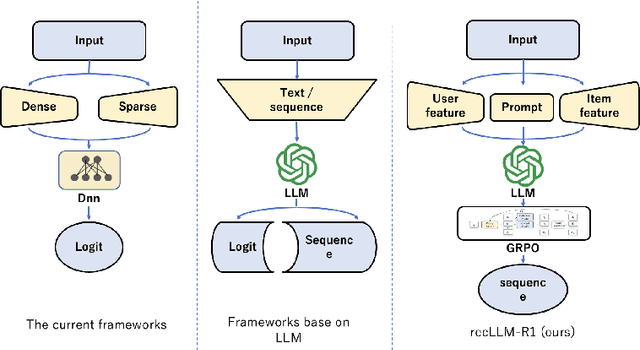
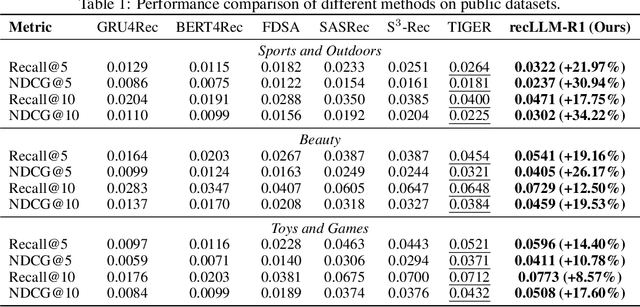
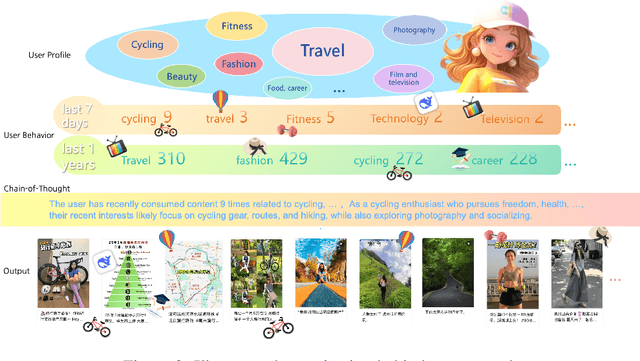

Traditional recommendation systems often grapple with "filter bubbles", underutilization of external knowledge, and a disconnect between model optimization and business policy iteration. To address these limitations, this paper introduces RecLLM-R1, a novel recommendation framework leveraging Large Language Models (LLMs) and drawing inspiration from the DeepSeek R1 methodology. The framework initiates by transforming user profiles, historical interactions, and multi-faceted item attributes into LLM-interpretable natural language prompts through a carefully engineered data construction process. Subsequently, a two-stage training paradigm is employed: the initial stage involves Supervised Fine-Tuning (SFT) to imbue the LLM with fundamental recommendation capabilities. The subsequent stage utilizes Group Relative Policy Optimization (GRPO), a reinforcement learning technique, augmented with a Chain-of-Thought (CoT) mechanism. This stage guides the model through multi-step reasoning and holistic decision-making via a flexibly defined reward function, aiming to concurrently optimize recommendation accuracy, diversity, and other bespoke business objectives. Empirical evaluations on a real-world user behavior dataset from a large-scale social media platform demonstrate that RecLLM-R1 significantly surpasses existing baseline methods across a spectrum of evaluation metrics, including accuracy, diversity, and novelty. It effectively mitigates the filter bubble effect and presents a promising avenue for the integrated optimization of recommendation models and policies under intricate business goals.