 Add to Chrome
 Add to Firefox
 Add to Edge
ISAAC: Auditing Causal Reasoning in Deep Models for Drug-Target Interaction
May 03, 2026
Deep learning models for drug--target interaction (DTI) prediction often achieve strong benchmark performance without necessarily relying on mechanistically meaningful molecular features, a limitation that standard accuracy-based evaluation cannot detect. We introduce ISAAC (Intervention-based Structural Auditing Approach for Causal Reasoning), a post-hoc framework that evaluates prior-relative structural sensitivity by probing frozen models through matched mechanistic and spurious input-level interventions, independently of predictive accuracy. Applied to three sequence-based DTI architectures on the Davis benchmark, ISAAC reveals approximately 25\% relative differences in reasoning scores across models with comparable AUROC (within around 3\%), stable across training and intervention seeds and two distinct perturbation operators. These discrepancies, undetectable under conventional accuracy metrics, motivate the use of post-hoc structural auditing as a complement to standard performance evaluation in scientific machine learning for molecular modeling.

CombiMOTS: Combinatorial Multi-Objective Tree Search for Dual-Target Molecule Generation
Apr 25, 2026Dual-target molecule generation, which focuses on discovering compounds capable of interacting with two target proteins, has garnered significant attention due to its potential for improving therapeutic efficiency, safety and resistance mitigation. Existing approaches face two critical challenges. First, by simplifying the complex dual-target optimization problem to scalarized combinations of individual objectives, they fail to capture important trade-offs between target engagement and molecular properties. Second, they typically do not integrate synthetic planning into the generative process. This highlights a need for more appropriate objective function design and synthesis-aware methodologies tailored to the dual-target molecule generation task. In this work, we propose CombiMOTS, a Pareto Monte Carlo Tree Search (PMCTS) framework that generates dual-target molecules. CombiMOTS is designed to explore a synthesizable fragment space while employing vectorized optimization constraints to encapsulate target affinity and physicochemical properties. Extensive experiments on real-world databases demonstrate that CombiMOTS produces novel dual-target molecules with high docking scores, enhanced diversity, and balanced pharmacological characteristics, showcasing its potential as a powerful tool for dual-target drug discovery. The code and data is accessible through https://github.com/Tibogoss/CombiMOTS.
* Accepted as a poster at ICML 2025 (Main Track)
Improving out-of-distribution generalization in graphs via hierarchical semantic environments
Mar 04, 2024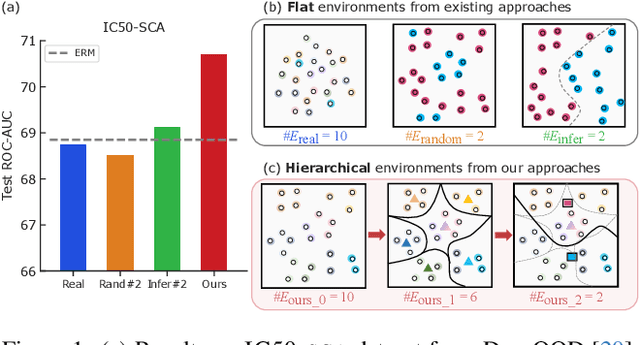
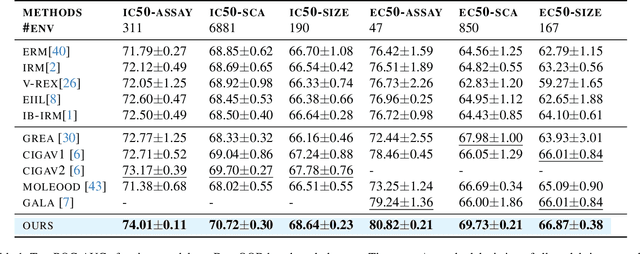
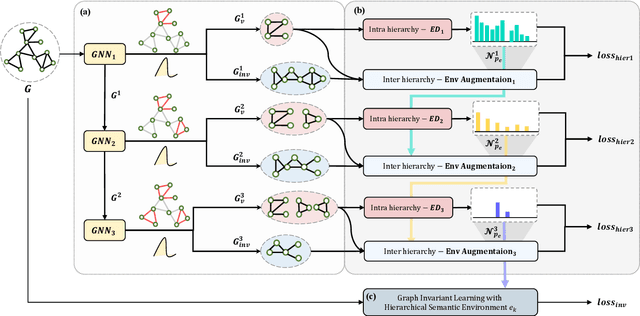
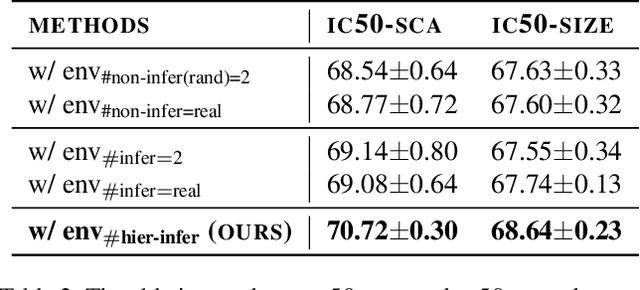
Out-of-distribution (OOD) generalization in the graph domain is challenging due to complex distribution shifts and a lack of environmental contexts. Recent methods attempt to enhance graph OOD generalization by generating flat environments. However, such flat environments come with inherent limitations to capture more complex data distributions. Considering the DrugOOD dataset, which contains diverse training environments (e.g., scaffold, size, etc.), flat contexts cannot sufficiently address its high heterogeneity. Thus, a new challenge is posed to generate more semantically enriched environments to enhance graph invariant learning for handling distribution shifts. In this paper, we propose a novel approach to generate hierarchical semantic environments for each graph. Firstly, given an input graph, we explicitly extract variant subgraphs from the input graph to generate proxy predictions on local environments. Then, stochastic attention mechanisms are employed to re-extract the subgraphs for regenerating global environments in a hierarchical manner. In addition, we introduce a new learning objective that guides our model to learn the diversity of environments within the same hierarchy while maintaining consistency across different hierarchies. This approach enables our model to consider the relationships between environments and facilitates robust graph invariant learning. Extensive experiments on real-world graph data have demonstrated the effectiveness of our framework. Particularly, in the challenging dataset DrugOOD, our method achieves up to 1.29\% and 2.83\% improvement over the best baselines on IC50 and EC50 prediction tasks, respectively.
Triangular Contrastive Learning on Molecular Graphs
May 26, 2022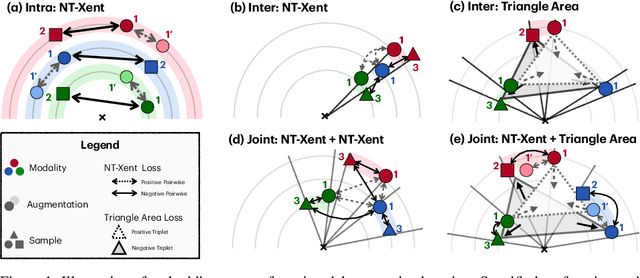
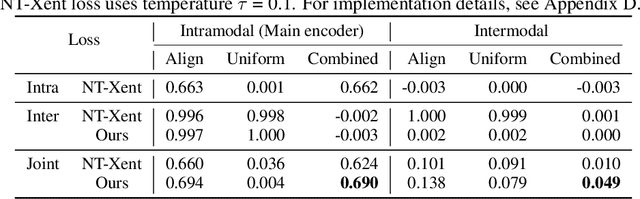
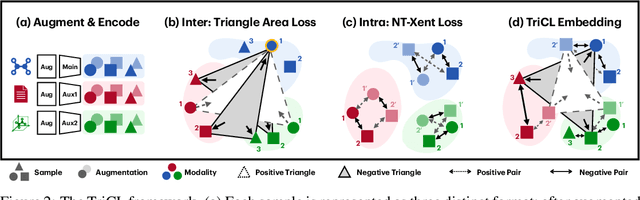
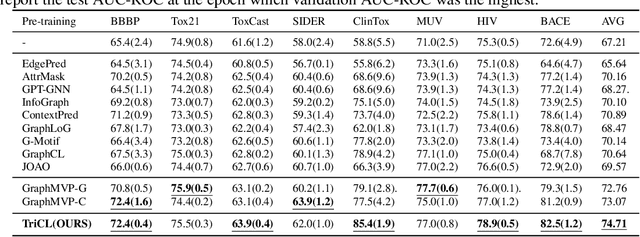
Recent contrastive learning methods have shown to be effective in various tasks, learning generalizable representations invariant to data augmentation thereby leading to state of the art performances. Regarding the multifaceted nature of large unlabeled data used in self-supervised learning while majority of real-word downstream tasks use single format of data, a multimodal framework that can train single modality to learn diverse perspectives from other modalities is an important challenge. In this paper, we propose TriCL (Triangular Contrastive Learning), a universal framework for trimodal contrastive learning. TriCL takes advantage of Triangular Area Loss, a novel intermodal contrastive loss that learns the angular geometry of the embedding space through simultaneously contrasting the area of positive and negative triplets. Systematic observation on embedding space in terms of alignment and uniformity showed that Triangular Area Loss can address the line-collapsing problem by discriminating modalities by angle. Our experimental results also demonstrate the outperformance of TriCL on downstream task of molecular property prediction which implies that the advantages of the embedding space indeed benefits the performance on downstream tasks.