 Add to Chrome
 Add to Firefox
 Add to Edge
Baichuan-M4: A Clinical-Grade Medical Agent System for Continuous Care
Jun 09, 2026
Baichuan-M4 is Baichuan Intelligence's clinical-grade medical large model, designed for continuous care rather than single-turn medical question answering. It is built as a coordinated medical agent system around three pillars: Baichuan-Harness, a unified runtime that keeps reinforcement-learning training and real-world deployment consistent while enforcing action constraints, tool use, long-term patient memory, and multi-agent coordination; a core reasoning model trained with a continuous-care reinforcement-learning framework that integrates span-level reward modeling (SPAR++), reasoning-path compression, curriculum learning, and stabilized policy optimization; and a clinical tool layer for patient-memory management, authoritative evidence-based retrieval, and multimodal medical perception across documents, X-rays, and dermatology. On a cross-dimensional medical evaluation suite, Baichuan-M4 attains leading results in static medical knowledge and safety, dynamic OSCE-style consultation, long-context clinical memory, evidence-based retrieval, medical document OCR, and multimodal image understanding, while lowering the hallucination rate to 3.3%.

LightHGNN: Distilling Hypergraph Neural Networks into MLPs for $100\times$ Faster Inference
Feb 18, 2024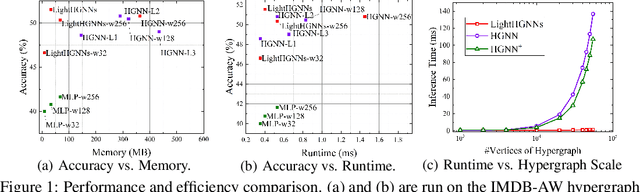
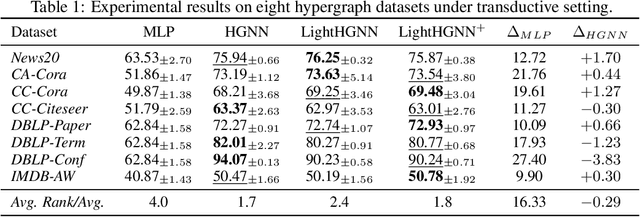


Hypergraph Neural Networks (HGNNs) have recently attracted much attention and exhibited satisfactory performance due to their superiority in high-order correlation modeling. However, it is noticed that the high-order modeling capability of hypergraph also brings increased computation complexity, which hinders its practical industrial deployment. In practice, we find that one key barrier to the efficient deployment of HGNNs is the high-order structural dependencies during inference. In this paper, we propose to bridge the gap between the HGNNs and inference-efficient Multi-Layer Perceptron (MLPs) to eliminate the hypergraph dependency of HGNNs and thus reduce computational complexity as well as improve inference speed. Specifically, we introduce LightHGNN and LightHGNN$^+$ for fast inference with low complexity. LightHGNN directly distills the knowledge from teacher HGNNs to student MLPs via soft labels, and LightHGNN$^+$ further explicitly injects reliable high-order correlations into the student MLPs to achieve topology-aware distillation and resistance to over-smoothing. Experiments on eight hypergraph datasets demonstrate that even without hypergraph dependency, the proposed LightHGNNs can still achieve competitive or even better performance than HGNNs and outperform vanilla MLPs by $16.3$ on average. Extensive experiments on three graph datasets further show the average best performance of our LightHGNNs compared with all other methods. Experiments on synthetic hypergraphs with 5.5w vertices indicate LightHGNNs can run $100\times$ faster than HGNNs, showcasing their ability for latency-sensitive deployments.