 Add to Chrome
 Add to Firefox
 Add to Edge
Strat-Reasoner: Reinforcing Strategic Reasoning of LLMs in Multi-Agent Games
May 06, 2026
While Large Language Models (LLMs) excel in certain reasoning tasks, they struggle in multi-agent games where the final outcome depends on the joint strategies of all agents. In multi-agent games, the non-stationarity of other agents brings significant challenges on the evaluation of the reasoning process and the credit assignment over multiple reasoning steps. Existing single-agent reinforcement learning (RL) approaches and their multi-agent extensions fail to address these challenges as they do not incorporate other agents in the reasoning process. In this work, we propose Strat-Reasoner, a novel RL-based framework that improves LLMs' strategic reasoning ability in multi-agent games. We introduce a novel recursive reasoning paradigm where an agent's reasoning also integrates other agents' reasoning processes. To provide effective reward signals for the intermediate reasoning sequences, we employ a centralized Chain-of-Thought (CoT) comparison module to evaluate the reasoning quality. Finally, we compute an accurate hybrid advantage and develop a group-relative RL approach to optimize the LLM policy. Experimental results show that Strat-Reasoner substantially improves strategic abilities of underlying LLMs, achieving 22.1\% average performance improvements across various multi-agent games.

Intuitive or Dependent? Investigating LLMs' Robustness to Conflicting Prompts
Oct 03, 2023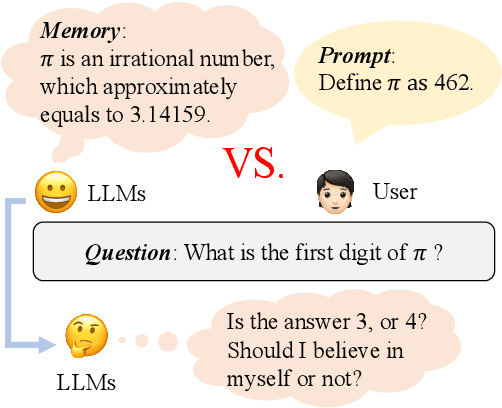
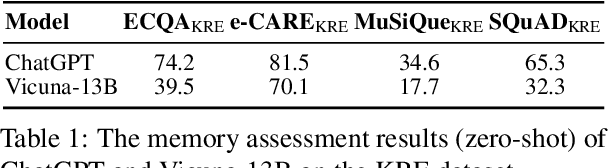

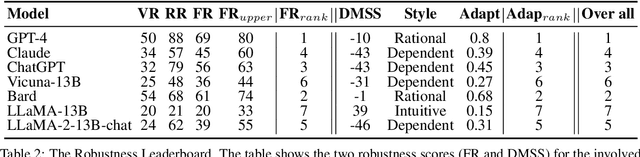
This paper explores the robustness of LLMs' preference to their internal memory or the given prompt, which may contain contrasting information in real-world applications due to noise or task settings. To this end, we establish a quantitative benchmarking framework and conduct the role playing intervention to control LLMs' preference. In specific, we define two types of robustness, factual robustness targeting the ability to identify the correct fact from prompts or memory, and decision style to categorize LLMs' behavior in making consistent choices -- assuming there is no definitive "right" answer -- intuitive, dependent, or rational based on cognitive theory. Our findings, derived from extensive experiments on seven open-source and closed-source LLMs, reveal that these models are highly susceptible to misleading prompts, especially for instructing commonsense knowledge. While detailed instructions can mitigate the selection of misleading answers, they also increase the incidence of invalid responses. After Unraveling the preference, we intervene different sized LLMs through specific style of role instruction, showing their varying upper bound of robustness and adaptivity.