 Add to Chrome
 Add to Firefox
 Add to Edge
Bridging battery design and health assessment through virtual sensing and physics-informed learning
Jul 18, 2026
Supercharging of lithium-ion batteries (LiBs) requires robust health monitoring to ensure durability, safety, and user confidence, particularly for emerging vehicle-to-grid applications with bidirectional energy flows. Yet battery management remains largely disconnected from the material and structural origins of aging, limiting both interpretable health assessment and informed battery design. Here we propose a physics-informed learning framework with virtual sensing that infers hard-to-measure design parameters, including solid-state diffusion coefficient, electrode thickness, ion concentration, and particle size, directly from standard battery management system (BMS) measurements. Across diverse fast-charging strategies and driving profiles, embedding a digital-twin-derived particle-cracking mechanism as a soft constraint reduces trajectory and lifetime prediction errors by 6-8 times relative to state-of-the-art machine learning baselines using only 2% early-life observations. We further show that accurate degradation extrapolation does not require fully resolved governing equations; validated partial mechanisms, jointly refined with limited data, provide sufficient guidance. Virtual sensing transforms standard charging signals into latent design variables without additional sensors, bridging observable battery behavior and underlying aging processes while reducing capacity loss error by up to 39%, end-of-life (EOL) error by 17%, and prediction variability by up to 54%, enabling real-time exploration of new battery configurations. More broadly, the proposed framework establishes a practical feedback loop between deployment and development, demonstrating how real-world operation can continuously inform upstream design decisions across complex multiphysics systems.

MINN: Learning the dynamics of differential-algebraic equations and application to battery modeling
Apr 27, 2023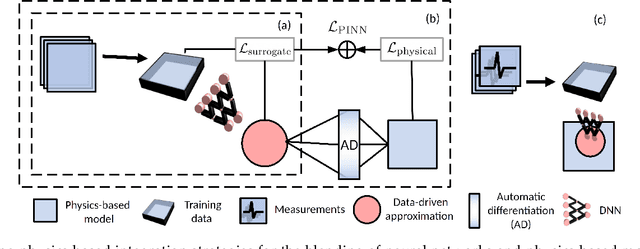
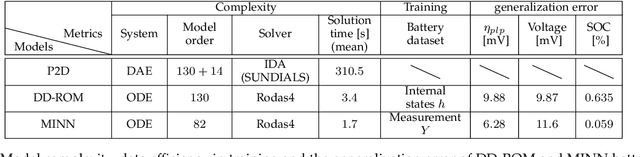

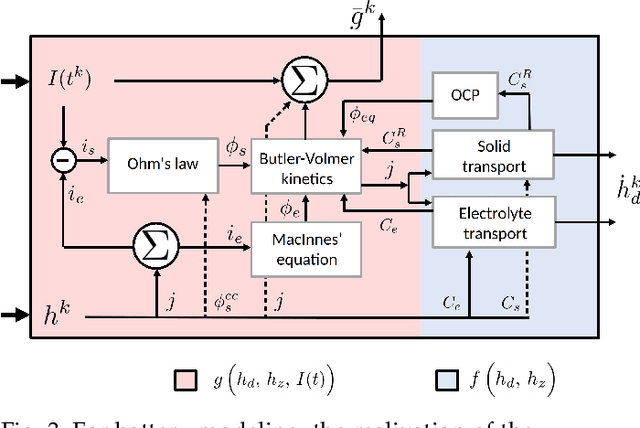
The concept of integrating physics-based and data-driven approaches has become popular for modeling sustainable energy systems. However, the existing literature mainly focuses on the data-driven surrogates generated to replace physics-based models. These models often trade accuracy for speed but lack the generalisability, adaptability, and interpretability inherent in physics-based models, which are often indispensable in the modeling of real-world dynamic systems for optimization and control purposes. In this work, we propose a novel architecture for generating model-integrated neural networks (MINN) to allow integration on the level of learning physics-based dynamics of the system. The obtained hybrid model solves an unsettled research problem in control-oriented modeling, i.e., how to obtain an optimally simplified model that is physically insightful, numerically accurate, and computationally tractable simultaneously. We apply the proposed neural network architecture to model the electrochemical dynamics of lithium-ion batteries and show that MINN is extremely data-efficient to train while being sufficiently generalizable to previously unseen input data, owing to its underlying physical invariants. The MINN battery model has an accuracy comparable to the first principle-based model in predicting both the system outputs and any locally distributed electrochemical behaviors but achieves two orders of magnitude reduction in the solution time.