 Add to Chrome
 Add to Firefox
 Add to Edge
Smark: A Watermark for Text-to-Speech Diffusion Models via Discrete Wavelet Transform
Dec 21, 2025
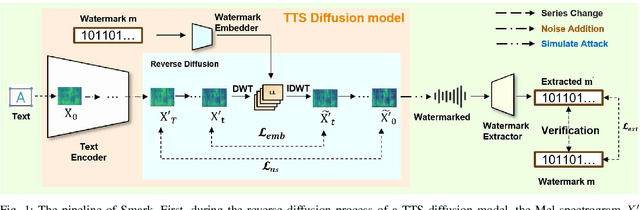
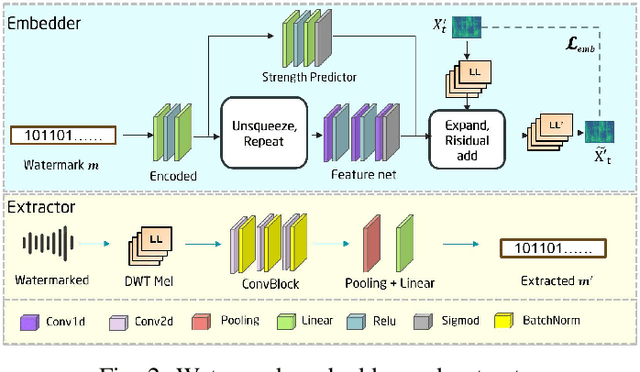
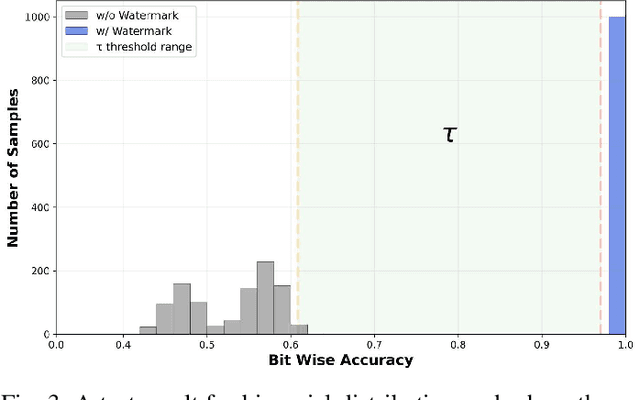
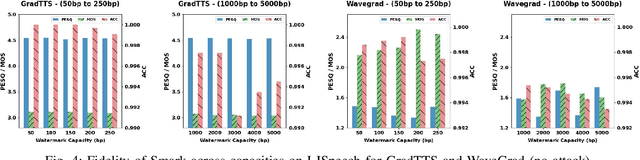
Text-to-Speech (TTS) diffusion models generate high-quality speech, which raises challenges for the model intellectual property protection and speech tracing for legal use. Audio watermarking is a promising solution. However, due to the structural differences among various TTS diffusion models, existing watermarking methods are often designed for a specific model and degrade audio quality, which limits their practical applicability. To address this dilemma, this paper proposes a universal watermarking scheme for TTS diffusion models, termed Smark. This is achieved by designing a lightweight watermark embedding framework that operates in the common reverse diffusion paradigm shared by all TTS diffusion models. To mitigate the impact on audio quality, Smark utilizes the discrete wavelet transform (DWT) to embed watermarks into the relatively stable low-frequency regions of the audio, which ensures seamless watermark-audio integration and is resistant to removal during the reverse diffusion process. Extensive experiments are conducted to evaluate the audio quality and watermark performance in various simulated real-world attack scenarios. The experimental results show that Smark achieves superior performance in both audio quality and watermark extraction accuracy.

The Theory and Algorithm of Ergodic Inference
Nov 17, 2018Approximate inference algorithm is one of the fundamental research fields in machine learning. The two dominant theoretical inference frameworks in machine learning are variational inference (VI) and Markov chain Monte Carlo (MCMC). However, because of the fundamental limitation in the theory, it is very challenging to improve existing VI and MCMC methods on both the computational scalability and statistical efficiency. To overcome this obstacle, we propose a new theoretical inference framework called ergodic Inference based on the fundamental property of ergodic transformations. The key contribution of this work is to establish the theoretical foundation of ergodic inference for the development of practical algorithms in future work.
Ergodic Measure Preserving Flows
Aug 13, 2018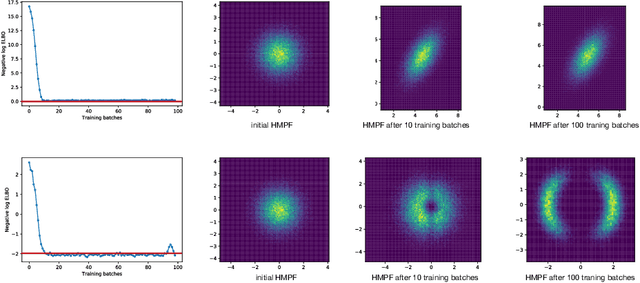
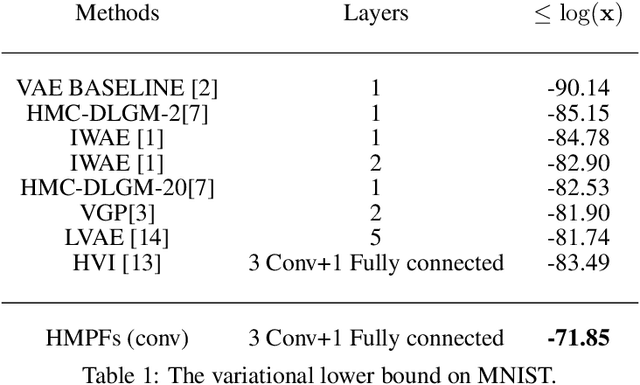
Probabilistic modelling is a general and elegant framework to capture the uncertainty, ambiguity and diversity of data. Probabilistic inference is the core technique for developing training and simulation algorithms on probabilistic models. However, the classic inference methods, like Markov chain Monte Carlo (MCMC) methods and mean-field variational inference (VI), are not computationally scalable for the recent developed probabilistic models with neural networks (NNs). This motivates many recent works on improving classic inference methods using NNs, especially, NN empowered VI. However, even with powerful NNs, VI still suffers its fundamental limitations. In this work, we propose a novel computational scalable general inference framework. With the theoretical foundation in ergodic theory, the proposed methods are not only computationally scalable like NN-based VI methods but also asymptotically accurate like MCMC. We test our method on popular benchmark problems and the results suggest that our methods can outperform NN-based VI and MCMC on deep generative models and Bayesian neural networks.
Semi-Separable Hamiltonian Monte Carlo for Inference in Bayesian Hierarchical Models
Jun 15, 2014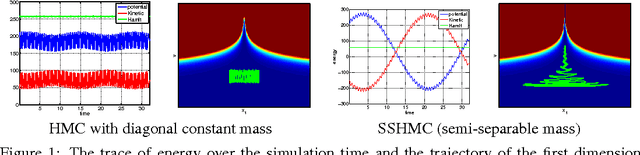


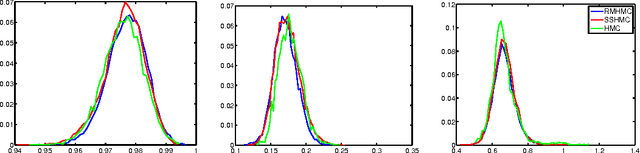
Sampling from hierarchical Bayesian models is often difficult for MCMC methods, because of the strong correlations between the model parameters and the hyperparameters. Recent Riemannian manifold Hamiltonian Monte Carlo (RMHMC) methods have significant potential advantages in this setting, but are computationally expensive. We introduce a new RMHMC method, which we call semi-separable Hamiltonian Monte Carlo, which uses a specially designed mass matrix that allows the joint Hamiltonian over model parameters and hyperparameters to decompose into two simpler Hamiltonians. This structure is exploited by a new integrator which we call the alternating blockwise leapfrog algorithm. The resulting method can mix faster than simpler Gibbs sampling while being simpler and more efficient than previous instances of RMHMC.