 Add to Chrome
 Add to Firefox
 Add to Edge
Long-Horizon Geometry-Aware Navigation among Polytopes via MILP-MPC and Minkowski-Based CBFs
Mar 31, 2026
Autonomous navigation in complex, non-convex environments remains challenging when robot dynamics, control limits, and exact robot geometry must all be taken into account. In this paper, we propose a hierarchical planning and control framework that bridges long-horizon guidance and geometry-aware safety guarantees for a polytopic robot navigating among polytopic obstacles. At the high level, Mixed-Integer Linear Programming (MILP) is embedded within a Model Predictive Control (MPC) framework to generate a nominal trajectory around polytopic obstacles while modeling the robot as a point mass for computational tractability. At the low level, we employ a control barrier function (CBF) based on the exact signed distance in the Minkowski-difference space as a safety filter to explicitly enforce the geometric constraints of the robot shape, and further extend its formulation to a high-order CBF (HOCBF). We demonstrate the proposed framework in U-shaped and maze-like environments under single- and double-integrator dynamics. The results show that the proposed architecture mitigates the topology-induced local-minimum behavior of purely reactive CBF-based navigation while enabling safe, real-time, geometry-aware navigation.

Control Barrier Functions via Minkowski Operations for Safe Navigation among Polytopic Sets
Apr 01, 2025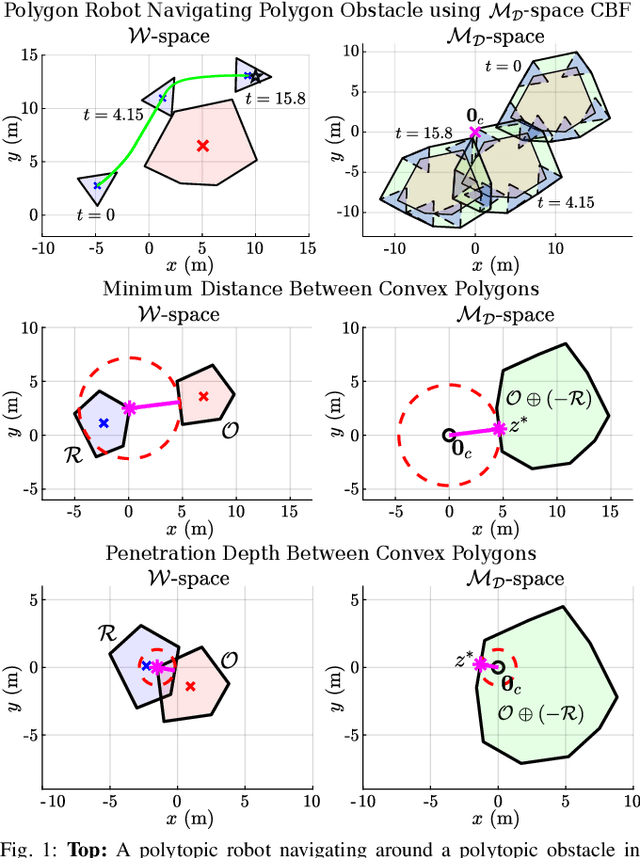
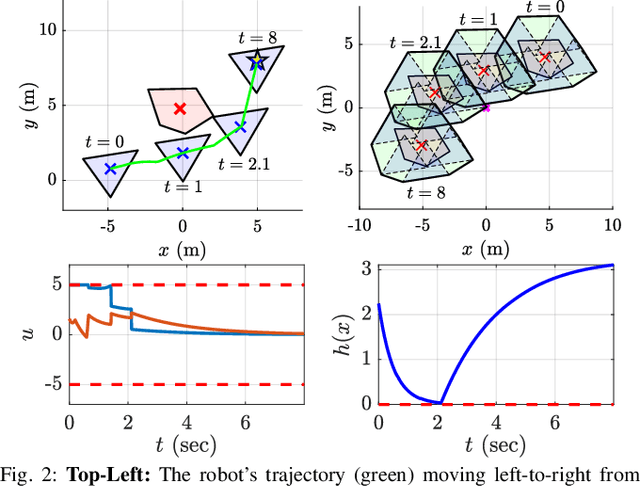
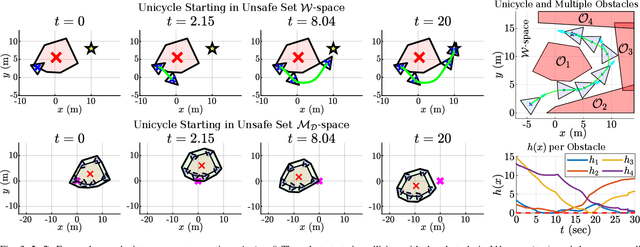
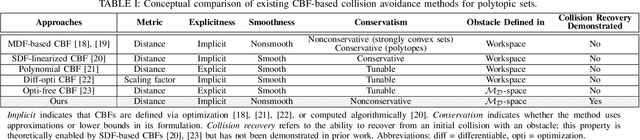
Safely navigating around obstacles while respecting the dynamics, control, and geometry of the underlying system is a key challenge in robotics. Control Barrier Functions (CBFs) generate safe control policies by considering system dynamics and geometry when calculating safe forward-invariant sets. Existing CBF-based methods often rely on conservative shape approximations, like spheres or ellipsoids, which have explicit and differentiable distance functions. In this paper, we propose an optimization-defined CBF that directly considers the exact Signed Distance Function (SDF) between a polytopic robot and polytopic obstacles. Inspired by the Gilbert-Johnson-Keerthi (GJK) algorithm, we formulate both (i) minimum distance and (ii) penetration depth between polytopic sets as convex optimization problems in the space of Minkowski difference operations (the MD-space). Convenient geometric properties of the MD-space enable the derivatives of implicit SDF between two polytopes to be computed via differentiable optimization. We demonstrate the proposed framework in three scenarios including pure translation, initialization inside an unsafe set, and multi-obstacle avoidance. These three scenarios highlight the generation of a non-conservative maneuver, a recovery after starting in collision, and the consideration of multiple obstacles via pairwise CBF constraint, respectively.