 Add to Chrome
 Add to Firefox
 Add to Edge
Random Coordinate Descent on the Wasserstein Space of Probability Measures
Apr 02, 2026
Optimization over the space of probability measures endowed with the Wasserstein-2 geometry is central to modern machine learning and mean-field modeling. However, traditional methods relying on full Wasserstein gradients often suffer from high computational overhead in high-dimensional or ill-conditioned settings. We propose a randomized coordinate descent framework specifically designed for the Wasserstein manifold, introducing both Random Wasserstein Coordinate Descent (RWCD) and Random Wasserstein Coordinate Proximal{-Gradient} (RWCP) for composite objectives. By exploiting coordinate-wise structures, our methods adapt to anisotropic objective landscapes where full-gradient approaches typically struggle. We provide a rigorous convergence analysis across various landscape geometries, establishing guarantees under non-convex, Polyak-Łojasiewicz, and geodesically convex conditions. Our theoretical results mirror the classic convergence properties found in Euclidean space, revealing a compelling symmetry between coordinate descent on vectors and on probability measures. The developed techniques are inherently adaptive to the Wasserstein geometry and offer a robust analytical template that can be extended to other optimization solvers within the space of measures. Numerical experiments on ill-conditioned energies demonstrate that our framework offers significant speedups over conventional full-gradient methods.

Forward-Euler time-discretization for Wasserstein gradient flows can be wrong
Jun 12, 2024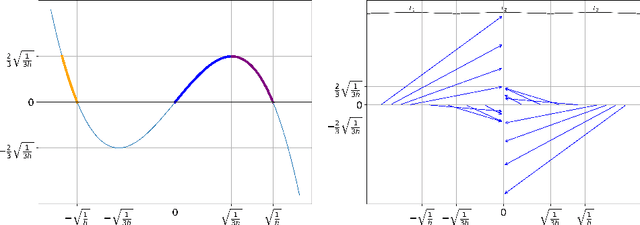
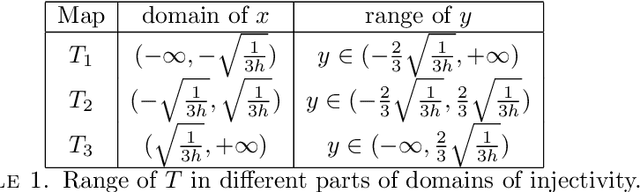

In this note, we examine the forward-Euler discretization for simulating Wasserstein gradient flows. We provide two counter-examples showcasing the failure of this discretization even for a simple case where the energy functional is defined as the KL divergence against some nicely structured probability densities. A simple explanation of this failure is also discussed.
Correcting auto-differentiation in neural-ODE training
Jun 03, 2023Does the use of auto-differentiation yield reasonable updates to deep neural networks that represent neural ODEs? Through mathematical analysis and numerical evidence, we find that when the neural network employs high-order forms to approximate the underlying ODE flows (such as the Linear Multistep Method (LMM)), brute-force computation using auto-differentiation often produces non-converging artificial oscillations. In the case of Leapfrog, we propose a straightforward post-processing technique that effectively eliminates these oscillations, rectifies the gradient computation and thus respects the updates of the underlying flow.