 Add to Chrome
 Add to Firefox
 Add to Edge
MAD: Microenvironment-Aware Distillation -- A Pretraining Strategy for Virtual Spatial Omics from Microscopy
Mar 11, 2026
Bridging microscopy and omics would allow us to read molecular states from images-at single-cell resolution and tissue scale-without the cost and throughput limits of omics technologies. Self-supervised pretraining offers a scalable approach with minimal labels, yet how to encode single-cell identity within tissue environments-and the extent of biological information such models can capture-remains an open question. Here, we introduce MAD (microenvironment-aware distillation), a pretraining strategy that learns cell-centric embeddings by jointly self-distilling the morphology view and the microenvironment view of the same indexed cell into a unified embedding space. Across diverse tissues and imaging modalities, MAD achieves state-of-the-art prediction performance on downstream tasks including cell subtyping, transcriptomic prediction, and bioinformatic inference. MAD even outperforms foundation models with a similar number of model parameters that have been trained on substantially larger datasets. These results demonstrate that MAD's dual-view joint self-distillation effectively captures the complexity and diversity of cells within tissues. Together, this establishes MAD as a general tool for representation learning in microscopy, enabling virtual spatial omics and biological insights from vast microscopy datasets.

PINNet: a deep neural network with pathway prior knowledge for Alzheimer's disease
Nov 27, 2022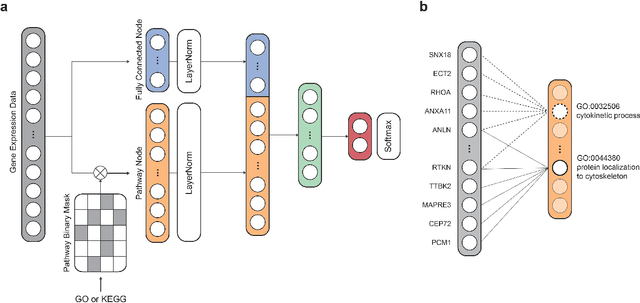

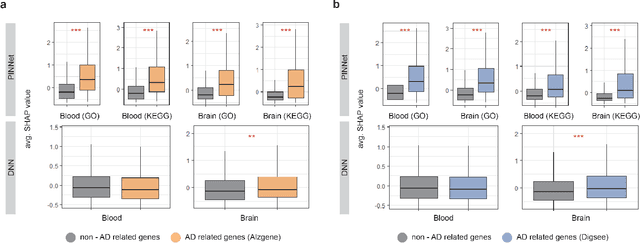

Identification of Alzheimer's Disease (AD)-related transcriptomic signatures from blood is important for early diagnosis of the disease. Deep learning techniques are potent classifiers for AD diagnosis, but most have been unable to identify biomarkers because of their lack of interpretability. To address these challenges, we propose a pathway information-based neural network (PINNet) to predict AD patients and analyze blood and brain transcriptomic signatures using an interpretable deep learning model. PINNet is a deep neural network (DNN) model with pathway prior knowledge from either the Gene Ontology or Kyoto Encyclopedia of Genes and Genomes databases. Then, a backpropagation-based model interpretation method was applied to reveal essential pathways and genes for predicting AD. We compared the performance of PINNet with a DNN model without a pathway. Performances of PINNet outperformed or were similar to those of DNN without a pathway using blood and brain gene expressions, respectively. Moreover, PINNet considers more AD-related genes as essential features than DNN without a pathway in the learning process. Pathway analysis of protein-protein interaction modules of highly contributed genes showed that AD-related genes in blood were enriched with cell migration, PI3K-Akt, MAPK signaling, and apoptosis in blood. The pathways enriched in the brain module included cell migration, PI3K-Akt, MAPK signaling, apoptosis, protein ubiquitination, and t-cell activation. Collectively, with prior knowledge about pathways, PINNet reveals essential pathways related to AD.