 Add to Chrome
 Add to Firefox
 Add to Edge
Seeing What Matters: Perceptual Wrapper with Common Randomness for 3D Gaussian Splatting
Jun 10, 2026
While 3D Gaussian Splatting (3DGS) achieves impressive real-time rendering, it frequently struggles to synthesize high-frequency textures, a limitation heavily exacerbated in memory-constrained and rate-distortion-optimized (RDO) pipelines. To address this, we propose a versatile 2D perceptual wrapper that enhances the rendered outputs of existing 3DGS representations in a content- and view-dependent manner. Our method leverages a lightweight synthesis network conditioned on pseudo-random Gaussian noise to synthesize perceptually plausible textures. Supervised by Wasserstein Distortion, the network learns to match local feature statistics rather than strictly enforcing pixel-wise reconstruction fidelity, effectively mitigating the blurriness inherent in standard frameworks. We demonstrate the broad applicability of our plug-and-play approach across vanilla, memory-constrained, and RDO 3DGS methods. Comprehensive subjective and objective experiments confirm that our method significantly improves over existing baselines, yielding superior perceptual quality at sharply reduced file or model sizes.

Exploring Autoregressive Vision Foundation Models for Image Compression
Sep 05, 2025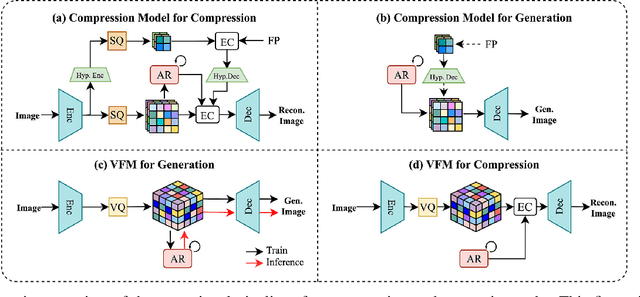
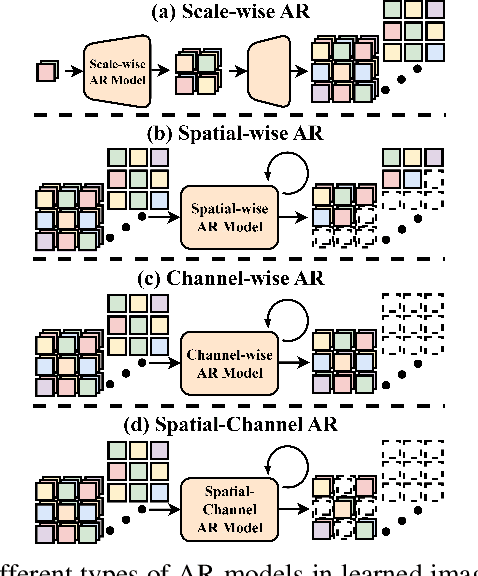
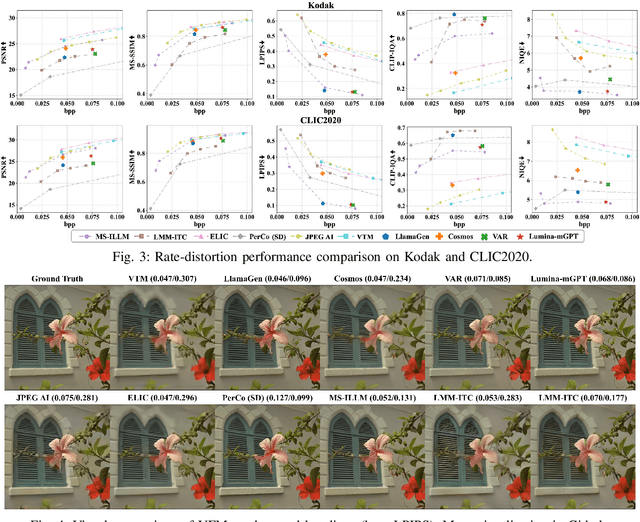
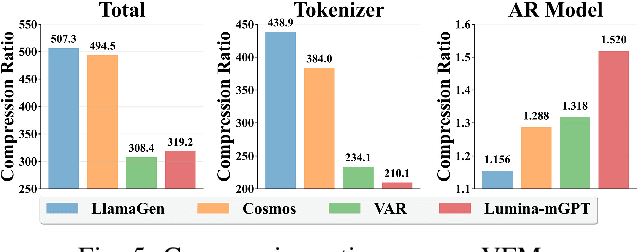
This work presents the first attempt to repurpose vision foundation models (VFMs) as image codecs, aiming to explore their generation capability for low-rate image compression. VFMs are widely employed in both conditional and unconditional generation scenarios across diverse downstream tasks, e.g., physical AI applications. Many VFMs employ an encoder-decoder architecture similar to that of end-to-end learned image codecs and learn an autoregressive (AR) model to perform next-token prediction. To enable compression, we repurpose the AR model in VFM for entropy coding the next token based on previously coded tokens. This approach deviates from early semantic compression efforts that rely solely on conditional generation for reconstructing input images. Extensive experiments and analysis are conducted to compare VFM-based codec to current SOTA codecs optimized for distortion or perceptual quality. Notably, certain pre-trained, general-purpose VFMs demonstrate superior perceptual quality at extremely low bitrates compared to specialized learned image codecs. This finding paves the way for a promising research direction that leverages VFMs for low-rate, semantically rich image compression.