 Add to Chrome
 Add to Firefox
 Add to Edge
Pragmatic Attack Surface: Vulnerabilities of Implicit Context in Large Language Models
Aug 10, 2026
In the era of large language models (LLMs), attackers often manipulate natural language to elicit unsafe or harmful outputs, creating a new natural language attack surface unique to LLM-based systems, where attacks directly exploit explicit linguistic cues in user prompts to bypass the safety mechanism of LLMs. However, such attacks can often be mitigated by existing safety alignment algorithms. On the other hand, human language is inherently grounded in pragmatics, necessitating typical context to interpret language, e.g., world knowledge, social norms. However, such contexts are often implicit because they are not directly expressed in human language and are not sufficiently leveraged in safety alignment, creating a fundamental mismatch between human language interpretation and safety alignment approaches. In this paper, we demonstrate that this mismatch exposes vulnerabilities in LLMs. We refer to this vulnerability as the pragmatic attack surface, which can be exploited to achieve high attack success rates. The experimental results demonstrate that our proposed approach outperforms baseline attack methods across various open-source and closed-source models by a substantial margin.

From Fake Focus to Real Precision: Confusion-Driven Adversarial Attention Learning in Transformers
Dec 19, 2025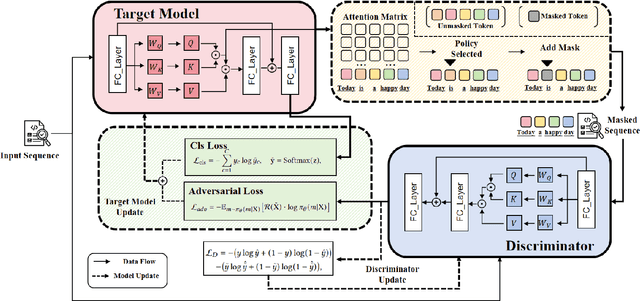
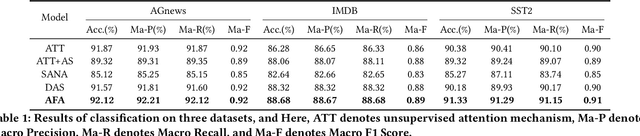

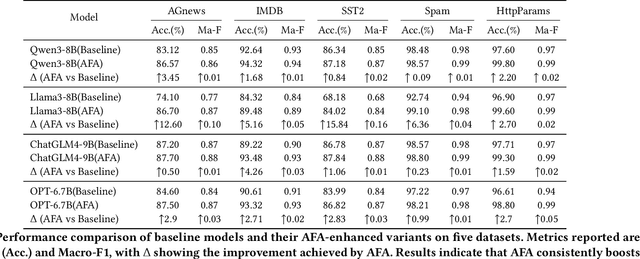
Transformer-based models have been widely adopted for sentiment analysis tasks due to their exceptional ability to capture contextual information. However, these methods often exhibit suboptimal accuracy in certain scenarios. By analyzing their attention distributions, we observe that existing models tend to allocate attention primarily to common words, overlooking less popular yet highly task-relevant terms, which significantly impairs overall performance. To address this issue, we propose an Adversarial Feedback for Attention(AFA) training mechanism that enables the model to automatically redistribute attention weights to appropriate focal points without requiring manual annotations. This mechanism incorporates a dynamic masking strategy that attempts to mask various words to deceive a discriminator, while the discriminator strives to detect significant differences induced by these masks. Additionally, leveraging the sensitivity of Transformer models to token-level perturbations, we employ a policy gradient approach to optimize attention distributions, which facilitates efficient and rapid convergence. Experiments on three public datasets demonstrate that our method achieves state-of-the-art results. Furthermore, applying this training mechanism to enhance attention in large language models yields a further performance improvement of 12.6%