 Add to Chrome
 Add to Firefox
 Add to Edge
Opportunistic Network-Level ISAC with Cooperative Sensing: A Meta-Distribution Analysis
Apr 07, 2026
We propose a cooperative sensing framework for mmWave ISAC networks in which a target is sensed by its nearest BS while opportunistically exploiting bistatic echoes from neighboring BSs. Cooperation requires no dedicated resources or exchange of sensing results, and is realized via non-coherent echo-power combining. Using stochastic geometry, we characterize sensing/communication coverage and rates and, for the first time, the cooperative sensing meta-distribution to quantify reliability across targets. Results show substantial sensing gains with limited communication loss and improved high-reliability tail, increasing the fraction of targets meeting stringent reliability guarantees crucial for safety-critical applications.

Ultra-Reliable Device-Centric Uplink Communications in Airborne Networks: A Spatiotemporal Analysis
Feb 26, 2023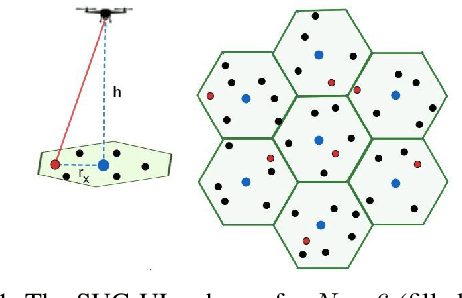
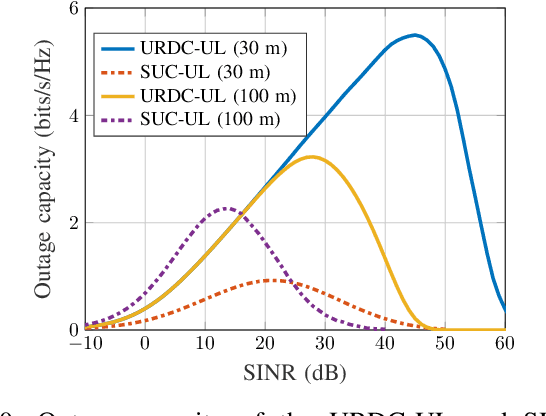
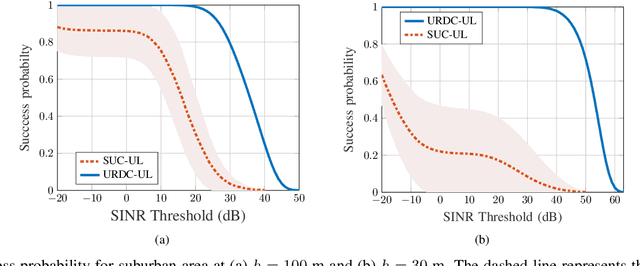
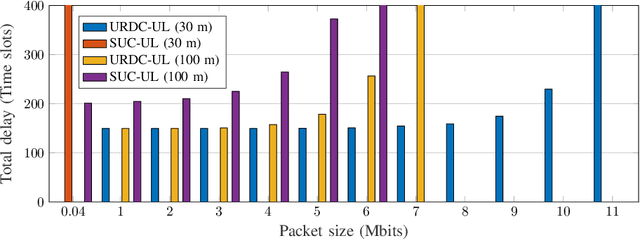
This paper proposes an ultra-reliable device-centric uplink (URDC-UL) communication scheme for airborne networks. In particular, base stations (BSs) are mounted on unmanned aerial vehicles (UAVs) that travel to schedule UL transmissions and collect data from devices. To attain an ultra-reliable unified device-centric performance, the UL connection is established when the UAV-BS is hovering at the nearest possible distance from the scheduled device. The performance of the proposed URDC-UL scheme is benchmarked against a stationary UAV-centric uplink (SUC-UL) scheme where the devices are scheduled to communicate to UAV-BSs that are continuously hovering at static locations. Utilizing stochastic geometry and queueing theory, novel spatiotemporal mathematical models are developed, which account for the UAV-BS spatial densities, mobility, altitude, antenna directivity, ground-to-air channel, and temporal traffic, among other factors. The results demonstrate the sensitivity of the URDC-UL scheme to the ratio between hovering and traveling time. In particular, the hovering to traveling time ratio should be carefully adjusted to maximize the harvested performance gains for the URDC-UL scheme in terms of link reliability, transmission rate, energy efficiency, and delay. Exploiting the URDC-UL scheme allows IoT devices to minimize transmission power while maintaining unified reliable transmission. This preserves the device's battery and addresses a critical IoT design challenge.