 Add to Chrome
 Add to Firefox
 Add to Edge
A Unified Framework for Multimodal Image Reconstruction and Synthesis using Denoising Diffusion Models
Feb 09, 2026
Image reconstruction and image synthesis are important for handling incomplete multimodal imaging data, but existing methods require various task-specific models, complicating training and deployment workflows. We introduce Any2all, a unified framework that addresses this limitation by formulating these disparate tasks as a single virtual inpainting problem. We train a single, unconditional diffusion model on the complete multimodal data stack. This model is then adapted at inference time to ``inpaint'' all target modalities from any combination of inputs of available clean images or noisy measurements. We validated Any2all on a PET/MR/CT brain dataset. Our results show that Any2all can achieve excellent performance on both multimodal reconstruction and synthesis tasks, consistently yielding images with competitive distortion-based performance and superior perceptual quality over specialized methods.

Self-Supervised Deep Equilibrium Models for Inverse Problems with Theoretical Guarantees
Oct 07, 2022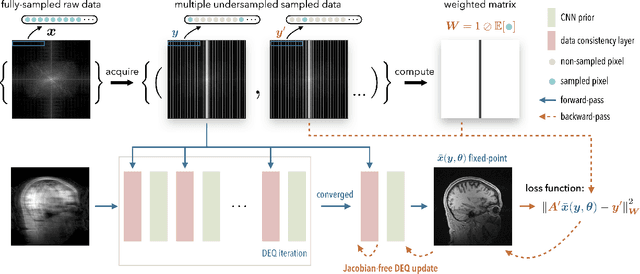
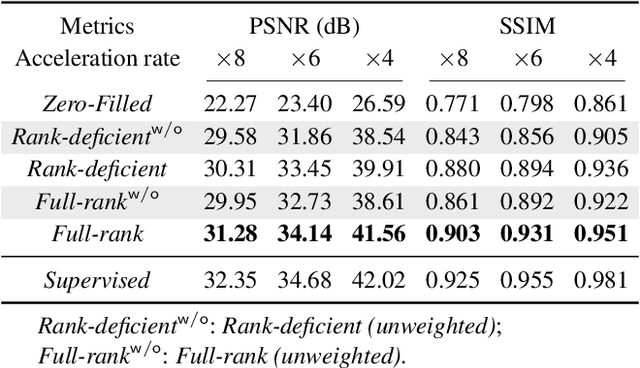
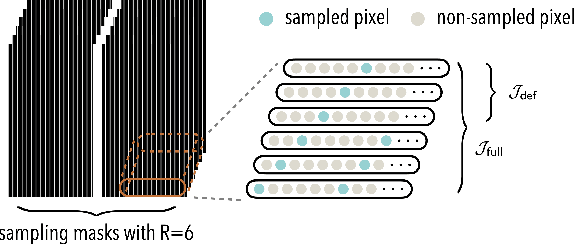
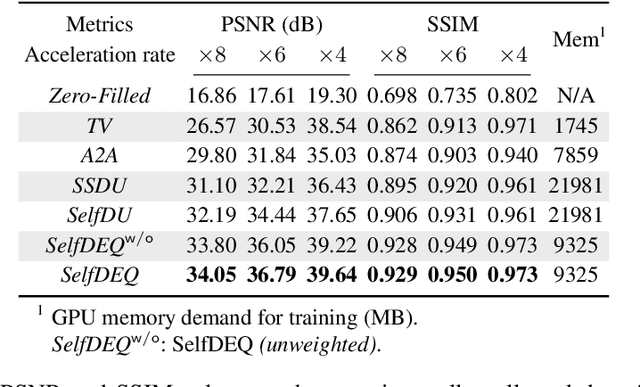
Deep equilibrium models (DEQ) have emerged as a powerful alternative to deep unfolding (DU) for image reconstruction. DEQ models-implicit neural networks with effectively infinite number of layers-were shown to achieve state-of-the-art image reconstruction without the memory complexity associated with DU. While the performance of DEQ has been widely investigated, the existing work has primarily focused on the settings where groundtruth data is available for training. We present self-supervised deep equilibrium model (SelfDEQ) as the first self-supervised reconstruction framework for training model-based implicit networks from undersampled and noisy MRI measurements. Our theoretical results show that SelfDEQ can compensate for unbalanced sampling across multiple acquisitions and match the performance of fully supervised DEQ. Our numerical results on in-vivo MRI data show that SelfDEQ leads to state-of-the-art performance using only undersampled and noisy training data.
SPICE: Self-Supervised Learning for MRI with Automatic Coil Sensitivity Estimation
Oct 05, 2022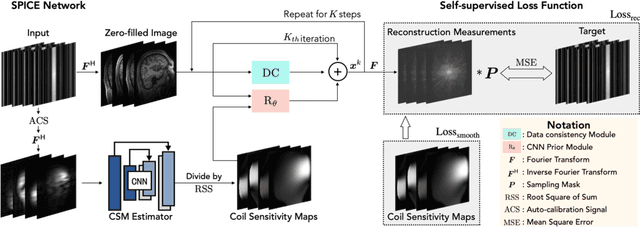
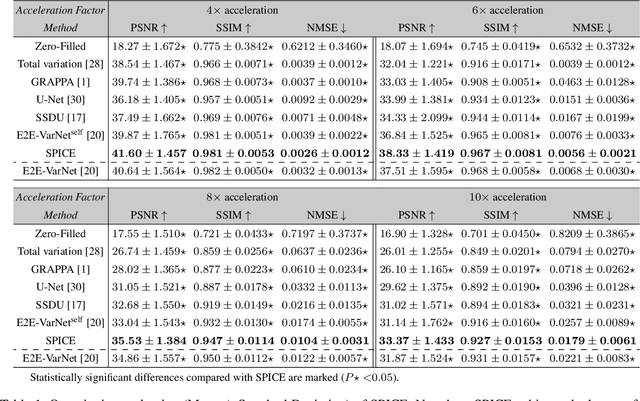
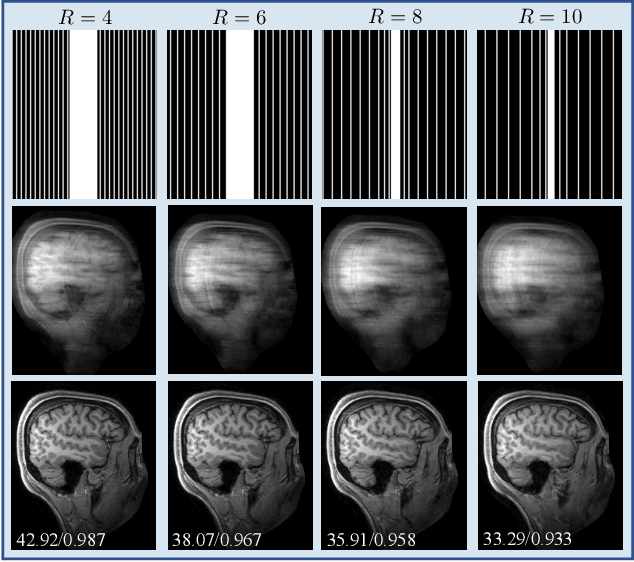
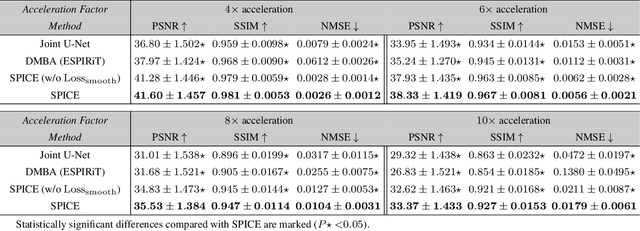
Deep model-based architectures (DMBAs) integrating physical measurement models and learned image regularizers are widely used in parallel magnetic resonance imaging (PMRI). Traditional DMBAs for PMRI rely on pre-estimated coil sensitivity maps (CSMs) as a component of the measurement model. However, estimation of accurate CSMs is a challenging problem when measurements are highly undersampled. Additionally, traditional training of DMBAs requires high-quality groundtruth images, limiting their use in applications where groundtruth is difficult to obtain. This paper addresses these issues by presenting SPICE as a new method that integrates self-supervised learning and automatic coil sensitivity estimation. Instead of using pre-estimated CSMs, SPICE simultaneously reconstructs accurate MR images and estimates high-quality CSMs. SPICE also enables learning from undersampled noisy measurements without any groundtruth. We validate SPICE on experimentally collected data, showing that it can achieve state-of-the-art performance in highly accelerated data acquisition settings (up to 10x).