 Add to Chrome
 Add to Firefox
 Add to Edge
DBLP: Phase-Aware Bounded-Loss Transport for Burst-Resilient Distributed ML Training
May 03, 2026
Distributed machine learning (ML) training has become a necessity with the prevalence of billion to trillion-parameter-scale models. While prior work has improved training efficiency from the ML perspective at the application layer, it often fails to address transient congestion events at the network layer that introduce severe tail latency and training-time variability, thereby undermining the quality of service (QoS) of distributed ML training systems. Existing network optimizations treat all gradients equally and thus fail to integrate sufficient model-training insights into communication protocol design. In this paper, we present Dynamic Bounded-Loss Protocol (DBLP), a burst-resilient, training-phase-aware, and hardware-agnostic transport protocol that incorporates model-level tolerance properties into gradient communication. By dynamically adjusting gradient loss tolerance across training phases, DBLP reduces overall training time and mitigates tail-latency collapse during transient high-loss events (i.e., microbursts). Compared to the current state-of-the-art solution (baseline), DBLP tolerates significantly higher loss while achieving comparable test accuracy, and reduces end-to-end training time by an average of 24.4% and a maximum of 33.9%. At microburst events, DBLP achieves up to 5.88x single-round communication latency speedups over the baseline, preventing burst-induced tail-latency spikes and maintaining stable training performance.

A Deep Reinforcement Learning Framework for Optimizing Congestion Control in Data Centers
Jan 29, 2023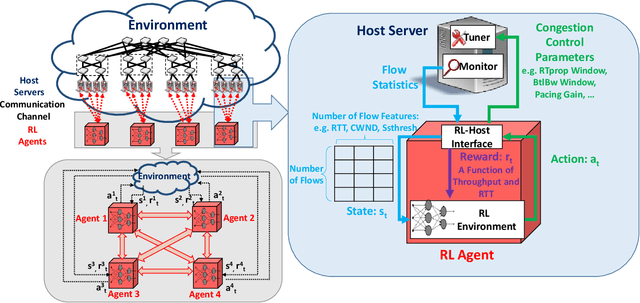
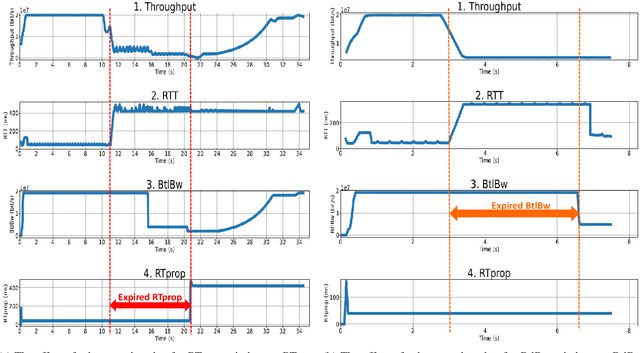
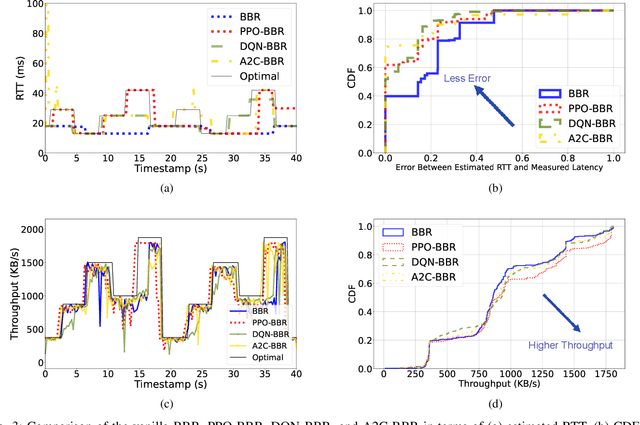
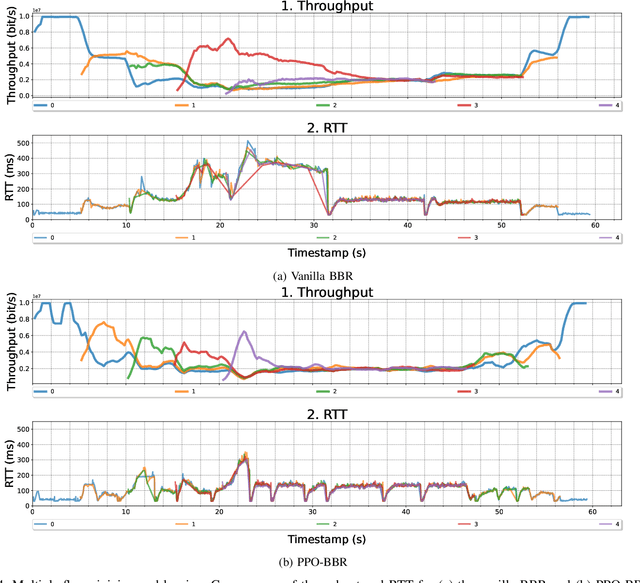
Various congestion control protocols have been designed to achieve high performance in different network environments. Modern online learning solutions that delegate the congestion control actions to a machine cannot properly converge in the stringent time scales of data centers. We leverage multiagent reinforcement learning to design a system for dynamic tuning of congestion control parameters at end-hosts in a data center. The system includes agents at the end-hosts to monitor and report the network and traffic states, and agents to run the reinforcement learning algorithm given the states. Based on the state of the environment, the system generates congestion control parameters that optimize network performance metrics such as throughput and latency. As a case study, we examine BBR, an example of a prominent recently-developed congestion control protocol. Our experiments demonstrate that the proposed system has the potential to mitigate the problems of static parameters.