 Add to Chrome
 Add to Firefox
 Add to Edge
LLM-YOLOMS: Large Language Model-based Semantic Interpretation and Fault Diagnosis for Wind Turbine Components
Nov 13, 2025
The health condition of wind turbine (WT) components is crucial for ensuring stable and reliable operation. However, existing fault detection methods are largely limited to visual recognition, producing structured outputs that lack semantic interpretability and fail to support maintenance decision-making. To address these limitations, this study proposes an integrated framework that combines YOLOMS with a large language model (LLM) for intelligent fault analysis and diagnosis. Specifically, YOLOMS employs multi-scale detection and sliding-window cropping to enhance fault feature extraction, while a lightweight key-value (KV) mapping module bridges the gap between visual outputs and textual inputs. This module converts YOLOMS detection results into structured textual representations enriched with both qualitative and quantitative attributes. A domain-tuned LLM then performs semantic reasoning to generate interpretable fault analyses and maintenance recommendations. Experiments on real-world datasets demonstrate that the proposed framework achieves a fault detection accuracy of 90.6\% and generates maintenance reports with an average accuracy of 89\%, thereby improving the interpretability of diagnostic results and providing practical decision support for the operation and maintenance of wind turbines.

Hyper-parameter estimation method with particle swarm optimization
Dec 14, 2020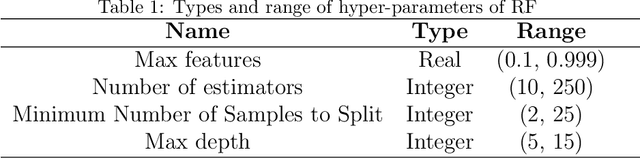
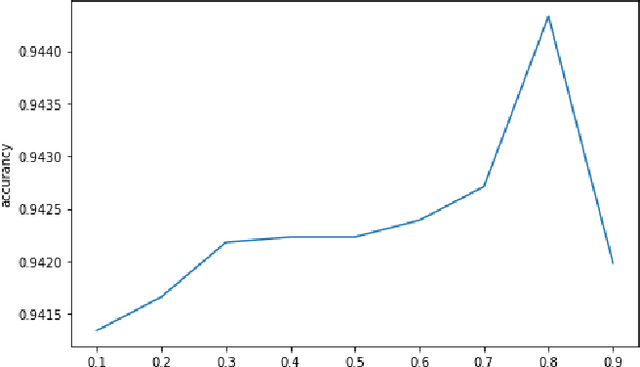
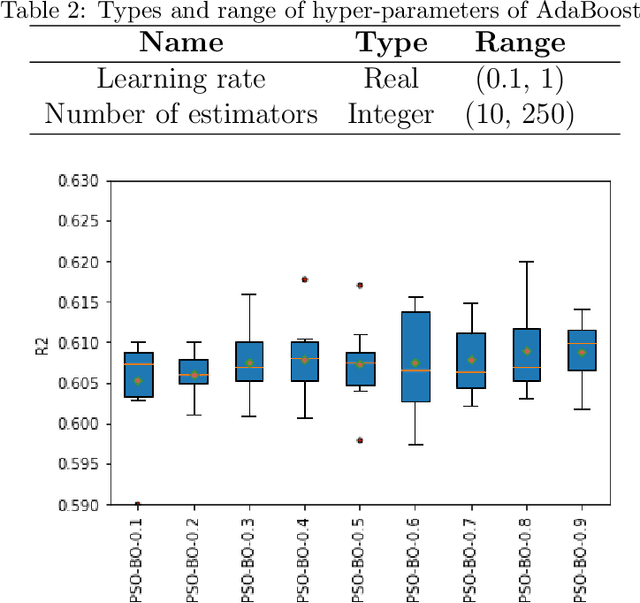
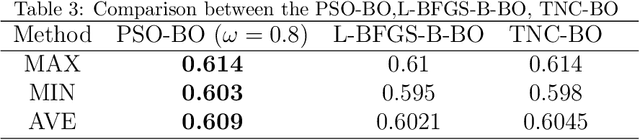
Particle swarm optimization (PSO) method cannot be directly used in the problem of hyper-parameter estimation since the mathematical formulation of the mapping from hyper-parameters to loss function or generalization accuracy is unclear. Bayesian optimization (BO) framework is capable of converting the optimization of the hyper-parameters into the optimization of an acquisition function. The acquisition function is non-convex and multi-peak. So the problem can be better solved by the PSO. The proposed method in this paper uses the particle swarm method to optimize the acquisition function in the BO framework to get better hyper-parameters. The performances of proposed method in both of the classification and regression models are evaluated and demonstrated. The results on several benchmark problems are improved.