 Add to Chrome
 Add to Firefox
 Add to Edge
A prism hierarchy of learning regimes in large linear autoencoders
Jun 03, 2026
Theoretical studies of machine learning models commonly consider different limiting regimes in which the learning dynamics of gradient descent becomes theoretically tractable. It is, however, desirable to have a systematically obtained picture of all qualitatively different extreme learning regimes for a particular type of models. In this paper we propose such a picture for large weight-tied linear autoencoders characterized by input and latent dimensions, initialization magnitude, and training set size. This model is nonlinear in the weights and its gradient flow does not have a general theoretical solution. We show that at the level of the formal loss-expansion hierarchy, its extreme regimes are naturally associated with faces of a triangular prism. In particular, there are five basic extreme regimes associated with the 2-faces of the prism: (1) large-data, (2) small-data, (3) mean-field, (4) narrow-latent, and (5) free. For regimes (1,2,3,4), we derive explicit expressions for both train and population limiting loss evolutions under gradient flow, obtaining very good agreement with experimental results.

Gradient Flow Through Diagram Expansions: Learning Regimes and Explicit Solutions
Feb 04, 2026We develop a general mathematical framework to analyze scaling regimes and derive explicit analytic solutions for gradient flow (GF) in large learning problems. Our key innovation is a formal power series expansion of the loss evolution, with coefficients encoded by diagrams akin to Feynman diagrams. We show that this expansion has a well-defined large-size limit that can be used to reveal different learning phases and, in some cases, to obtain explicit solutions of the nonlinear GF. We focus on learning Canonical Polyadic (CP) decompositions of high-order tensors, and show that this model has several distinct extreme lazy and rich GF regimes such as free evolution, NTK and under- and over-parameterized mean-field. We show that these regimes depend on the parameter scaling, tensor order, and symmetry of the model in a specific and subtle way. Moreover, we propose a general approach to summing the formal loss expansion by reducing it to a PDE; in a wide range of scenarios, it turns out to be 1st order and solvable by the method of characteristics. We observe a very good agreement of our theoretical predictions with experiment.
Molecular Learning Dynamics
Apr 14, 2025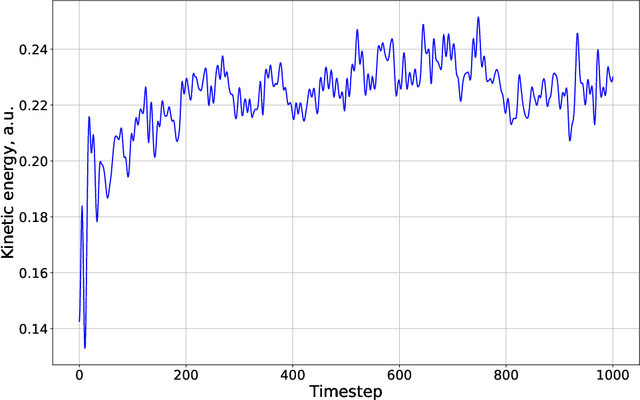

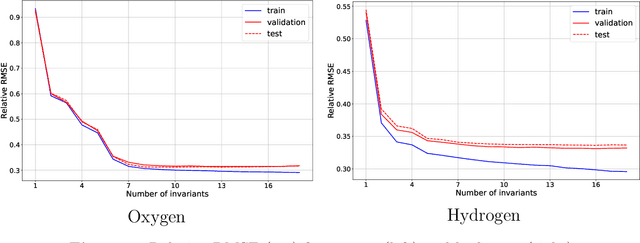
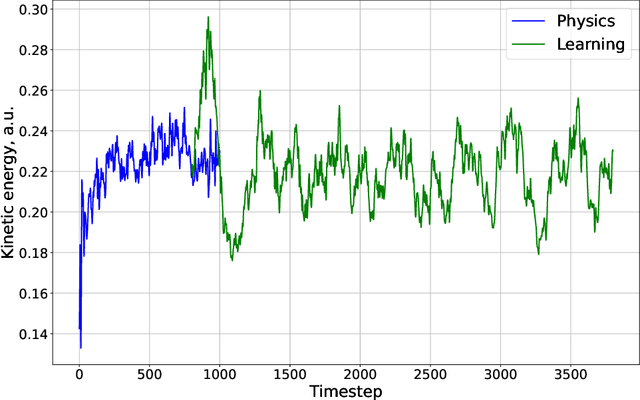
We apply the physics-learning duality to molecular systems by complementing the physical description of interacting particles with a dual learning description, where each particle is modeled as an agent minimizing a loss function. In the traditional physics framework, the equations of motion are derived from the Lagrangian function, while in the learning framework, the same equations emerge from learning dynamics driven by the agent loss function. The loss function depends on scalar quantities that describe invariant properties of all other agents or particles. To demonstrate this approach, we first infer the loss functions of oxygen and hydrogen directly from a dataset generated by the CP2K physics-based simulation of water molecules. We then employ the loss functions to develop a learning-based simulation of water molecules, which achieves comparable accuracy while being significantly more computationally efficient than standard physics-based simulations.