 Add to Chrome
 Add to Firefox
 Add to Edge
Lightweight Ac Arc Fault Diagnosis via Fourier Transform Inspired Multi-frequency Neural Network
Oct 30, 2025
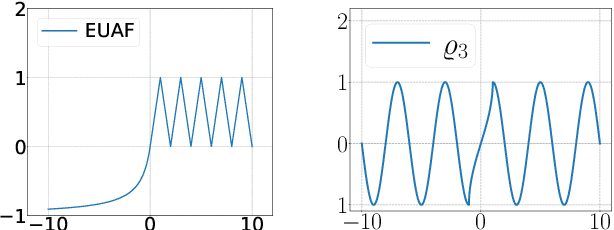
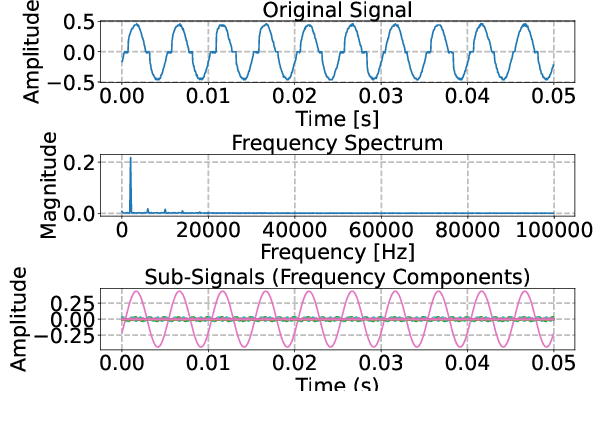
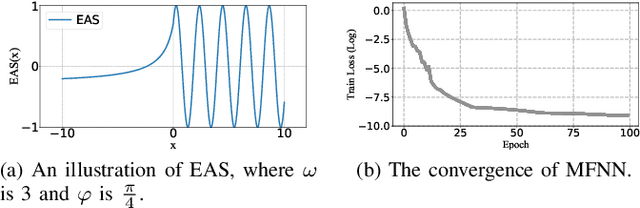
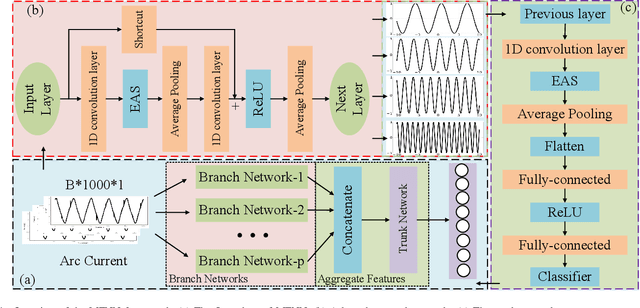
Lightweight online detection of series arc faults is critically needed in residential and industrial power systems to prevent electrical fires. Existing diagnostic methods struggle to achieve both rapid response and robust accuracy under resource-constrained conditions. To overcome the challenge, this work suggests leveraging a multi-frequency neural network named MFNN, embedding prior physical knowledge into the network. Inspired by arcing current curve and the Fourier decomposition analysis, we create an adaptive activation function with super-expressiveness, termed EAS, and a novel network architecture with branch networks to help MFNN extract features with multiple frequencies. In our experiments, eight advanced arc fault diagnosis models across an experimental dataset with multiple sampling times and multi-level noise are used to demonstrate the superiority of MFNN. The corresponding experiments show: 1) The MFNN outperforms other models in arc fault location, befitting from signal decomposition of branch networks. 2) The noise immunity of MFNN is much better than that of other models, achieving 14.51% over LCNN and 16.3% over BLS in test accuracy when SNR=-9. 3) EAS and the network architecture contribute to the excellent performance of MFNN.

Bi-Residual Neural Network based Synchronous Motor Electrical Faults Diagnosis: Intra-link Layer Design for High-frequency Features
May 29, 2025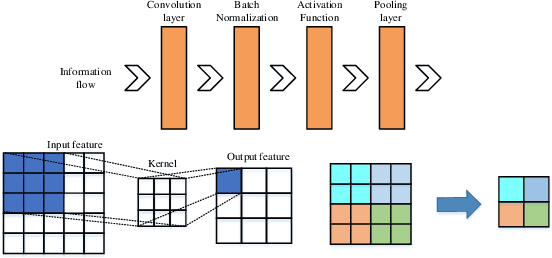
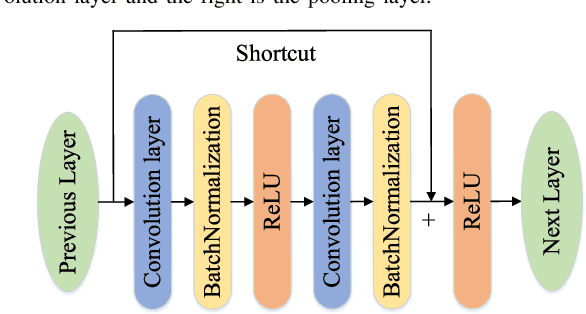
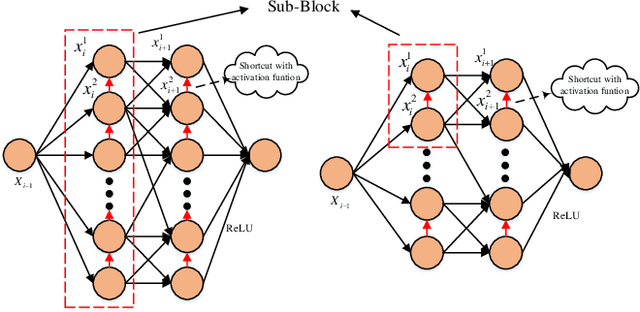
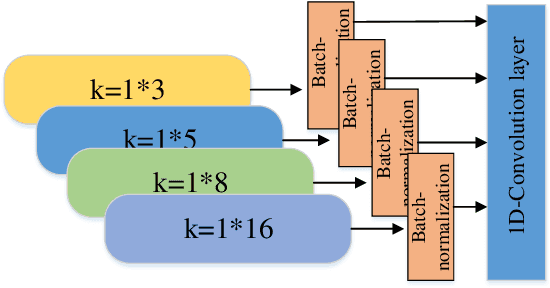
In practical resource-constrained environments, efficiently extracting the potential high-frequency fault-critical information is an inherent problem. To overcome this problem, this work suggests leveraging a bi-residual neural network named Bi-ResNet to extract the inner spatial-temporal high-frequency features using embedded spatial-temporal convolution blocks and intra-link layers. It can be considered as embedding a high-frequency extractor into networks without adding any parameters, helping shallow networks achieve the performance of deep networks. In our experiments, five advanced CNN-based neural networks and two baselines across a real-life dataset are utilized for synchronous motor electrical fault diagnosis to demonstrate the effectiveness of Bi-ResNet including one analytical, comparative, and ablation experiments. The corresponding experiments show: 1) The Bi-ResNet can perform better on low-resolution noisy data. 2) The proposed intra-links can help high-frequency components extraction and location from raw data. 3) There is a trade-off between intra-link number and input data complexity.