 Add to Chrome
 Add to Firefox
 Add to Edge
TumorBoard: Evidence-Grounded Multi-Agent Decision Support for Longitudinal Neuro-Oncology
Aug 04, 2026
Neuro-oncology decisions require coordinated interpretation of serial MRI, pathology, molecular markers, treatment history, performance status, and evolving guidelines. We present TumorBoard, a multi-agent decision-support system built around a shared longitudinal case state and an auditable claim-evidence ledger. Specialist agents for radiology, neuropathology, molecular diagnosis, guidelines, and therapy planning produce atomic claims with provenance. An adversarial critic exposes contradictions, and a safety governor releases, qualifies, or defers recommendations according to evidence sufficiency and temporal validity. On a 360-case hidden benchmark at a matched token budget, TumorBoard achieved an action F1 of 0.772 and evidence entailment of 0.914. It exceeded the strongest typed-council baseline by 3.1 percentage points (95% CI: 1.6 to 4.7, adjusted p = 0.0012), while recommendation-to-evidence coverage reached 0.927. Under evidence deletion, the system deferred 84.2% of unsafe cases and limited harmful recommendations to 5.8%. The safety governor reduced harmful release by 7.8 percentage points at a false-deferral cost of 4.3 percentage points. Ablation studies of the ledger, critic, and governor produced the predicted failure patterns, establishing structured coordination as the source of the measured multi-agent advantage.

NeuroMosaic: Anatomically Grounded Multimodal Large Language Modeling for Molecularly Aware Glioma Reasoning from 3D MRI and Clinical Narratives
Aug 04, 2026Multimodal medical large language models remain structurally weak for neuro-oncology because volumetric evidence is compressed into generic visual tokens and diagnostic conclusions often lack an auditable link to MRI regions. We present NeuroMosaic, a 3D multimodal language model that converts multi-sequence brain MRI into anatomy-indexed regional tokens, aligns them with clinical narrative and molecular concepts, and generates evidence-linked outputs. The architecture combines a multi-resolution volumetric tokenizer, a neuroanatomical graph router, a molecular concept memory, and selective risk control. Across four glioma cohorts, NeuroMosaic achieved an internal subtype macro-F1 of 0.827 and external macro-F1 values of 0.784, 0.761, and 0.742. On UPenn-GBM, it improved over the strongest matched-input baseline by 3.6 percentage points (95% CI: 1.8 to 5.4, adjusted p = 0.0018), with IDH, 1p/19q, and MGMT AUROCs of 0.918, 0.861, and 0.781. Evidence pointing accuracy reached 0.703, and targeted evidence deletion reduced correct-answer probability by 0.187, compared with 0.046 for random deletion. These results establish anatomy-indexed routing as a measurable mechanism for accurate, grounded, and calibrated volumetric medical-language reasoning.
Utilizing Computer Vision for Continuous Monitoring of Vaccine Side Effects in Experimental Mice
Apr 03, 2024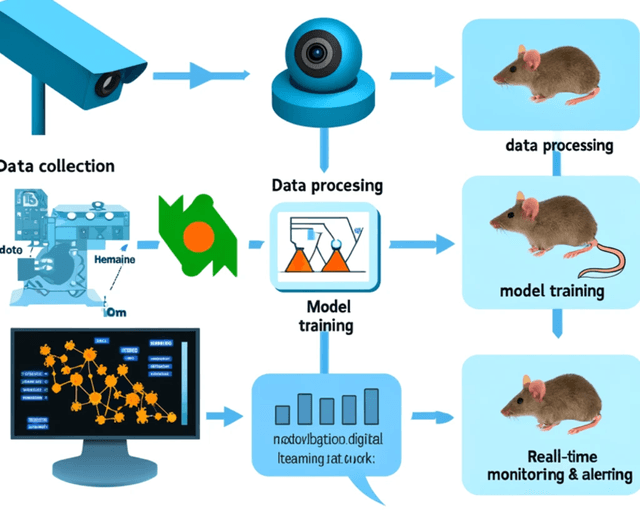
The demand for improved efficiency and accuracy in vaccine safety assessments is increasing. Here, we explore the application of computer vision technologies to automate the monitoring of experimental mice for potential side effects after vaccine administration. Traditional observation methods are labor-intensive and lack the capability for continuous monitoring. By deploying a computer vision system, our research aims to improve the efficiency and accuracy of vaccine safety assessments. The methodology involves training machine learning models on annotated video data of mice behaviors pre- and post-vaccination. Preliminary results indicate that computer vision effectively identify subtle changes, signaling possible side effects. Therefore, our approach has the potential to significantly enhance the monitoring process in vaccine trials in animals, providing a practical solution to the limitations of human observation.
A real-time material breakage detection for offshore wind turbines based on improved neural network algorithm
Jul 25, 2023The integrity of offshore wind turbines, pivotal for sustainable energy generation, is often compromised by surface material defects. Despite the availability of various detection techniques, limitations persist regarding cost-effectiveness, efficiency, and applicability. Addressing these shortcomings, this study introduces a novel approach leveraging an advanced version of the YOLOv8 object detection model, supplemented with a Convolutional Block Attention Module (CBAM) for improved feature recognition. The optimized loss function further refines the learning process. Employing a dataset of 5,432 images from the Saemangeum offshore wind farm and a publicly available dataset, our method underwent rigorous testing. The findings reveal a substantial enhancement in defect detection stability, marking a significant stride towards efficient turbine maintenance. This study's contributions illuminate the path for future research, potentially revolutionizing sustainable energy practices.
Fast Recognition of birds in offshore wind farms based on an improved deep learning model
Jun 28, 2023The safety of wind turbines is a prerequisite for the stable operation of offshore wind farms. However, bird damage poses a direct threat to the safe operation of wind turbines and wind turbine blades. In addition, millions of birds are killed by wind turbines every year. In order to protect the ecological environment and maintain the safe operation of offshore wind turbines, and to address the problem of the low detection capability of current target detection algorithms in low-light environments such as at night, this paper proposes a method to improve the network performance by integrating the CBAM attention mechanism and the RetinexNet network into YOLOv5. First, the training set images are fed into the YOLOv5 network with integrated CBAM attention module for training, and the optimal weight model is stored. Then, low-light images are enhanced and denoised using Decom-Net and Enhance-Net, and the accuracy is tested on the optimal weight model. In addition, the k-means++ clustering algorithm is used to optimise the anchor box selection method, which solves the problem of unstable initial centroids and achieves better clustering results. Experimental results show that the accuracy of this model in bird detection tasks can reach 87.40%, an increase of 21.25%. The model can detect birds near wind turbines in real time and shows strong stability in night, rainy and shaky conditions, proving that the model can ensure the safe and stable operation of wind turbines.