 Add to Chrome
 Add to Firefox
 Add to Edge
GARLIC: Graph Attention-based Relational Learning of Multivariate Time Series in Intensive Care
Aug 11, 2026
Healthcare data, such as Intensive Care Unit (ICU) records, comprise heterogeneous multivariate time series sampled at irregular intervals with pervasive missingness. However, clinical applications demand predictive models that are both accurate and interpretable. We present our Graph Attention-based Relational Learning for Intensive Care (GARLIC) model, a novel neural network architecture that imputes missing data through a learnable exponential-decay encoder, captures inter-sensor dependencies via time-lagged summary graphs, and fuses global patterns with cross-dimensional sequential attention. All attention weights and graph edges are learned end-to-end to serve as built-in observation-, signal-, and edge-level explanations. To reconcile auxiliary reconstruction and primary classification objectives, we developed an alternating decoupled optimization scheme that stabilizes training. On three ICU benchmarks (PhysioNet 2012 & 2019, MIMIC-III), GARLIC sets the new state of the art in outcome prediction, significantly improving AUROC and AUPRC over best-performing baselines at comparable computational cost. Ablation studies confirm the contribution of each module, and feature-removal trials validate the fidelity of importance attribution through a monotonic performance drop (full > top 50% > random 50% > bottom 50%). Real-time case studies demonstrate actionable risk warnings with transparent explanations, marking a significant advance toward accurate, explainable deep learning for irregularly sampled ICU time series data. Moreover, we demonstrated \proposed{}'s superiority in data imputation and classification on various time-series datasets beyond the ICU domain, showing its generalizability and applicability to broader tasks.

KarmaTS: A Universal Simulation Platform for Multivariate Time Series with Functional Causal Dynamics
Nov 14, 2025We introduce KarmaTS, an interactive framework for constructing lag-indexed, executable spatiotemporal causal graphical models for multivariate time series (MTS) simulation. Motivated by the challenge of access-restricted physiological data, KarmaTS generates synthetic MTS with known causal dynamics and augments real-world datasets with expert knowledge. The system constructs a discrete-time structural causal process (DSCP) by combining expert knowledge and algorithmic proposals in a mixed-initiative, human-in-the-loop workflow. The resulting DSCP supports simulation and causal interventions, including those under user-specified distribution shifts. KarmaTS handles mixed variable types, contemporaneous and lagged edges, and modular edge functionals ranging from parameterizable templates to neural network models. Together, these features enable flexible validation and benchmarking of causal discovery algorithms through expert-informed simulation.
DAPDAG: Domain Adaptation via Perturbed DAG Reconstruction
Aug 02, 2022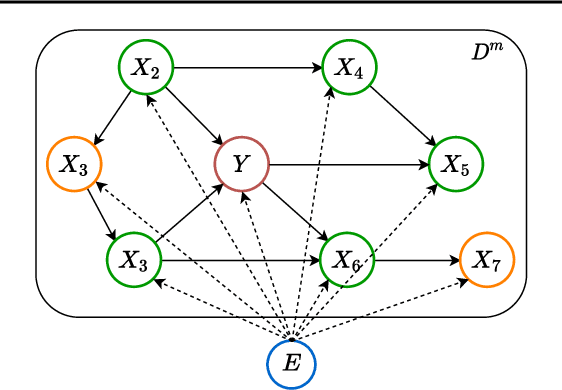
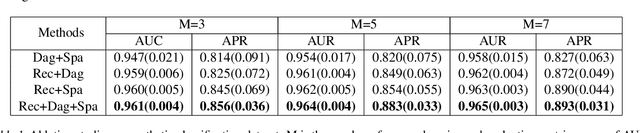
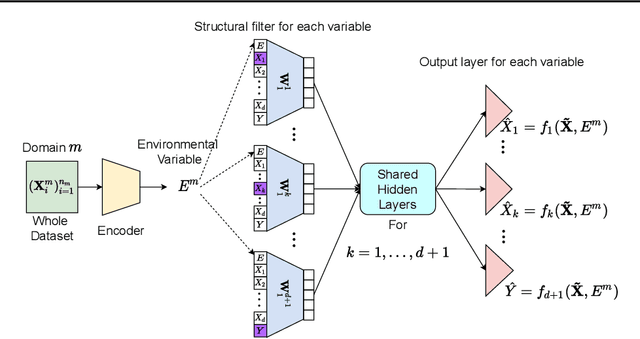
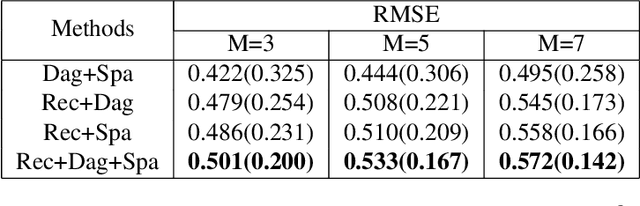
Leveraging labelled data from multiple domains to enable prediction in another domain without labels is a significant, yet challenging problem. To address this problem, we introduce the framework DAPDAG (\textbf{D}omain \textbf{A}daptation via \textbf{P}erturbed \textbf{DAG} Reconstruction) and propose to learn an auto-encoder that undertakes inference on population statistics given features and reconstructing a directed acyclic graph (DAG) as an auxiliary task. The underlying DAG structure is assumed invariant among observed variables whose conditional distributions are allowed to vary across domains led by a latent environmental variable $E$. The encoder is designed to serve as an inference device on $E$ while the decoder reconstructs each observed variable conditioned on its graphical parents in the DAG and the inferred $E$. We train the encoder and decoder jointly in an end-to-end manner and conduct experiments on synthetic and real datasets with mixed variables. Empirical results demonstrate that reconstructing the DAG benefits the approximate inference. Furthermore, our approach can achieve competitive performance against other benchmarks in prediction tasks, with better adaptation ability, especially in the target domain significantly different from the source domains.