 Add to Chrome
 Add to Firefox
 Add to Edge
Scattering Environment Aware Joint Multi-BS Channel Estimation and Localization with Clock Asynchronism
Jun 01, 2026
Clock asynchronism between base stations (BSs) and users significantly degrades scatterer localization accuracy. To address this issue, this paper proposes a multi-BS joint channel estimation and localization scheme that exploits shared scatterer information among multiple BSs. First, channel modeling in the location domain is performed by leveraging the joint sparsity of multi-BS channels. Subsequently, a multi-BS scatterer association algorithm is developed based solely on Angle of Arrival (AoA) estimates. By utilizing the shared scatterers and the geometric relationships among the scatterers, BSs, and the user equipment (UE), coarse estimates of the UE location and timing offsets are obtained. Based on these coarse estimates of scatterer locations, UE location, and timing offsets, an expectation-maximization (EM) framework is employed. Specifically, the UE location and timing offsets are iteratively refined while jointly enabling high-precision estimation of scatterer locations and channel coefficients. Simulation results demonstrate that the proposed scheme achieves significant improvements in both channel estimation and localization accuracy compared with baseline methods.

Scattering Environment Aware Joint Multi-user Channel Estimation and Localization with Spatially Reused Pilots
Jan 04, 2025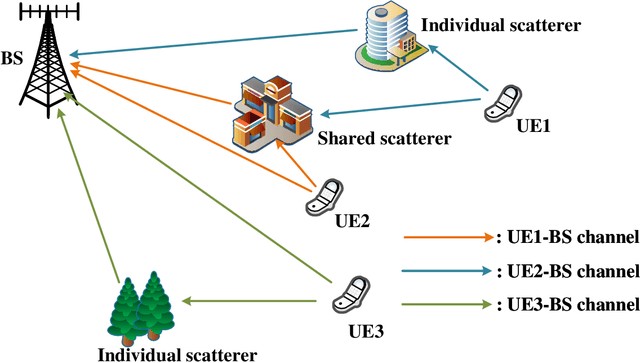

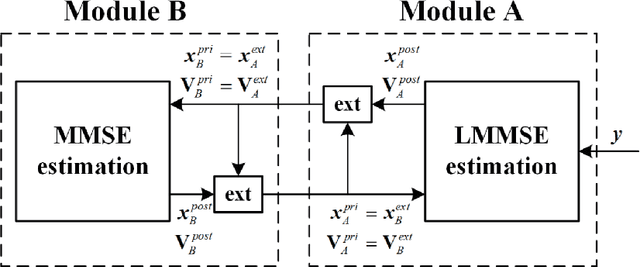
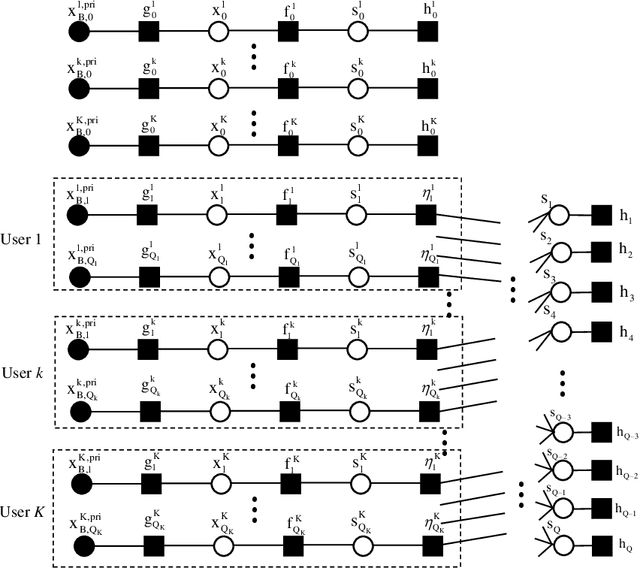
The increasing number of users leads to an increase in pilot overhead, and the limited pilot resources make it challenging to support all users using orthogonal pilots. By fully capturing the inherent physical characteristics of the multi-user (MU) environment, it is possible to reduce pilot costs and improve the channel estimation performance. In reality, users nearby may share the same scatterer, while users further apart tend to have orthogonal channels. This paper proposes a two-timescale approach for joint MU uplink channel estimation and localization in MIMO-OFDM systems, which fully captures the spatial characteristics of MUs. To accurately represent the structure of the MU channel, the channel is modeled in the 3-D location domain. In the long-timescale phase, the time-space-time multiple signal classification (TST-MUSIC) algorithm initially offers a rough approximation of scatterer positions for each user, which is subsequently refined through the scatterer association algorithm based on density-based spatial clustering of applications with noise (DBSCAN) algorithm. The BS then utilizes this prior information to apply a graph-coloring-based user grouping algorithm, enabling spatial division multiplexing of pilots and reducing pilot overhead. In the short timescale phase, a low-complexity scattering environment aware location-domain turbo channel estimation (SEA-LD-TurboCE) algorithm is introduced to merge the overlapping scatterer information from MUs, facilitating high-precision joint MU channel estimation and localization under spatially reused pilots. Simulation results verify the superior channel estimation and localization performance of our proposed scheme over the baselines.