 Add to Chrome
 Add to Firefox
 Add to Edge
Elo-Evolve: A Co-evolutionary Framework for Language Model Alignment
Feb 14, 2026
Current alignment methods for Large Language Models (LLMs) rely on compressing vast amounts of human preference data into static, absolute reward functions, leading to data scarcity, noise sensitivity, and training instability. We introduce Elo-Evolve, a co-evolutionary framework that redefines alignment as dynamic multi-agent competition within an adaptive opponent pool. Our approach makes two key innovations: (1) eliminating Bradley-Terry model dependencies by learning directly from binary win/loss outcomes in pairwise competitions, and (2) implementing Elo-orchestrated opponent selection that provides automatic curriculum learning through temperature-controlled sampling. We ground our approach in PAC learning theory, demonstrating that pairwise comparison achieves superior sample complexity and empirically validate a 4.5x noise reduction compared to absolute scoring approaches. Experimentally, we train a Qwen2.5-7B model using our framework with opponents including Qwen2.5-14B, Qwen2.5-32B, and Qwen3-8B models. Results demonstrate a clear performance hierarchy: point-based methods < static pairwise training < Elo-Evolve across Alpaca Eval 2.0 and MT-Bench, validating the progressive benefits of pairwise comparison and dynamic opponent selection for LLM alignment.

Learning Fine-grained Image Similarity with Deep Ranking
Apr 17, 2014
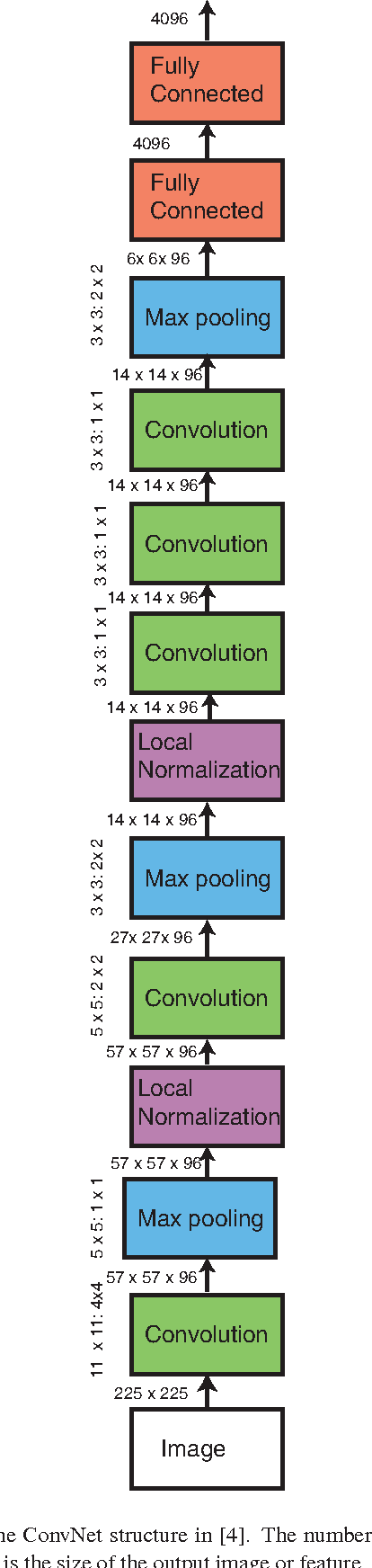
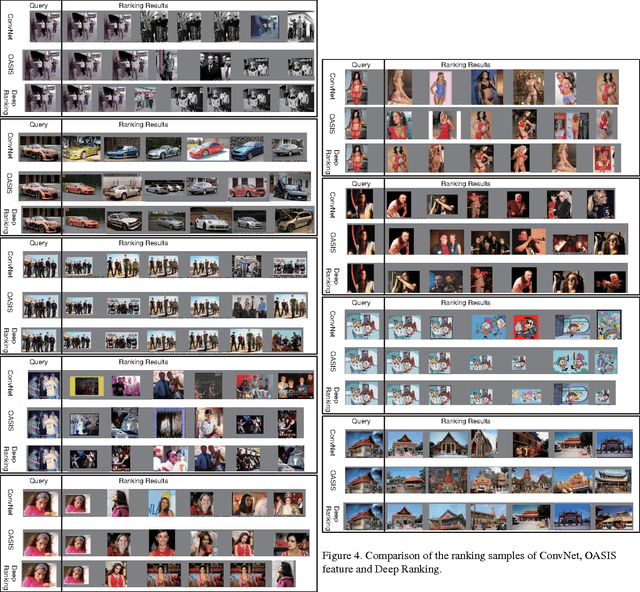
Learning fine-grained image similarity is a challenging task. It needs to capture between-class and within-class image differences. This paper proposes a deep ranking model that employs deep learning techniques to learn similarity metric directly from images.It has higher learning capability than models based on hand-crafted features. A novel multiscale network structure has been developed to describe the images effectively. An efficient triplet sampling algorithm is proposed to learn the model with distributed asynchronized stochastic gradient. Extensive experiments show that the proposed algorithm outperforms models based on hand-crafted visual features and deep classification models.