 Add to Chrome
 Add to Firefox
 Add to Edge
Subspace Control: Turning Constrained Model Steering into Controllable Spectral Optimization
Apr 05, 2026
Foundation models, such as large language models (LLMs), are powerful but often require customization before deployment to satisfy practical constraints such as safety, privacy, and task-specific requirements, leading to "constrained" optimization problems for model steering and adaptation. However, solving such problems remains largely underexplored and is particularly challenging due to interference between the primary objective and constraint objectives during optimization. In this paper, we propose a subspace control framework for constrained model training. Specifically, (i) we first analyze, from a model merging perspective, how spectral cross-task interference arises and show that it can be resolved via a one-shot solution that orthogonalizes the merged subspace; (ii) we establish a connection between this solution and gradient orthogonalization in the spectral optimizer Muon; and (iii) building on these insights, we introduce SIFT (spectral interference-free training), which leverages a localization scheme to selectively intervene during optimization, enabling controllable updates that mitigate objective-constraint conflicts. We evaluate SIFT across four representative applications: (a) machine unlearning, (b) safety alignment, (c) text-to-speech adaptation, and (d) hallucination mitigation. Compared to both control-based and control-free baselines, SIFT consistently achieves substantial and robust performance improvements across all tasks. Code is available at https://github.com/OPTML-Group/SIFT.

RoS-Guard: Robust and Scalable Online Change Detection with Delay-Optimal Guarantees
Nov 17, 2025Online change detection (OCD) aims to rapidly identify change points in streaming data and is critical in applications such as power system monitoring, wireless network sensing, and financial anomaly detection. Existing OCD methods typically assume precise system knowledge, which is unrealistic due to estimation errors and environmental variations. Moreover, existing OCD methods often struggle with efficiency in large-scale systems. To overcome these challenges, we propose RoS-Guard, a robust and optimal OCD algorithm tailored for linear systems with uncertainty. Through a tight relaxation and reformulation of the OCD optimization problem, RoS-Guard employs neural unrolling to enable efficient parallel computation via GPU acceleration. The algorithm provides theoretical guarantees on performance, including expected false alarm rate and worst-case average detection delay. Extensive experiments validate the effectiveness of RoS-Guard and demonstrate significant computational speedup in large-scale system scenarios.
Triadic-OCD: Asynchronous Online Change Detection with Provable Robustness, Optimality, and Convergence
May 03, 2024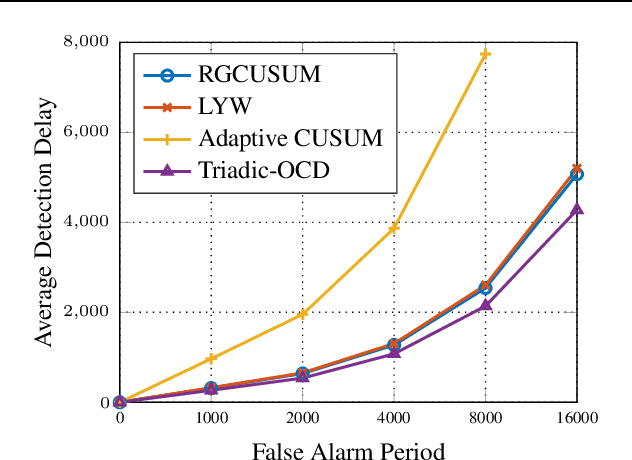
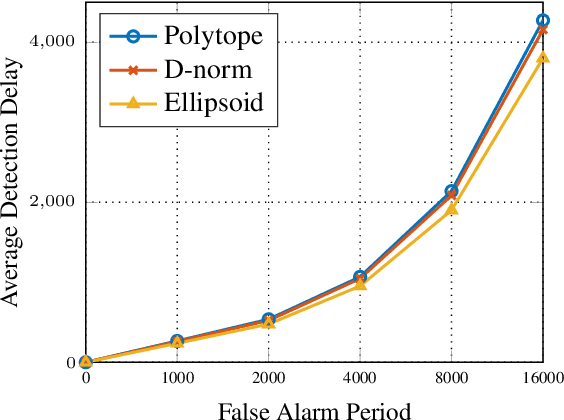
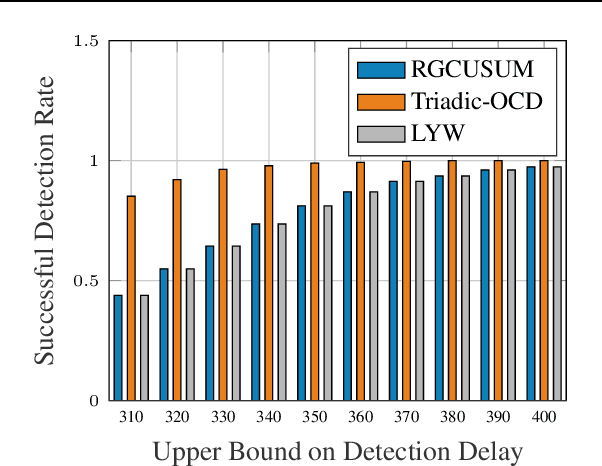
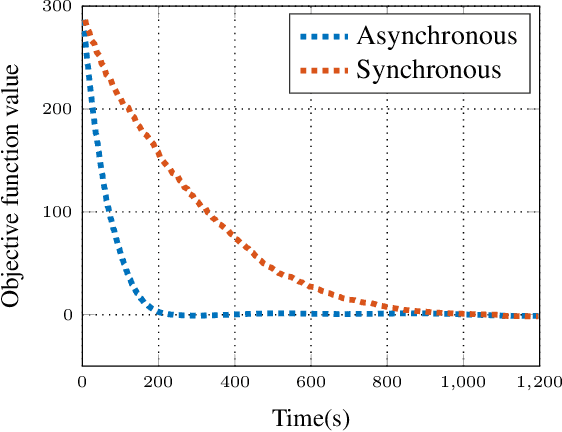
The primary goal of online change detection (OCD) is to promptly identify changes in the data stream. OCD problem find a wide variety of applications in diverse areas, e.g., security detection in smart grids and intrusion detection in communication networks. Prior research usually assumes precise knowledge of the parameters linked to the data stream. Nevertheless, this presumption often proves unattainable in practical scenarios due to factors such as estimation errors, system updates, etc. This paper aims to take the first attempt to develop a triadic-OCD framework with certifiable robustness, provable optimality, and guaranteed convergence. In addition, the proposed triadic-OCD algorithm can be realized in a fully asynchronous distributed manner, easing the necessity of transmitting the data to a single server. This asynchronous mechanism also could mitigate the straggler issue that faced by traditional synchronous algorithm. We then analyze the non-asymptotic convergence property of triadic-OCD and derive its iteration complexity to achieve an $\epsilon$-optimal point. Finally, extensive experiments have been conducted to elucidate the effectiveness of the proposed method.