 Add to Chrome
 Add to Firefox
 Add to Edge
When Writing Style Drifts: Benchmarking Authorship Verification under Distribution Shifts in Genre, Time and the AI-Era
Aug 18, 2026
Authorship verification (AV) assumes that an author's writing style remains sufficiently stable to distinguish it from that of other writers. In practice, however, this assumption is challenged by distribution shifts caused by changes in genre, time, and AI-assisted writing. Existing AV benchmarks typically study these factors in isolation and focus predominantly on English, limiting our understanding of model robustness under realistic conditions. We introduce AVShift, the first German benchmark for systematically evaluating AV under multiple distribution shifts. AVShift comprises over 150,000 text pairs spanning three genres and 21 years, enabling controlled evaluation of cross-genre, temporal, and AI-era shifts within a unified framework. We benchmark representative feature-based, embedding-based, and LLM-based approaches. Our experiments show that fine-tuned LLMs generalize best across genres and benefit substantially from stylistically diverse training data. We further demonstrate that temporal drift is one of the strongest factors affecting AV, with performance degrading significantly as the time gap between documents increases. In contrast, we find no evidence of a measurable AI-era distribution shift within AVShift. Finally, our feature analysis reveals stylistic features that remain stable across genres, while their relative importance varies depending on the specific genre transition. We release AVShift and our code for future research.

Topic Ontologies for Arguments
Jan 23, 2023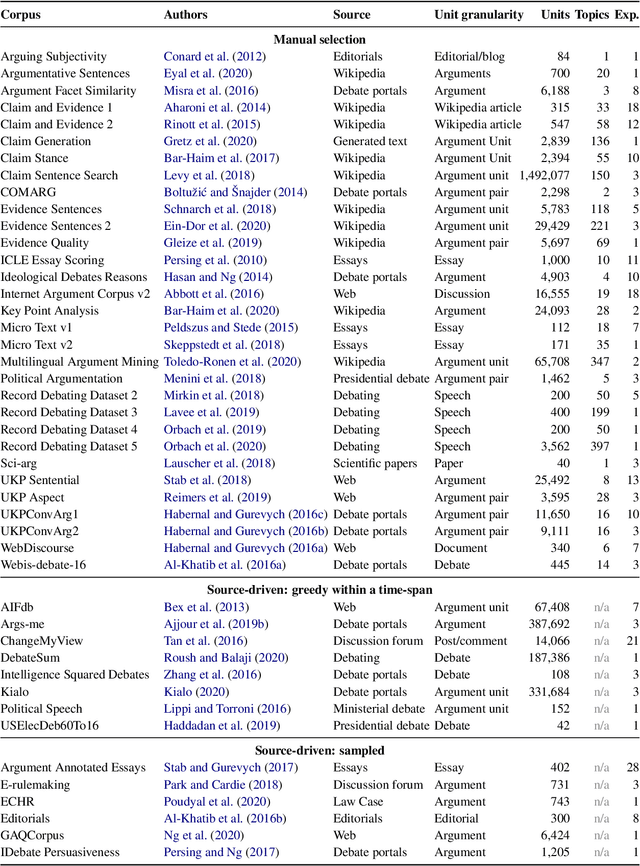
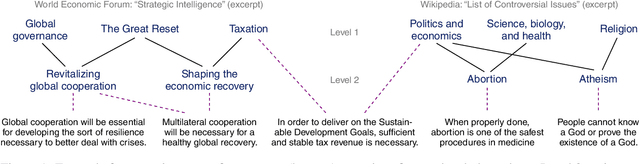
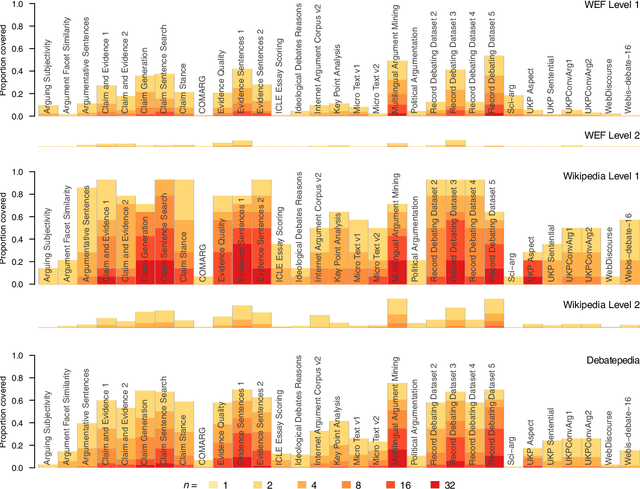
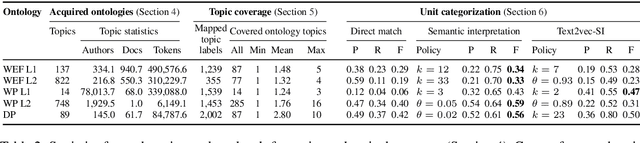
Many computational argumentation tasks, like stance classification, are topic-dependent: the effectiveness of approaches to these tasks significantly depends on whether the approaches were trained on arguments from the same topics as those they are tested on. So, which are these topics that researchers train approaches on? This paper contributes the first comprehensive survey of topic coverage, assessing 45 argument corpora. For the assessment, we take the first step towards building an argument topic ontology, consulting three diverse authoritative sources: the World Economic Forum, the Wikipedia list of controversial topics, and Debatepedia. Comparing the topic sets between the authoritative sources and corpora, our analysis shows that the corpora topics-which are mostly those frequently discussed in public online fora - are covered well by the sources. However, other topics from the sources are less extensively covered by the corpora of today, revealing interesting future directions for corpus construction.