 Add to Chrome
 Add to Firefox
 Add to Edge
EAD-Net: Emotion-Aware Talking Head Generation with Spatial Refinement and Temporal Coherence
Apr 25, 2026
Emotionally talking head video generation aims to generate expressive portrait videos with accurate lip synchronization and emotional facial expressions. Current methods rely on simple emotional labels, leading to insufficient semantic information. While introducing high-level semantics enhances expressiveness, it easily causes lip-sync degradation. Furthermore, mainstream generation methods struggle to balance computational efficiency and global motion awareness in long videos and suffer from poor temporal coherence. Therefore, we propose an \textbf{E}motion-\textbf{A}ware \textbf{D}iffusion model-based \textbf{Net}work, called \textbf{EAD-Net}. We introduce SyncNet supervision and Temporal Representation Alignment (TREPA) to mitigate lip-sync degradation caused by multi-modal fusion. To model complex spatio-temporal dependencies in long video sequences, we propose a Spatio-Temporal Directional Attention (STDA) mechanism that captures global motion patterns through strip attention. Additionally, we design a Temporal Frame graph Reasoning Module (TFRM) to explicitly model temporal coherence between video frames through graph structure learning. To enhance emotional semantic control, a large language model is employed to extract textual descriptions from real videos, serving as high-level semantic guidance. Experiments on the HDTF and MEAD datasets demonstrate that our method outperforms existing methods in terms of lip-sync accuracy, temporal consistency, and emotional accuracy.

RealityAvatar: Towards Realistic Loose Clothing Modeling in Animatable 3D Gaussian Avatars
Apr 02, 2025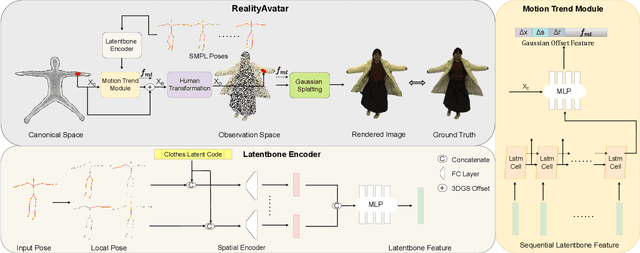
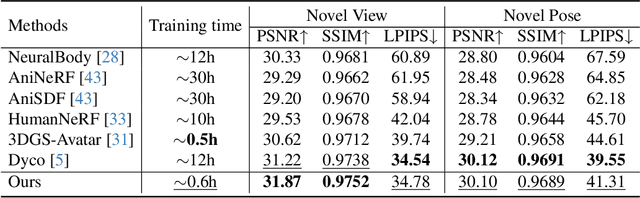
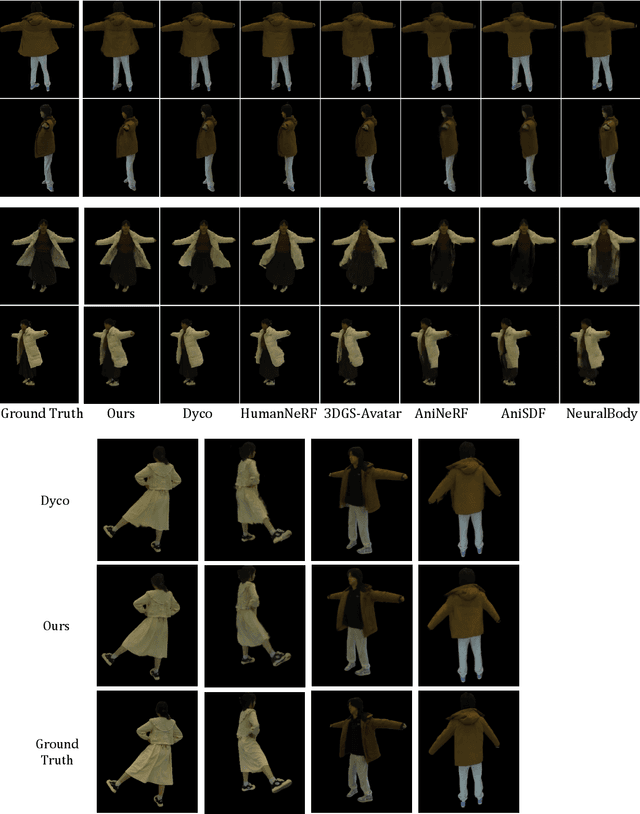
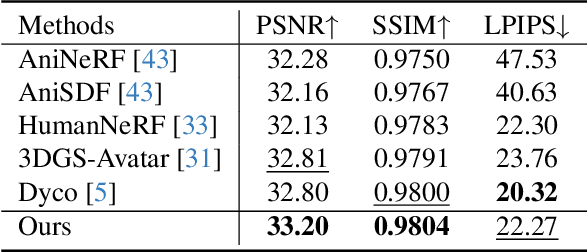
Modeling animatable human avatars from monocular or multi-view videos has been widely studied, with recent approaches leveraging neural radiance fields (NeRFs) or 3D Gaussian Splatting (3DGS) achieving impressive results in novel-view and novel-pose synthesis. However, existing methods often struggle to accurately capture the dynamics of loose clothing, as they primarily rely on global pose conditioning or static per-frame representations, leading to oversmoothing and temporal inconsistencies in non-rigid regions. To address this, We propose RealityAvatar, an efficient framework for high-fidelity digital human modeling, specifically targeting loosely dressed avatars. Our method leverages 3D Gaussian Splatting to capture complex clothing deformations and motion dynamics while ensuring geometric consistency. By incorporating a motion trend module and a latentbone encoder, we explicitly model pose-dependent deformations and temporal variations in clothing behavior. Extensive experiments on benchmark datasets demonstrate the effectiveness of our approach in capturing fine-grained clothing deformations and motion-driven shape variations. Our method significantly enhances structural fidelity and perceptual quality in dynamic human reconstruction, particularly in non-rigid regions, while achieving better consistency across temporal frames.