 Add to Chrome
 Add to Firefox
 Add to Edge
Enhanced Mixture 3D CGAN for Completion and Generation of 3D Objects
Feb 08, 2026
The generation and completion of 3D objects represent a transformative challenge in computer vision. Generative Adversarial Networks (GANs) have recently demonstrated strong potential in synthesizing realistic visual data. However, they often struggle to capture complex and diverse data distributions, particularly in scenarios involving incomplete inputs or significant missing regions. These challenges arise mainly from the high computational requirements and the difficulty of modeling heterogeneous and structurally intricate data, which restrict their applicability in real-world settings. Mixture of Experts (MoE) models have emerged as a promising solution to these limitations. By dynamically selecting and activating the most relevant expert sub-networks for a given input, MoEs improve both performance and efficiency. In this paper, we investigate the integration of Deep 3D Convolutional GANs (CGANs) with a MoE framework to generate high-quality 3D models and reconstruct incomplete or damaged objects. The proposed architecture incorporates multiple generators, each specialized to capture distinct modalities within the dataset. Furthermore, an auxiliary loss-free dynamic capacity constraint (DCC) mechanism is introduced to guide the selection of categorical generators, ensuring a balance between specialization, training stability, and computational efficiency, which is critical for 3D voxel processing. We evaluated the model's ability to generate and complete shapes with missing regions of varying sizes and compared its performance with state-of-the-art approaches. Both quantitative and qualitative results confirm the effectiveness of the proposed MoE-DCGAN in handling complex 3D data.

Handwriting Quality Analysis using Online-Offline Models
Oct 09, 2020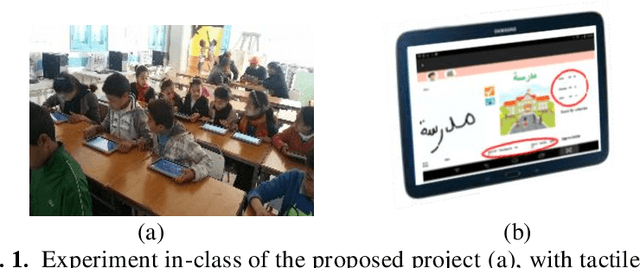
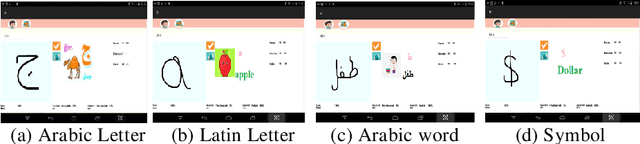
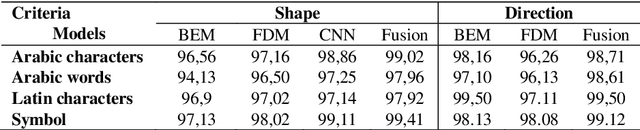
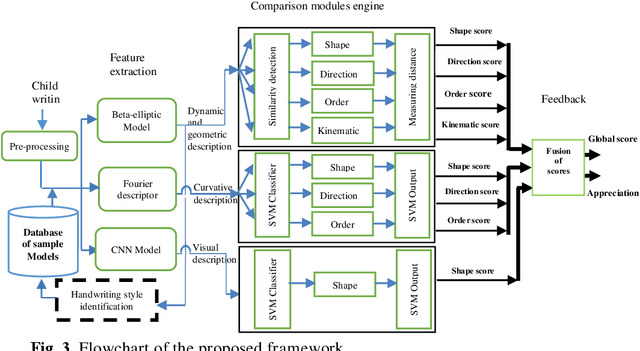
This work is part of an innovative e-learning project allowing the development of an advanced digital educational tool that provides feedback during the process of learning handwriting for young school children (three to eight years old). In this paper, we describe a new method for children handwriting quality analysis. It automatically detects mistakes, gives real-time on-line feedback for children's writing, and helps teachers comprehend and evaluate children's writing skills. The proposed method adjudges five main criteria shape, direction, stroke order, position respect to the reference lines, and kinematics of the trace. It analyzes the handwriting quality and automatically gives feedback based on the combination of three extracted models: Beta-Elliptic Model (BEM) using similarity detection (SD) and dissimilarity distance (DD) measure, Fourier Descriptor Model (FDM), and perceptive Convolutional Neural Network (CNN) with Support Vector Machine (SVM) comparison engine. The originality of our work lies partly in the system architecture which apprehends complementary dynamic, geometric, and visual representation of the examined handwritten scripts and in the efficient selected features adapted to various handwriting styles and multiple script languages such as Arabic, Latin, digits, and symbol drawing. The application offers two interactive interfaces respectively dedicated to learners, educators, experts or teachers and allows them to adapt it easily to the specificity of their disciples. The evaluation of our framework is enhanced by a database collected in Tunisia primary school with 400 children. Experimental results show the efficiency and robustness of our suggested framework that helps teachers and children by offering positive feedback throughout the handwriting learning process using tactile digital devices.