 Add to Chrome
 Add to Firefox
 Add to Edge
Identifying Implicit Premises for Logical Reconstruction of Argument Graphs
Aug 19, 2026
The logical reconstruction of argument graphs from natural language text is challenging because of the prevalence of enthymemes (i.e., arguments with implicit premises). There are natural language processing methods for identifying enthymemes in text, and there are symbolic methods based on abduction for identifying missing premises in a logical representation of enthymemes. However, there is a need for methods to generate implicit premises to logically show a known entailment or contradiction relationship between a pair of statements. To address this, we propose a neuro-symbolic pipeline that uses large language models (LLMs) to generate intermediate implicit premises that are translated into logical formulae and used with logical formulae representing explicit premises and explicit claims to show the logical relationships between them (entailment, contradiction, or neutrality). Our approach is evaluated on the Microtext Argumentative Corpus.

Pairwise Logical Selection of Enthymeme Completions under Semantic-Link Uncertainty
Aug 19, 2026Arguments often omit premises or claims, forming enthymemes. We study pairwise logical selection between two candidates for the omitted component. Existing natural language methods can identify or generate candidates but often do not expose how the selected candidate completes the inference, while logic-based approaches usually assume that the required formulae and background knowledge are available. We extend a prior neuro-symbolic pipeline from missing-premise to missing-claim selection and replace binary entailment outcomes with logical-resistance scores. Top-Link uses weighted Partial MaxSAT under a single configuration of highest-confidence semantic links. We then introduce Possible-World Atom-Link Formalization (PWAL), which keeps translated formulae fixed and marginalizes logical resistance over alternative cross-formula semantic-link configurations. We evaluate PWAL on five tasks: ARCT and a CDED-derived task for missing-premise selection, iDebate- and AAE2-derived tasks for missing-claim selection, and alphaNLI for abductive hypothesis selection. Relative to Top-Link, PWAL raises strict accuracy by 2.95-30.86 percentage points and reduces tie rates by 4.57-58.00 percentage points on all five tasks. When ties receive half credit, accuracy still increases by 0.45-6.04 percentage points. PWAL also records the translated formulae, sampled link configurations, and resistance components for every comparison, providing a transparent trace of each score.
Identification of Entailment and Contradiction Relations between Natural Language Sentences: A Neurosymbolic Approach
May 02, 2024
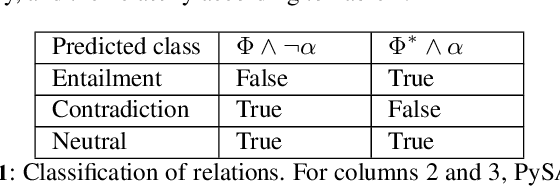
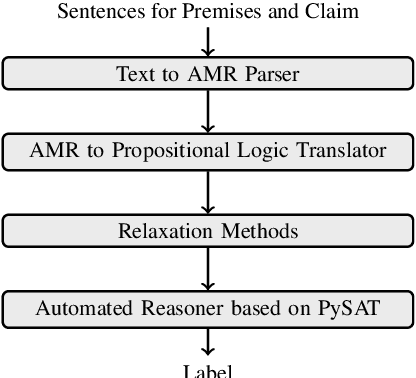

Natural language inference (NLI), also known as Recognizing Textual Entailment (RTE), is an important aspect of natural language understanding. Most research now uses machine learning and deep learning to perform this task on specific datasets, meaning their solution is not explainable nor explicit. To address the need for an explainable approach to RTE, we propose a novel pipeline that is based on translating text into an Abstract Meaning Representation (AMR) graph. For this we use a pre-trained AMR parser. We then translate the AMR graph into propositional logic and use a SAT solver for automated reasoning. In text, often commonsense suggests that an entailment (or contradiction) relationship holds between a premise and a claim, but because different wordings are used, this is not identified from their logical representations. To address this, we introduce relaxation methods to allow replacement or forgetting of some propositions. Our experimental results show this pipeline performs well on four RTE datasets.