 Add to Chrome
 Add to Firefox
 Add to Edge
Not All Frames Are Equal: Complexity-Aware Masked Motion Generation via Motion Spectral Descriptors
Mar 31, 2026
Masked generative models have become a strong paradigm for text-to-motion synthesis, but they still treat motion frames too uniformly during masking, attention, and decoding. This is a poor match for motion, where local dynamic complexity varies sharply over time. We show that current masked motion generators degrade disproportionately on dynamically complex motions, and that frame-wise generation error is strongly correlated with motion dynamics. Motivated by this mismatch, we introduce the Motion Spectral Descriptor (MSD), a simple and parameter-free measure of local dynamic complexity computed from the short-time spectrum of motion velocity. Unlike learned difficulty predictors, MSD is deterministic, interpretable, and derived directly from the motion signal itself. We use MSD to make masked motion generation complexity-aware. In particular, MSD guides content-focused masking during training, provides a spectral similarity prior for self-attention, and can additionally modulate token-level sampling during iterative decoding. Built on top of masked motion generators, our method, DynMask, improves motion generation most clearly on dynamically complex motions while also yielding stronger overall FID on HumanML3D and KIT-ML. These results suggest that respecting local motion complexity is a useful design principle for masked motion generation. Project page: https://xiangyue-zhang.github.io/DynMask

Text-driven 3D Human Generation via Contrastive Preference Optimization
Feb 13, 2025Recent advances in Score Distillation Sampling (SDS) have improved 3D human generation from textual descriptions. However, existing methods still face challenges in accurately aligning 3D models with long and complex textual inputs. To address this challenge, we propose a novel framework that introduces contrastive preferences, where human-level preference models, guided by both positive and negative prompts, assist SDS for improved alignment. Specifically, we design a preference optimization module that integrates multiple models to comprehensively capture the full range of textual features. Furthermore, we introduce a negation preference module to mitigate over-optimization of irrelevant details by leveraging static-dynamic negation prompts, effectively preventing ``reward hacking". Extensive experiments demonstrate that our method achieves state-of-the-art results, significantly enhancing texture realism and visual alignment with textual descriptions, particularly for long and complex inputs.
JGHand: Joint-Driven Animatable Hand Avater via 3D Gaussian Splatting
Jan 31, 2025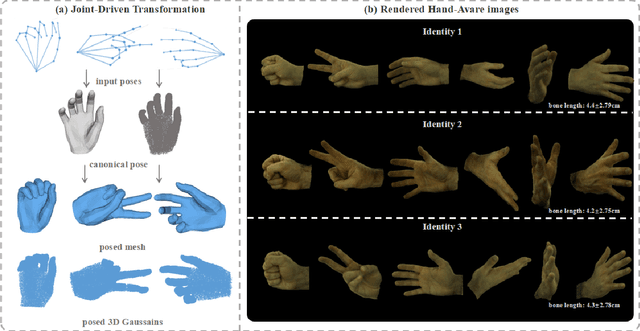


Since hands are the primary interface in daily interactions, modeling high-quality digital human hands and rendering realistic images is a critical research problem. Furthermore, considering the requirements of interactive and rendering applications, it is essential to achieve real-time rendering and driveability of the digital model without compromising rendering quality. Thus, we propose Jointly 3D Gaussian Hand (JGHand), a novel joint-driven 3D Gaussian Splatting (3DGS)-based hand representation that renders high-fidelity hand images in real-time for various poses and characters. Distinct from existing articulated neural rendering techniques, we introduce a differentiable process for spatial transformations based on 3D key points. This process supports deformations from the canonical template to a mesh with arbitrary bone lengths and poses. Additionally, we propose a real-time shadow simulation method based on per-pixel depth to simulate self-occlusion shadows caused by finger movements. Finally, we embed the hand prior and propose an animatable 3DGS representation of the hand driven solely by 3D key points. We validate the effectiveness of each component of our approach through comprehensive ablation studies. Experimental results on public datasets demonstrate that JGHand achieves real-time rendering speeds with enhanced quality, surpassing state-of-the-art methods.