 Add to Chrome
 Add to Firefox
 Add to Edge
Algorithm-Architecture Co-Design for Efficient VLA Inference via Speculative Inference and Verification
Aug 16, 2026
Vision-Language-Action (VLA) models have demonstrated remarkable capabilities in the field of embodied AI, but their high computational cost and limited predicted action length hinder real-time deployment. Although Dadu-Corki, a dedicated accelerator for efficient embodied AI, has been introduced, it does not exploit the inherent interaction patterns between the robot and its environment, which results in a relatively short predicted action length. We observe that robotic environments naturally alternate between active states-where precise actions are crucial-and inactive states-where actions have limited impact on task success. This insight enables a new scheduling opportunity: long-action-length speculative prediction in inactive states, paired with selective verification in active states. We propose SpecVLA, an algorithm-system co-design framework that adaptively balances action length, inference latency, and task reliability. On the algorithm side, SpecVLA introduces a state-aware VLA inference execution paradigm and a hardware-friendly construction of a smaller verification model (sVLA) using differential residuals and block-wise mixed-precision quantization. On the system side, we develop a heterogeneous architecture consisting of a GPU and a robotic-specific hardware module, along with a speculative dataflow that decouples VLA and sVLA through parallel execution. Comprehensive evaluations on OpenVLA and RDT across LIBERO and ManiSkill benchmarks show that SpecVLA reduces end-to-end latency significantly while preserving task success rate. By enabling long-action-length speculative prediction with timely verification, SpecVLA achieves real-time robotic manipulation with both high efficiency and reliability.

AddNet: Deep Neural Networks Using FPGA-Optimized Multipliers
Nov 19, 2019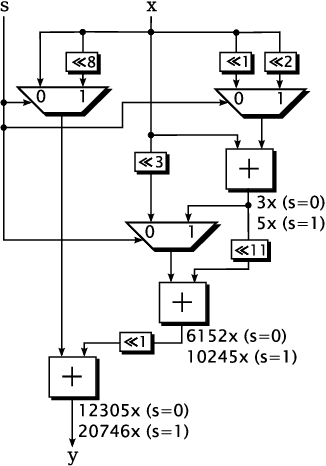
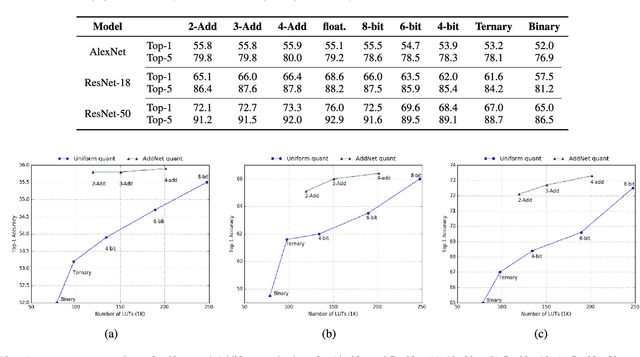
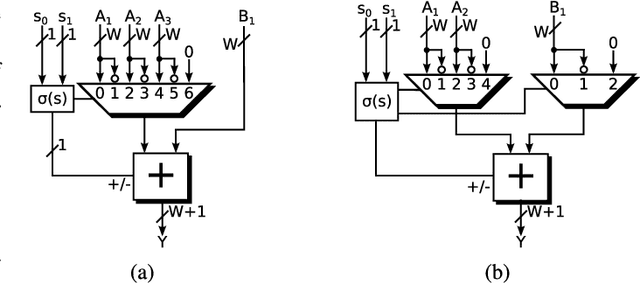
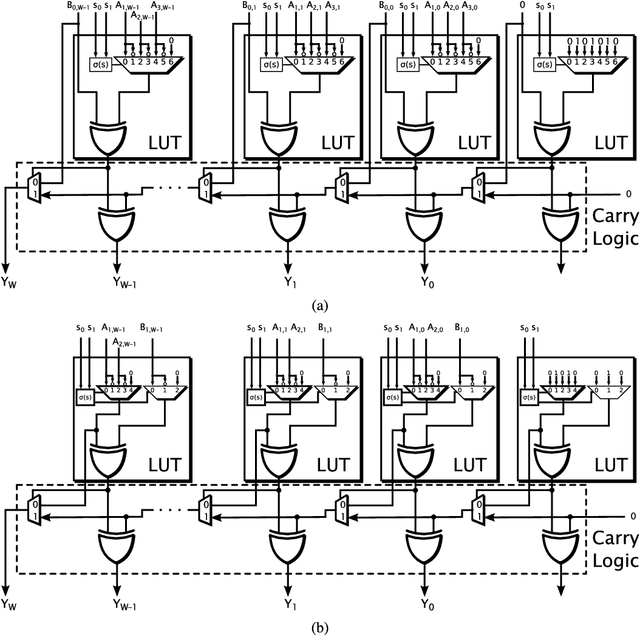
Low-precision arithmetic operations to accelerate deep-learning applications on field-programmable gate arrays (FPGAs) have been studied extensively, because they offer the potential to save silicon area or increase throughput. However, these benefits come at the cost of a decrease in accuracy. In this article, we demonstrate that reconfigurable constant coefficient multipliers (RCCMs) offer a better alternative for saving the silicon area than utilizing low-precision arithmetic. RCCMs multiply input values by a restricted choice of coefficients using only adders, subtractors, bit shifts, and multiplexers (MUXes), meaning that they can be heavily optimized for FPGAs. We propose a family of RCCMs tailored to FPGA logic elements to ensure their efficient utilization. To minimize information loss from quantization, we then develop novel training techniques that map the possible coefficient representations of the RCCMs to neural network weight parameter distributions. This enables the usage of the RCCMs in hardware, while maintaining high accuracy. We demonstrate the benefits of these techniques using AlexNet, ResNet-18, and ResNet-50 networks. The resulting implementations achieve up to 50% resource savings over traditional 8-bit quantized networks, translating to significant speedups and power savings. Our RCCM with the lowest resource requirements exceeds 6-bit fixed point accuracy, while all other implementations with RCCMs achieve at least similar accuracy to an 8-bit uniformly quantized design, while achieving significant resource savings.