 Add to Chrome
 Add to Firefox
 Add to Edge
SpanVLA: Efficient Action Bridging and Learning from Negative-Recovery Samples for Vision-Language-Action Model
Apr 21, 2026
Vision-Language-Action (VLA) models offer a promising autonomous driving paradigm for leveraging world knowledge and reasoning capabilities, especially in long-tail scenarios. However, existing VLA models often struggle with the high latency in action generation using an autoregressive generation framework and exhibit limited robustness. In this paper, we propose SpanVLA, a novel end-to-end autonomous driving framework, integrating an autoregressive reasoning and a flow-matching action expert. First, SpanVLA introduces an efficient bridge to leverage the vision and reasoning guidance of VLM to efficiently plan future trajectories using a flow-matching policy conditioned on historical trajectory initialization, which significantly reduces inference time. Second, to further improve the performance and robustness of the SpanVLA model, we propose a GRPO-based post-training method to enable the VLA model not only to learn from positive driving samples but also to learn how to avoid the typical negative behaviors and learn recovery behaviors. We further introduce mReasoning, a new real-world driving reasoning dataset, focusing on complex, reasoning-demanding scenarios and negative-recovery samples. Extensive experiments on the NAVSIM (v1 and v2) demonstrate the competitive performance of the SpanVLA model. Additionally, the qualitative results across diverse scenarios highlight the planning performance and robustness of our model.

VLPG-Nav: Object Navigation Using Visual Language Pose Graph and Object Localization Probability Maps
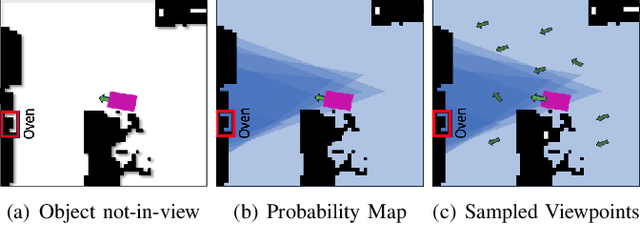
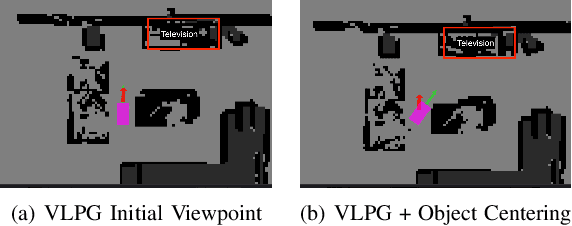
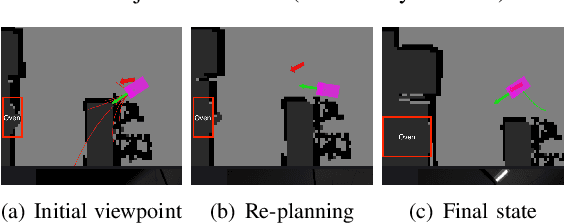
Aug 15, 2024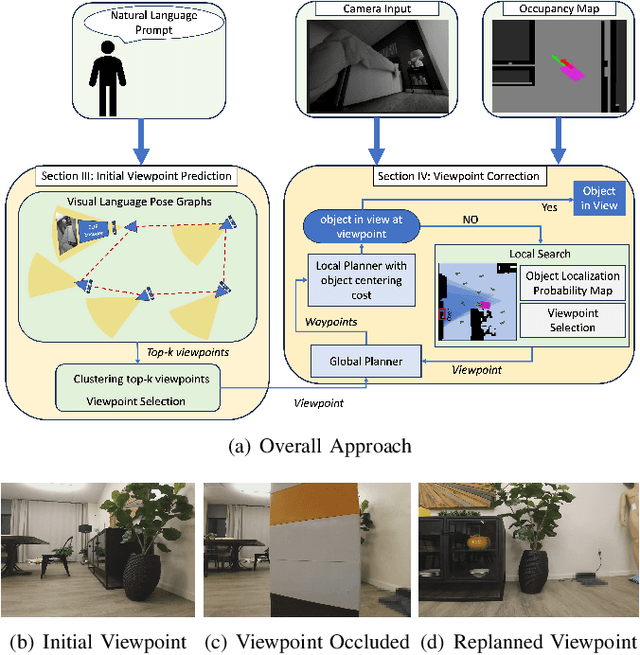
We present VLPG-Nav, a visual language navigation method for guiding robots to specified objects within household scenes. Unlike existing methods primarily focused on navigating the robot toward objects, our approach considers the additional challenge of centering the object within the robot's camera view. Our method builds a visual language pose graph (VLPG) that functions as a spatial map of VL embeddings. Given an open vocabulary object query, we plan a viewpoint for object navigation using the VLPG. Despite navigating to the viewpoint, real-world challenges like object occlusion, displacement, and the robot's localization error can prevent visibility. We build an object localization probability map that leverages the robot's current observations and prior VLPG. When the object isn't visible, the probability map is updated and an alternate viewpoint is computed. In addition, we propose an object-centering formulation that locally adjusts the robot's pose to center the object in the camera view. We evaluate the effectiveness of our approach through simulations and real-world experiments, evaluating its ability to successfully view and center the object within the camera field of view. VLPG-Nav demonstrates improved performance in locating the object, navigating around occlusions, and centering the object within the robot's camera view, outperforming the selected baselines in the evaluation metrics.