 Add to Chrome
 Add to Firefox
 Add to Edge
DrawAI: Agentic Benchmark and Workflow for Making Raster Images Editable
Aug 01, 2026
Recent image-generation models and multimodal agents can produce high-quality visuals for increasingly complex visual communication tasks. Yet their raster outputs remain difficult to use directly because meaningful content and relationships are flattened into pixels, preventing users from inspecting, modifying, rearranging, or reusing individual components. We formulate image-to-editable reconstruction, which recovers a structured, directly manipulable artifact from a raster image while preserving its visual and semantic content. The central challenge is to jointly satisfy Fidelity and Editability, which often trade off in practice. To study this task, we introduce DrawAI, comprising an agentic benchmark, DrawAI-Bench, and a reconstruction workflow, DrawAI-Flow. DrawAI-Bench spans scientific figures, presentation slides, posters, and diagrams, combining real and AI-generated images to reflect practical visual-creation scenarios. It evaluates Fidelity and Editability through a hybrid protocol of 39 criteria: deterministic rule-based metrics measure properties with direct correspondences, while asset-specific vision-language rubrics capture semantic and perceptual qualities for which exact matching is misleading. Besides, we propose DrawAI-Flow, a two-stage agentic workflow in which a Parser Agent turns extracted elements evidence into an explicit reconstruction plan, and a Reconstruction Agent realizes the plan as executable graphics code through an iterative code-render-validate-revise loop. On DrawAI-Bench, we systematically evaluate thirteen models across five agent harnesses to study the effects of model capability, harness choice, and workflow design. The results show that reconstruction quality and costs vary substantially across model-harness configurations, while DrawAI-Flow consistently improves editable structure.

Preliminary Explorations with GPT-4o(mni) Native Image Generation
May 06, 2025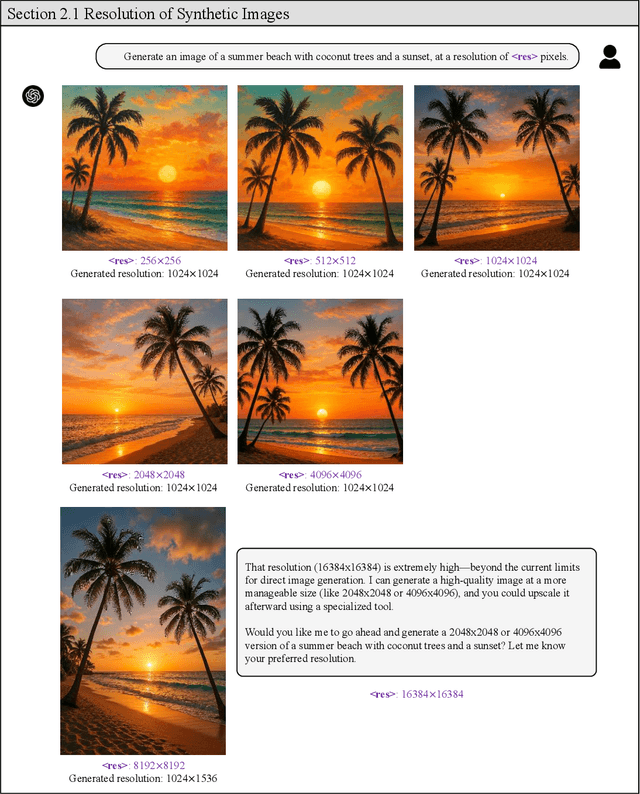
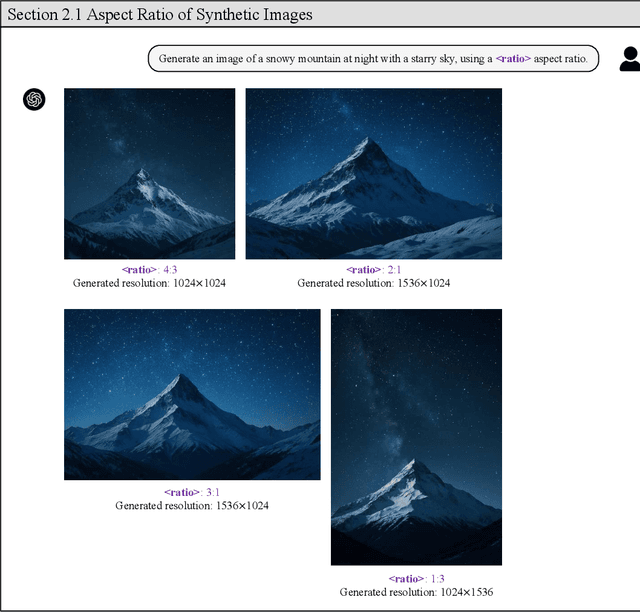
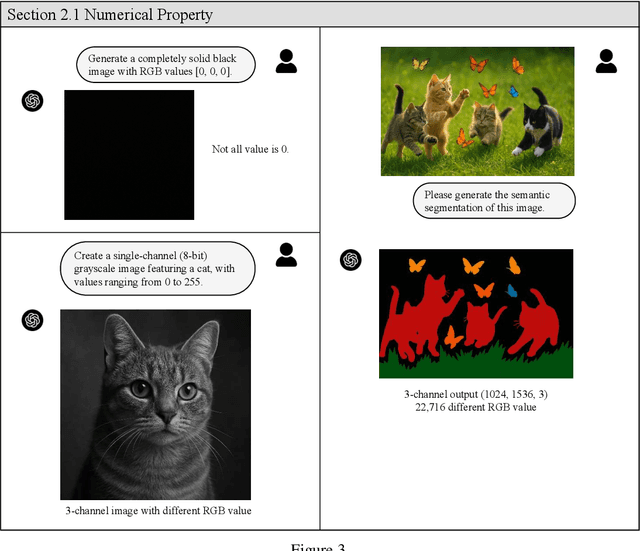

Recently, the visual generation ability by GPT-4o(mni) has been unlocked by OpenAI. It demonstrates a very remarkable generation capability with excellent multimodal condition understanding and varied task instructions. In this paper, we aim to explore the capabilities of GPT-4o across various tasks. Inspired by previous study, we constructed a task taxonomy along with a carefully curated set of test samples to conduct a comprehensive qualitative test. Benefiting from GPT-4o's powerful multimodal comprehension, its image-generation process demonstrates abilities surpassing those of traditional image-generation tasks. Thus, regarding the dimensions of model capabilities, we evaluate its performance across six task categories: traditional image generation tasks, discriminative tasks, knowledge-based generation, commonsense-based generation, spatially-aware image generation, and temporally-aware image generation. These tasks not only assess the quality and conditional alignment of the model's outputs but also probe deeper into GPT-4o's understanding of real-world concepts. Our results reveal that GPT-4o performs impressively well in general-purpose synthesis tasks, showing strong capabilities in text-to-image generation, visual stylization, and low-level image processing. However, significant limitations remain in its ability to perform precise spatial reasoning, instruction-grounded generation, and consistent temporal prediction. Furthermore, when faced with knowledge-intensive or domain-specific scenarios, such as scientific illustrations or mathematical plots, the model often exhibits hallucinations, factual errors, or structural inconsistencies. These findings suggest that while GPT-4o marks a substantial advancement in unified multimodal generation, there is still a long way to go before it can be reliably applied to professional or safety-critical domains.