 Add to Chrome
 Add to Firefox
 Add to Edge
MOSA: Motion-Guided Semantic Alignment for Dynamic Scene Graph Generation
Apr 21, 2026
Dynamic Scene Graph Generation (DSGG) aims to structurally model objects and their dynamic interactions in video sequences for high-level semantic understanding. However, existing methods struggle with fine-grained relationship modeling, semantic representation utilization, and the ability to model tail relationships. To address these issues, this paper proposes a motion-guided semantic alignment method for DSGG (MoSA). First, a Motion Feature Extractor (MFE) encodes object-pair motion attributes such as distance, velocity, motion persistence, and directional consistency. Then, these motion attributes are fused with spatial relationship features through the Motion-guided Interaction Module (MIM) to generate motion-aware relationship representations. To further enhance semantic discrimination capabilities, the cross-modal Action Semantic Matching (ASM) mechanism aligns visual relationship features with text embeddings of relationship categories. Finally, a category-weighted loss strategy is introduced to emphasize learning of tail relationships. Extensive and rigorous testing shows that MoSA performs optimally on the Action Genome dataset.

ReactDance: Progressive-Granular Representation for Long-Term Coherent Reactive Dance Generation
May 08, 2025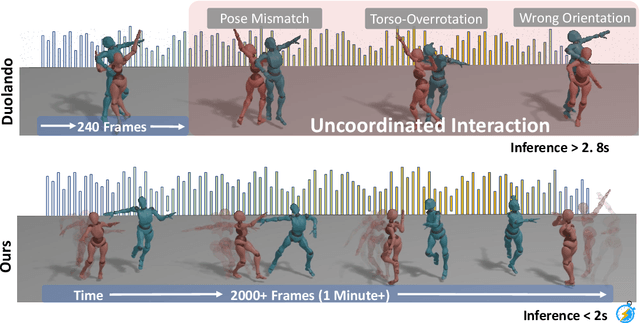
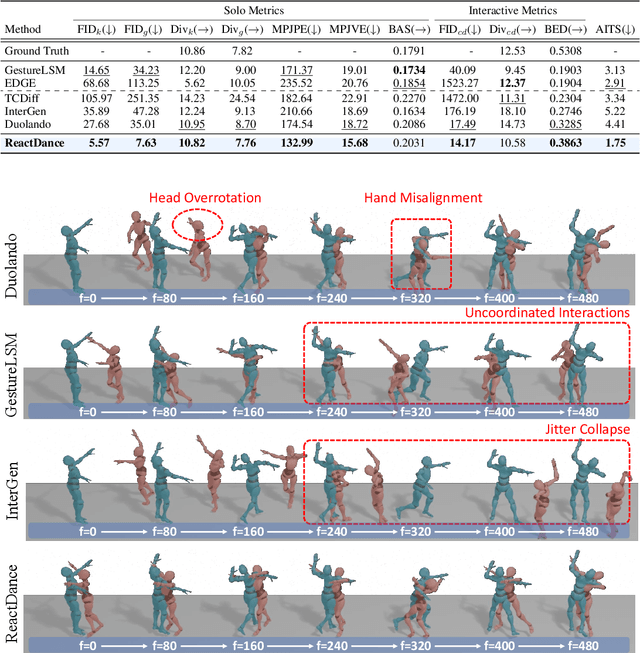
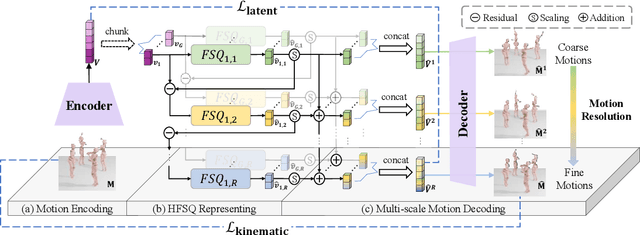
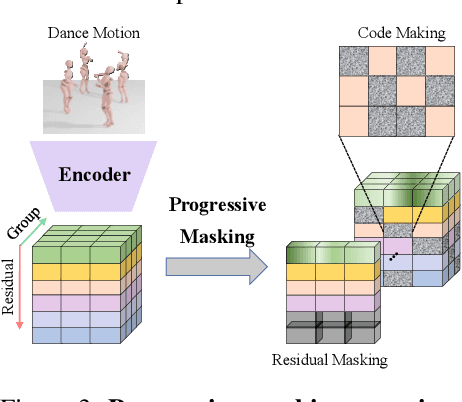
Reactive dance generation (RDG) produces follower movements conditioned on guiding dancer and music while ensuring spatial coordination and temporal coherence. However, existing methods overemphasize global constraints and optimization, overlooking local information, such as fine-grained spatial interactions and localized temporal context. Therefore, we present ReactDance, a novel diffusion-based framework for high-fidelity RDG with long-term coherence and multi-scale controllability. Unlike existing methods that struggle with interaction fidelity, synchronization, and temporal consistency in duet synthesis, our approach introduces two key innovations: 1)Group Residual Finite Scalar Quantization (GRFSQ), a multi-scale disentangled motion representation that captures interaction semantics from coarse body rhythms to fine-grained joint dynamics, and 2)Blockwise Local Context (BLC), a sampling strategy eliminating error accumulation in long sequence generation via local block causal masking and periodic positional encoding. Built on the decoupled multi-scale GRFSQ representation, we implement a diffusion model withLayer-Decoupled Classifier-free Guidance (LDCFG), allowing granular control over motion semantics across scales. Extensive experiments on standard benchmarks demonstrate that ReactDance surpasses existing methods, achieving state-of-the-art performance.