 Add to Chrome
 Add to Firefox
 Add to Edge
Improving Anomaly Detection with Foundation-Model Synthesis and Wavelet-Domain Attention
Mar 03, 2026
Industrial anomaly detection faces significant challenges due to the scarcity of anomalous samples and the complexity of real-world anomalies. In this paper, we propose a foundation model-based anomaly synthesis pipeline (FMAS) that generates highly realistic anomalous samples without fine-tuning or class-specific training. Motivated by the distinct frequency-domain characteristics of anomalies, we introduce aWavelet Domain Attention Module (WDAM), which exploits adaptive sub-band processing to enhance anomaly feature extraction. The combination of FMAS and WDAM significantly improves anomaly detection sensitivity while maintaining computational efficiency. Comprehensive experiments on MVTec AD and VisA datasets demonstrate that WDAM, as a plug-and-play module, achieves substantial performance gains against existing baselines.

Accurate and lightweight dehazing via multi-receptive-field non-local network and novel contrastive regularization
Sep 28, 2023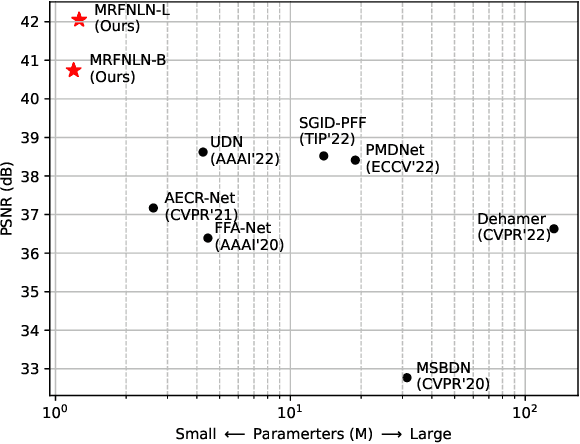
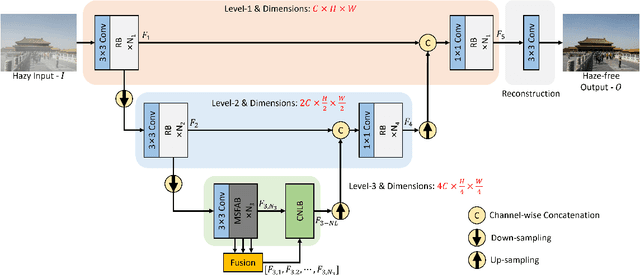
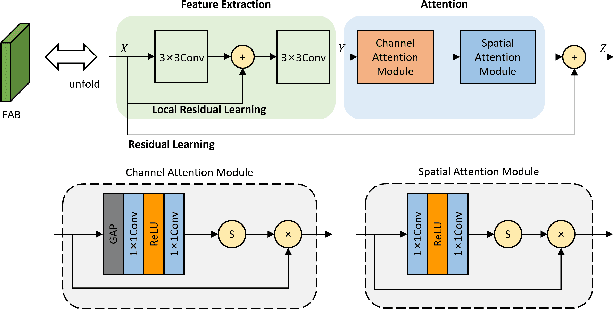
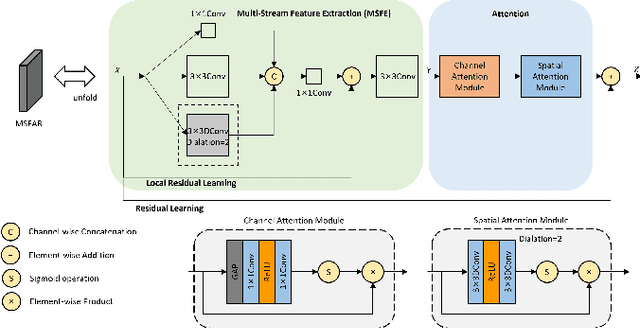
Recently, deep learning-based methods have dominated image dehazing domain. Although very competitive dehazing performance has been achieved with sophisticated models, effective solutions for extracting useful features are still under-explored. In addition, non-local network, which has made a breakthrough in many vision tasks, has not been appropriately applied to image dehazing. Thus, a multi-receptive-field non-local network (MRFNLN) consisting of the multi-stream feature attention block (MSFAB) and cross non-local block (CNLB) is presented in this paper. We start with extracting richer features for dehazing. Specifically, we design a multi-stream feature extraction (MSFE) sub-block, which contains three parallel convolutions with different receptive fields (i.e., $1\times 1$, $3\times 3$, $5\times 5$) for extracting multi-scale features. Following MSFE, we employ an attention sub-block to make the model adaptively focus on important channels/regions. The MSFE and attention sub-blocks constitute our MSFAB. Then, we design a cross non-local block (CNLB), which can capture long-range dependencies beyond the query. Instead of the same input source of query branch, the key and value branches are enhanced by fusing more preceding features. CNLB is computation-friendly by leveraging a spatial pyramid down-sampling (SPDS) strategy to reduce the computation and memory consumption without sacrificing the performance. Last but not least, a novel detail-focused contrastive regularization (DFCR) is presented by emphasizing the low-level details and ignoring the high-level semantic information in the representation space. Comprehensive experimental results demonstrate that the proposed MRFNLN model outperforms recent state-of-the-art dehazing methods with less than 1.5 Million parameters.